

Thermal energy recovery from abandoned mines
New research at the UK Geoenergy Observatories is assessing the efficiency of UK geology for thermal energy recovery.
09/11/2026 By BGS Press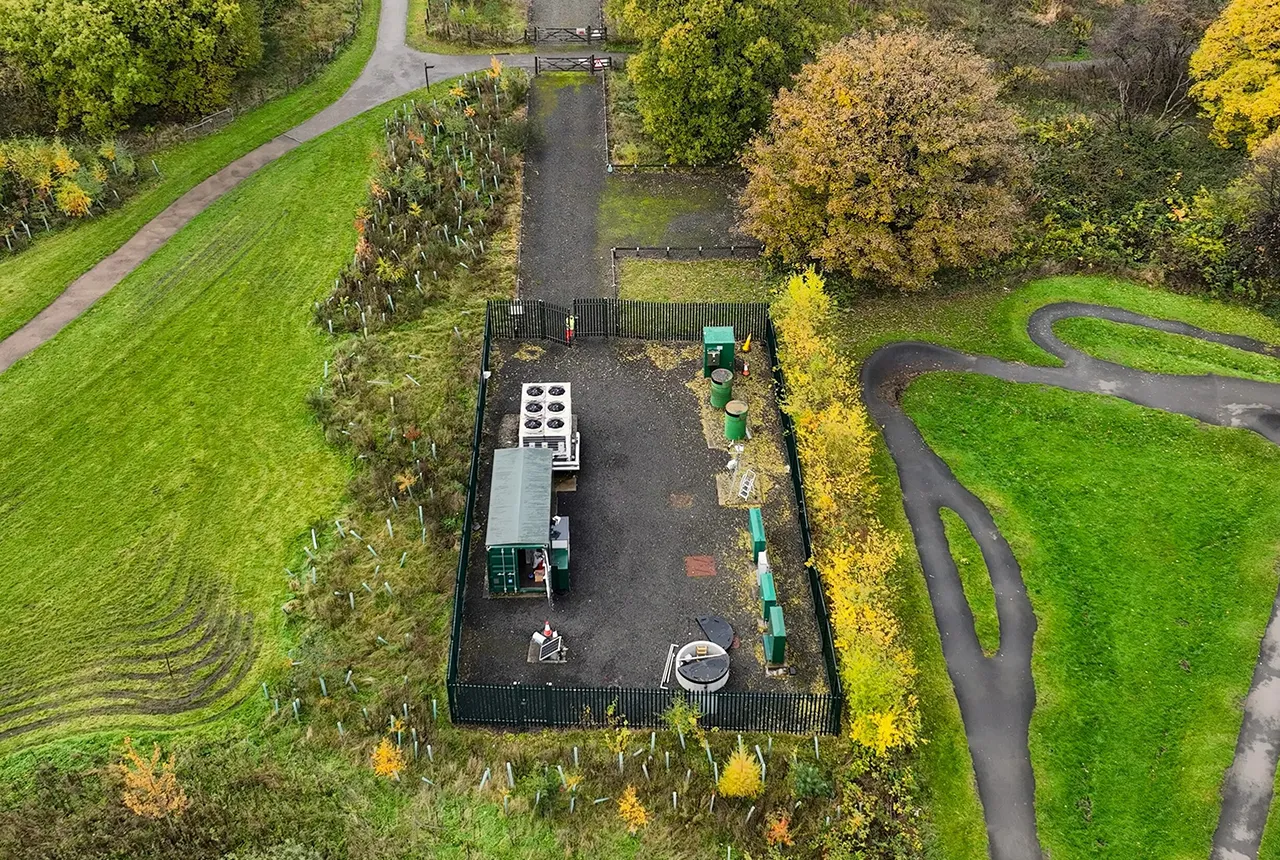

Underground thermal energy storage (UTES) is a technology that has been widely adopted in Europe, but has limited uptake in the UK. Most of the schemes are located in sandy aquifers in the Netherlands and, subsequently, the algorithms used in UTES calculations do not reflect the geology and hydrogeology of the UK’s hard-rock aquifers.
Funding from the Natural Environment Research Council (NERC) has enabled BGS to undertake new research at the UK Geoenergy Observatories (UKGEOS) in Cheshire and Glasgow. Project Thermal Recoverywill conduct experiments related to the efficiency of UTES, with the initial fieldwork phase already underway alongside parallel work developing a new calculator tool. The proposed calculator tool is being designed to assist in the feasibility planning stage for both mine thermal energy storage and borehole thermal energy storage schemes.
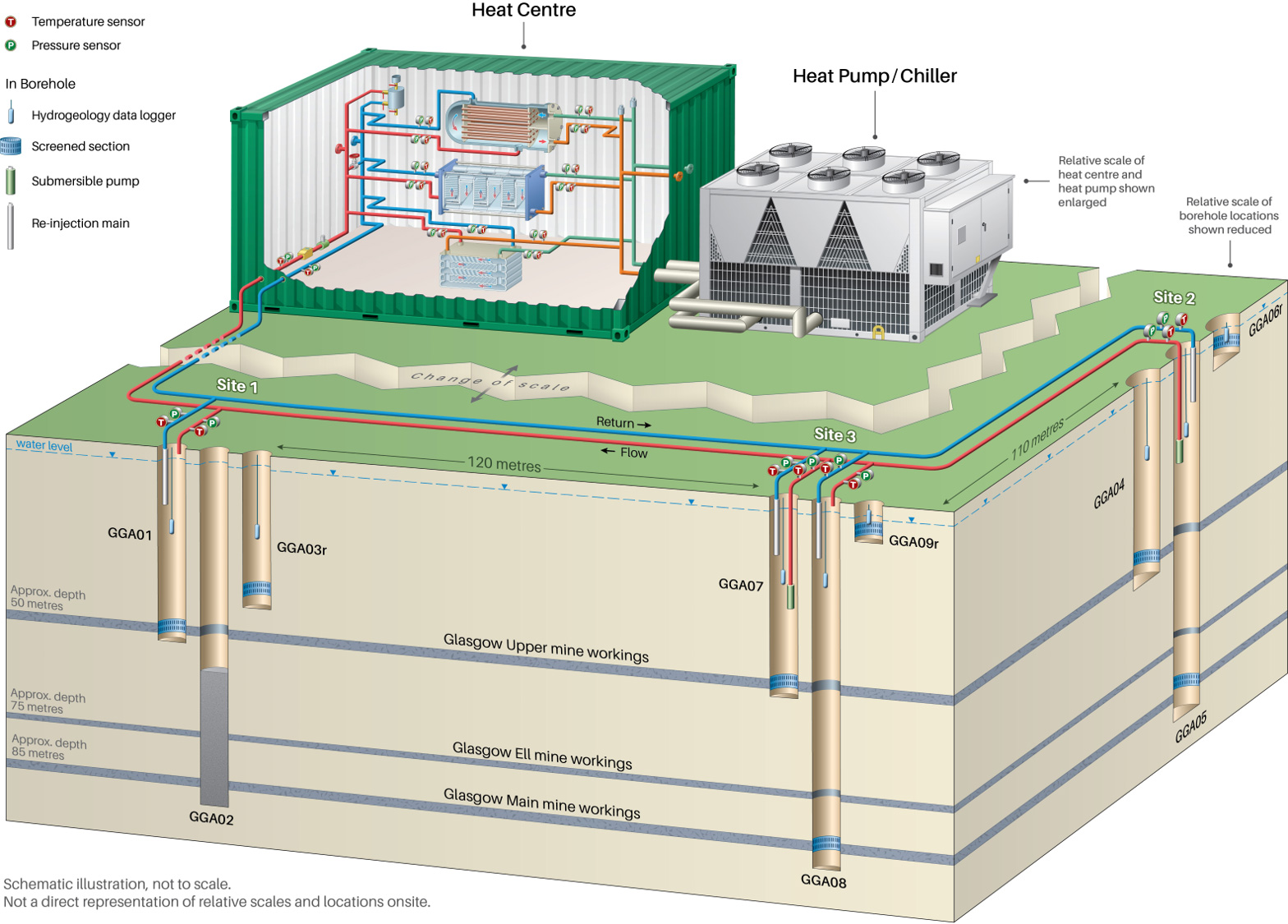
Schematic diagram of the geothermal infrastructure at the Glasgow Observatory. BGS © UKRI.
The experiments being conducted at the Glasgow Observatory are investigating how UTES efficiency is influenced by the storage period and repeated storage events, utilising both the Glasgow Upper and the Glasgow Main workings with heat injection alternating between the two mines. A range of storage durations, from 24 hours to 21 days, will be tested to simulate different demand scenarios. (Longer, interseasonal storage will not be tested in this project due to time constraints.)
Distributed temperature sensing (DTS), electrical resistivity tomography (ERT) and groundwater logger data from the mine-workings boreholes will be analysed to determine any changes in temperature in the mines and gain an understanding of the thermal plume movement and recovery efficiencies. This data will be fed into the development of the calculator tool.

This research is an exciting opportunity to increase the understanding of thermal energy storage and how this technology can be applied to the geology around the UK.
Vanessa Starcher, science and operations lead for the Glasgow Observatory.
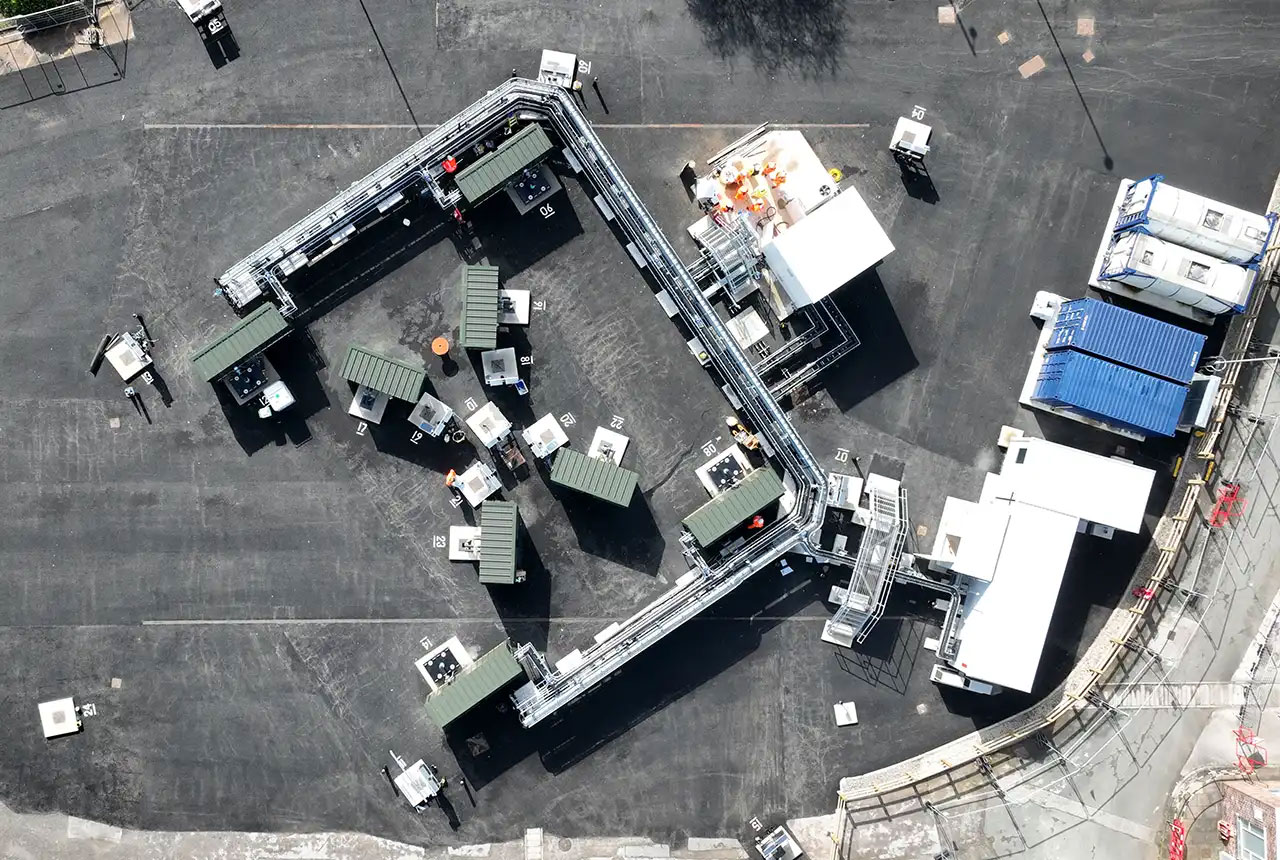
At the Cheshire Observatory, the thermal storage properties of the Sherwood Sandstone aquifer are being profiled using active (heated) DTS and ERT. Heat loss is evaluated as a function of the geology and groundwater flow velocity to understand the main heat loss pathways and how schemes can be designed to maximise storage efficiency. The field data will be used to simulate the behaviour of model UTES installed at different depths with varying well geometry and hydraulic gradients.
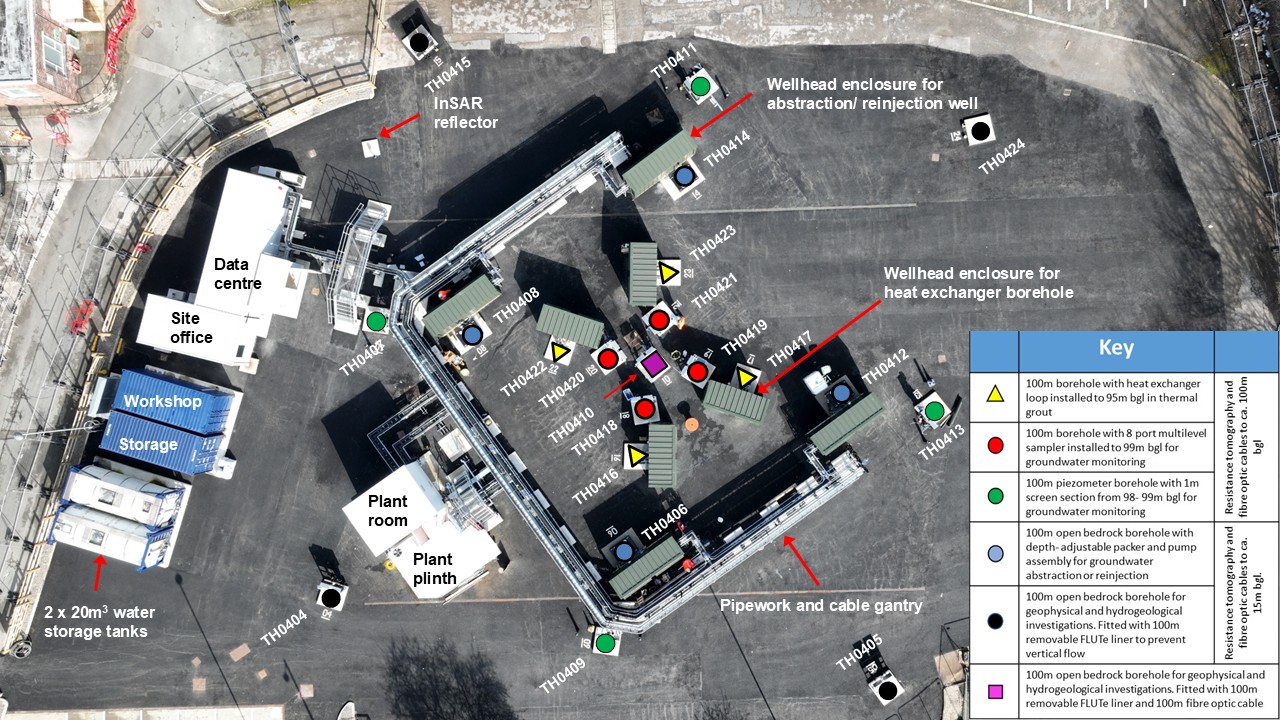
Aerial view of the Geoenergy Observatory in Cheshire. BGS © UKRI.
These experiments are expected to be complete in early January 2027 and the data generated will be provided to the research community on an open-access basis, alongside an accompanying data report. The calculator tool will allow the idealised storage behaviour of both the Glasgow and Cheshire observatories’ geology to be compared to actual results from field testing, and identify features that influence storage performance.
For those interested in the data or finding out more about Project Thermal Recovery, there will be opportunities to discuss the project and final calculator tool in the New Year. In the interim, interested parties can contact UKGEOS enquiries (ukgeosenquiries@bgs.ac.uk) to find out more about the project.
Relative topics
Related news
Thermal energy recovery from abandoned mines
09/11/2026
New research at the UK Geoenergy Observatories is assessing the efficiency of UK geology for thermal energy recovery.
Forties at 56: the North Sea discovery that’s informing the energy transition five decades later
26/10/2026
Geological samples recovered from the UK’s first giant oil field in the 1970s continue to inform industry and researchers aiming to support the UK’s energy security needs.

New project mapping UK Continental Shelf provides boost to offshore infrastructure and development
22/10/2026
BGS is leading a three-year project funded by The Crown Estate to develop a new suite of seabed geology datasets and reports, providing crucial information for offshore developers about the seabed around the UK.

Demand for data centres presents challenges and opportunities for UK critical mineral supply chains
02/09/2026
Government-backed research finds that vulnerabilities in raw material supply chains must be addressed to secure the critical minerals needed to expand the UK’s digital infrastructure and boost economic growth.

MaxStoreUK hydrogen geological storage policy roundtable
Event on 08/10/2026
Storage operators, regulators, licensor and Government stakeholders are invited to join our roundtable discussion of hydrogen geological storage policy.
Cheshire Geoenergy Observatory releases key geological datasets for UK thermal energy storage scheme design
09/07/2026
A new report and data packs from BGS will provide a unique resource for scientists working on the geology and hydrogeology of the Sherwood Sandstone Formation, an important aquifer and reservoir rock.

UK and Philippines scientists investigate natural hydrogen generation processes at atomic scale
22/06/2026
BGS researchers were granted access to use the Diamond Light Source facility in order to study hydrogen in light brighter than the sun.

Shortage of end-of-life materials presents challenge to UK critical minerals security
17/06/2026
A new report by the UK Critical Minerals Intelligence Centre reveals insufficient end-of-life material stocks present a supply risk over the coming decade, but offer significant long-term potential to meet critical mineral demand through recycling.
UK geothermal catalogue receives update
16/06/2026
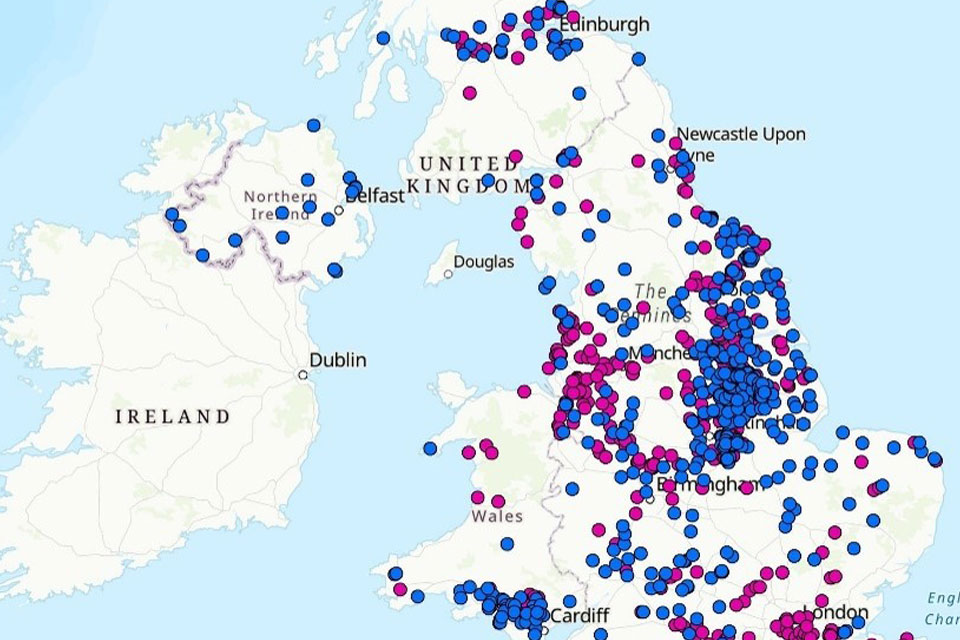
BGS releases the second digital version of the UK geothermal catalogue of subsurface temperature and rock thermal conductivity measurements and heat flow calculations.
Natural hydrogen research
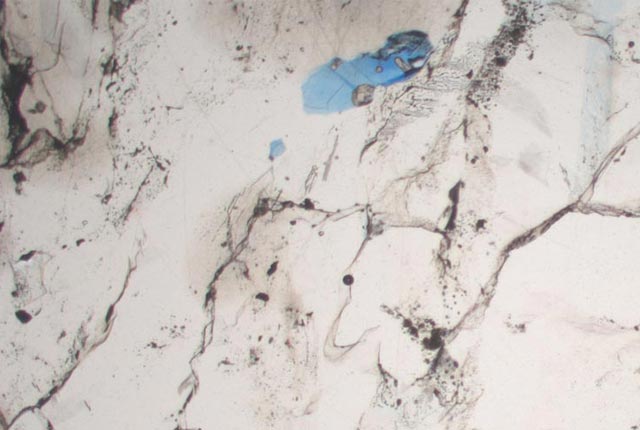
Understanding aspects of the natural hydrogen value chain on a national and international level.
Strengthening capacity through partnership: a critical minerals perspective
28/04/2026
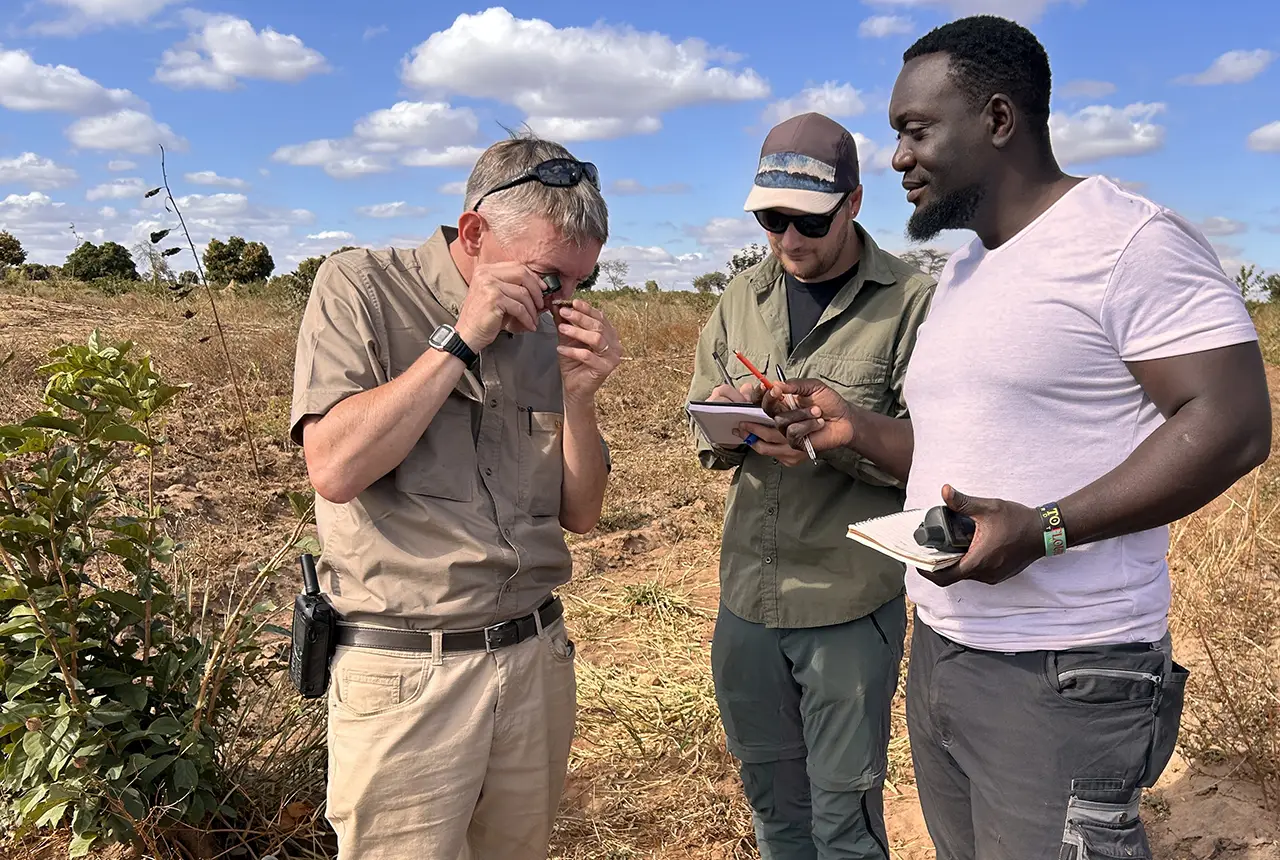
BGS has been working in partnership with the Geological Survey Department of Zambia (GSD) to build national capacity, improve data accessibility and support long-term, sustainable development.
Updated geological assessment of the Southern North Sea set to underpin future offshore infrastructure development
25/03/2026
The first regional assessment for 30 years will support offshore marine and subsurface planning for the UK’s low-carbon energy infrastructure, including the 2030 target of 45 to 50 GW generated through offshore wind.