

Demand for data centres presents challenges and opportunities for UK critical mineral supply chains
Government-backed research finds that vulnerabilities in raw material supply chains must be addressed to secure the critical minerals needed to expand the UK’s digital infrastructure and boost economic growth.
02/09/2026 By BGS Press

Critical minerals are essential to the UK’s economy, national security, and clean energy transition. Surging demand for such materials, driven by the UK’s ambition to become a global leader in digital technologies, will place unprecedented pressure on already vulnerable global supply chains. A new report published by the UK Critical Minerals Intelligence Centre (CMIC) presents both the opportunities for innovation-led economic growth and the challenges associated with securing the materials required for data centres, artificial intelligence (AI) and quantum computing.
Data centres are now recognised as critical national infrastructure in the UK, with more than 90 new facilities planned by 2030, while, quantum technologies and AI have been identified as strategically important technologies. Meeting increasing demand for such digital services requires a growing range of critical minerals and high-purity materials. The growth of these technologies will increase demand for critical minerals including copper, aluminium, rare earth elements and battery materials (such as lithium and cobalt) used in digital technology components and backup power systems. Quantum technologies also require some critical minerals that are more rarely discussed, including niobium, hafnium, bismuth, high-purity silicon and other raw materials such as helium.
CMIC is hosted by the British Geological Survey (BGS) and funded by the Department for Business, Innovation, Science & Technology (DBIST). This report highlights the value of data centres, AI and quantum computing to the UK economy and future economic growth and emphasises the importance of critical minerals in their development. The global trade routes that feed the UK with many of the necessary raw materials for cutting-edge technologies are still immature and underdeveloped, relying on exports from a small group of countries. Additionally, many critical minerals are only produced as by-products from the mining and refining of other commodities, such as copper and aluminium, so their production can be affected by the market swings for those major metals. Collectively, these factors can render vital supply chains unresponsive to demand and vulnerable to geopolitical factors.
The report highlights several ways to strengthen resilience, including international partnerships, supply chain diversification and targeted development of domestic capabilities. There are many opportunities for the UK, which should capitalise on its potential to mine, refine, purify and recycle some critical minerals. Nonetheless, international collaboration and strategic partnerships remain essential. In the future, digital technologies will face increasing competition for critical minerals from other sectors that we rely on for our energy, transportation, home and work lives, defence and health care, and we may need to prioritise how our critical mineral supplies are used. The report’s lead author, BGS Minerals geoscientist Dr Holly Elliott, believes that the need to better understand and forecast the nation’s mineral supply requirements has never been greater and is central to delivering the country’s ambitions.

“While some of the materials used in digital technologies have highly concentrated supply chains, there are also opportunities to improve resilience through innovation, international collaboration, diversification of supply and the development of specialist capabilities where the UK already has strengths.
“The UK has already invested in the development of a skilled domestic workforce and created growth zones but, to become a centre of excellence within the digital revolution, we must identify potential bottlenecks and vulnerabilities in the critical mineral supply for the decades to come, and act now.”
Dr Holly Elliott, BGS minerals geoscientist
Many of the materials required for digital technologies, such as lithium, cobalt and graphite, are experiencing significant growth in demand and intensifying competition between key sectors, including low-carbon technologies, aerospace, defence and advanced manufacturing. These are all expected to experience their own growth surges in the near future, while the wider adoption of quantum computing is currently an unknown, but likely to be a significant, factor.
Batteries sit at the heart of many of these technologies, with data centres requiring huge, grid-scale batteries to ensure an uninterruptible energy supply in the event of a disruption to mains power. The energy requirements of these facilities is considerable. Based on the findings of a recent energy demand report, a 1 GW data centre running continuously could use as much power as up to 3.2 million UK households over the course of a year. The Government estimates that the UK will need up to 6 GW of AI-capable data centre capacity by 2030, highlighting the true scale of the demand for battery raw materials.
The UK Government will increasingly face the challenge of prioritising how much of the available critical mineral supply will be directed toward the development of AI technologies and data centres while also nurturing fledgling industries such as quantum computing.
Dr Elliott says diversification will be essential to securing reliable and sustainable supplies of critical minerals.
“Whilst the UK has the potential to develop domestic supplies of certain critical minerals, it is unlikely to achieve self-reliance and cannot become a specialist in all parts of the supply chain.
“Access to global supply chains, international collaboration and strategic partnerships therefore remain vital; the opportunity best lies in collaboration and strategic partnerships to offset the risk posed by geopolitical uncertainty.”
Dr Holly Elliott
The report also highlights opportunities for the UK to build on existing strengths in semiconductor technologies, photonics, cryogenics, quantum technologies and high-purity materials. Alongside these established capabilities, opportunities will emerge to develop domestic recycling and secondary supply chains as demand for digital technologies continues to grow.
In terms of primary supply, various prospective UK projects are likely to become more economically viable with the increase in demand, such as:
- lithium resources in Cornwall
- tungsten in Devon
- graphite in Northern Ireland
- nickel, vanadium and the platinum group metals in Scotland
However, Dr Holly Elliott warns that ambition does need to be balanced against realistic understandings of how these supply chains operate.
“Geologically speaking, the Earth is not short of minerals. Scarcity is typically driven by a combination of factors, such as geopolitical access, the economic viability of extraction, and the technological constraints around our ability to refine and process them.
“History suggests that restricted supply but increasing demand creates market opportunities and that supply chains eventually catch up with demand but, in the case of minerals, this can take decades.”
Dr Holly Elliott
As such, enhanced access to global supply chains, international collaboration and strategic partnerships will be vital in the immediate future, offsetting the risk posed by geopolitical uncertainty. Over the longer term, investment that builds on the UK’s existing technological strengths and development of regions with domestic prospectivity can further strengthen the UK’s position as the demand for critical minerals intensifies.
Report recommendations
In summary the report recommendations include:
- Isotopic purification and high-purity materials: the UK can build on its strong expertise in isotopic purification to increase domestic commercial production, supporting global diversification and reducing supply risks
- Expand downstream manufacturing capabilities: broadening established industries (including cryogenics, photonics and semiconductors) from design into manufacturing could reduce the UK’s reliance on imported components
- Critical minerals and processing capacity: the UK should assess viable opportunities in the domestic critical mineral supply chain, including extraction and value-added processing where potential exists
- Quantum-enabling materials: developing domestic capabilities in non-linear materials and crystals would mitigate trade interventions and strengthen supply resilience
- Recycling and secondary supply: developing recycling and processing hubs for electronic waste components would help to establish a secondary supply of the materials for which the UK has limited domestic extraction potential
- Industrial support and enabling environment: there may be a role for targeted support mechanisms to encourage the development or expansion of domestic facilities for primary production, materials refining, isotopic purification and secondary material recovery
- Data, demand visibility and supply chain mapping: encouraging UK companies to report quantified material requirements for key technologies, such as data centres and batteries, would support improved modelling of future demand under different technology adoption and growth trajectories
- Workforce and skills development: further support for workforce development in emerging sectors such as quantum computing would help address shortages in specialist and technical roles spanning engineering, computer science and physics
The full report, ‘Mineral requirements of digital technologies: data centres, artificial intelligence and quantum computing’, is available on the CMIC website.
This research was funded by the Department for Business, Innovation, Science and Technology as part of the 2025 to 2026 work programme for CMIC.
For more information, please contact BGS press (bgspress@bgs.ac.uk) or call 07790 607 010.
About the British Geological Survey (BGS)
The British Geological Survey is a world-leading geological survey and global geoscience organisation, focused on public-good science for government and research to understand earth and environmental processes.
We are the UK’s premier provider of objective, impartial and authoritative geoscientific data, information and knowledge to help society to use its natural resources responsibly, manage environmental change and build resilience capabilities.
From resource management and environmental protection to natural hazard mitigation and climate change adaptation, our work underpins many of the key challenges and opportunities facing the UK today.
Department for Business, Innovation, Science and Technology (BIST), the UK Critical Minerals Intelligence Centre (CMIC) is hosted by the British Geological Survey.
Related news
Demand for data centres presents challenges and opportunities for UK critical mineral supply chains
02/09/2026
Government-backed research finds that vulnerabilities in raw material supply chains must be addressed to secure the critical minerals needed to expand the UK’s digital infrastructure and boost economic growth.
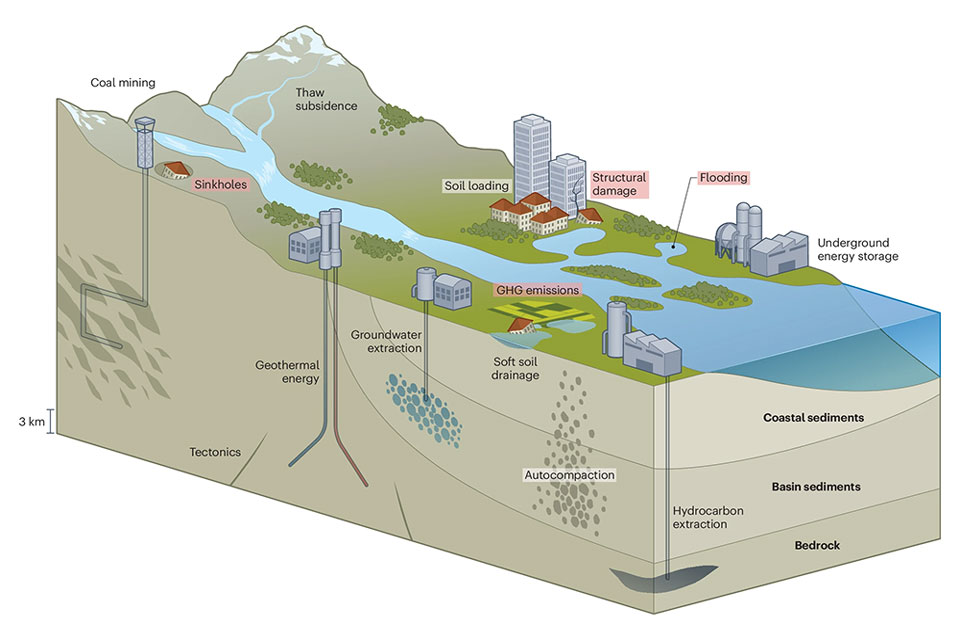
What lies beneath Europe’s sinking ground?
01/09/2026
Land subsidence is becoming increasingly visible across Europe. New research examines how better monitoring, shared data and a deeper understanding of the subsurface can help assess and manage its impacts.

Secrets of an ancient supervolcano uncovered that change our understanding of England’s geological past
28/08/2026
Scientists have found evidence of a long-hidden link between an ancient buried ash layer in Scandinavia and a concealed supervolcano in eastern England.

BGS research into drought-exposed soils wins award
26/08/2026
A research paper investigating how temperate soils respond to drought has been announced as the winner of the Land Best Paper Award.

UK aquifers robust despite driest July on record
16/08/2026
In a summer experiencing widespread drought, groundwater levels around the country are showing resilience, demonstrating their value as a crucial resource and indicating they could play a more significant role in mitigating the impacts of extreme weather.

New NERC-funded project empowers young people to engage with environmental science
23/07/2026
BGS is part of a new, collaborative project, funded through NERC’s ‘Opening up the environment’ programme, helping the environmental research community become more accessible.

Delving deep into mountains for future water security
16/07/2026
A BGS-led project is using new water-tracing investigation methods, geophysics and modelling to understand how water moves from mountains to the lowlands, helping to improve water security for billions of people.

Updated national 3D model will determine the depth to the solid bedrock beneath our feet
13/07/2026
The BGS Superficial Deposit Thickness Model now includes an elevation model of geological rockhead for the first time, providing important data for civil engineers, geoscientists and environmental scientists.
UK’s world-class research organisations launch new collective
10/07/2026
The launch of the National Research Organisations Group brings together more than 100 science leaders to provide an authorativive voice on science, research policy and long-term investment.
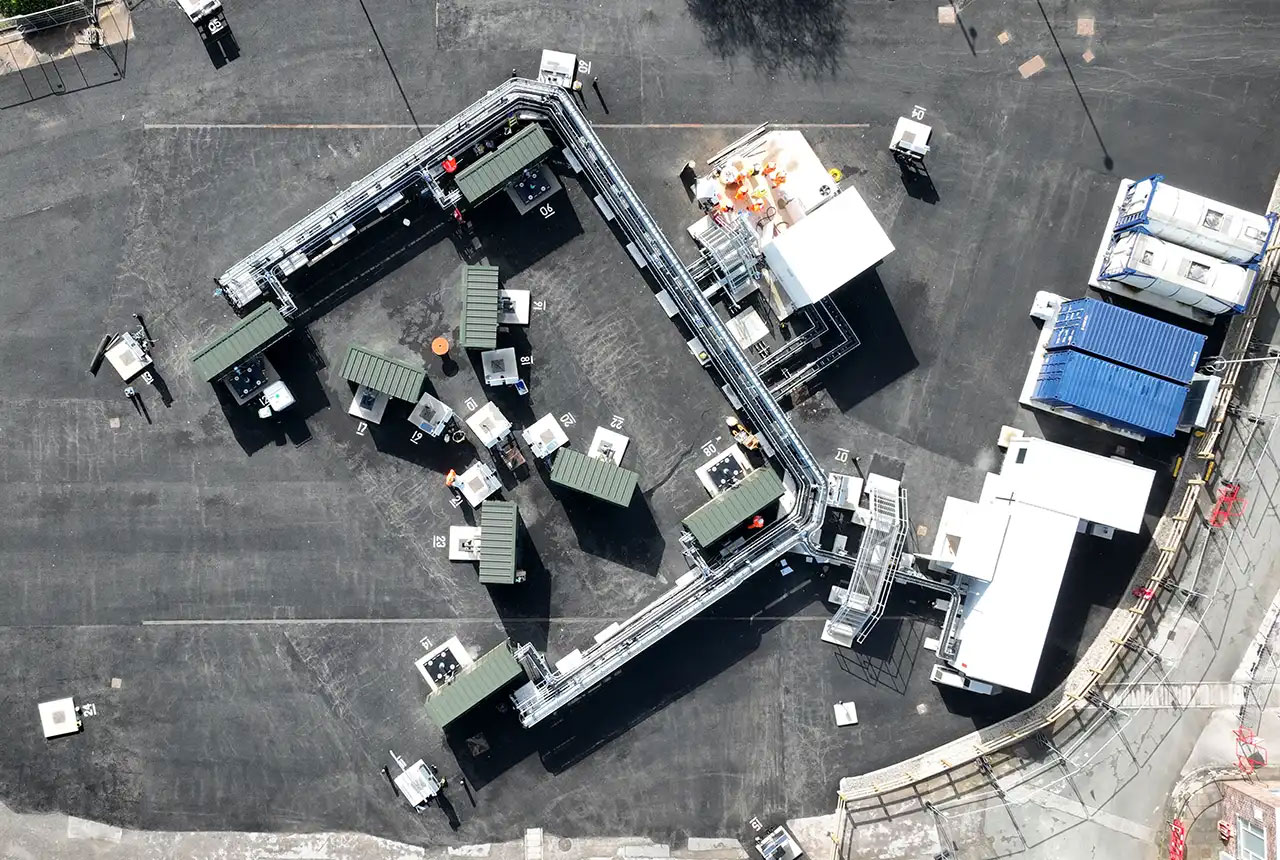
Cheshire Geoenergy Observatory releases key geological datasets for UK thermal energy storage scheme design
09/07/2026
A new report and data packs from BGS will provide a unique resource for scientists working on the geology and hydrogeology of the Sherwood Sandstone Formation, an important aquifer and reservoir rock.

New geological mapping underway to help manage flooding along the River Tweed
08/07/2026
Scientists are surveying the Tweed catchment for the first time in over 100 years to enhance understanding of localised groundwater and improve flood forecasting.

Geological research in North Sea helping to safeguard subsea cables
06/07/2026
Subsea power and telecommunications cables are critical to the UK’s energy infrastructure and global connectivity, yet they remain vulnerable to damage from ship anchors, fishing activity and natural hazards.