

Measuring the environmental impacts of carbon fibre: life cycle assessment
Undergraduate student Phoebe Brown visited BGS to understand the life cycle of carbon fibre, from primary production to recycling.
01/09/2026 By BGS Press

Last summer, I completed a research project in partnership with BGS and the University of Warwick. Based at BGS’s headquarters in Keyworth, Nottinghamshire, I worked alongside the UK Critical Minerals Intelligence Centre (CMIC), gaining first-hand experience of their work and research.
My project focused on using life-cycle assessment (LCA) methods to measure the environmental impacts of a specific product. LCA is a systematic methodology to quantify and evaluate the impacts of a product, service or process throughout its life cycle, from raw material extraction to end of life. The project involved four weeks of LCA training before I conducted my own LCA on a product of my choosing, in this case the composite material carbon fibre (CF).
As a Manufacturing and Mechanical Engineering undergraduate student, I have a particular interest in carbon fibre, for which the UK market is rapidly growing (4.9 per cent compound annual growth rate). With its unique strength-to-weight properties, it’s an important material for innovation in industries such as aerospace, automotives and renewable energy technologies. However, as its use expands, CF recycling becomes ever more essential.
This raises a question: for a high-polymer content material such as CF, how much more environmentally beneficial is recycling over primary production? To answer this, I set out to perform an LCA on both primary production and recycling of CF, to compare and evaluate their consequences on human and environmental health. This was done by first understanding the primary production and recycling processes and then collating the input and output data from secondary sources.
Recycling performed substantially better than primary production across the majority of impact categories, showing large reductions in:
- climate change (91.5 per cent)
- ozone depletion (95.5 per cent)
- acidification (91.4 per cent)
- particulate matter formulation (86 per cent)
- water use (88.7 per cent)
- ionising radiation (99.5 per cent)
- land use (95.9 per cent)
- energy resources (non-renewable) (90.6 per cent)
The category ‘material resources’ saw a 29.7 per cent gain back into the CF life cycle, due to fibre recovery, and ‘human health: carcinogenic’ performed 21.5 per cent worse in recycling compared to initial production, due to the emission of benzene (a known carcinogen) during pyrolysis.
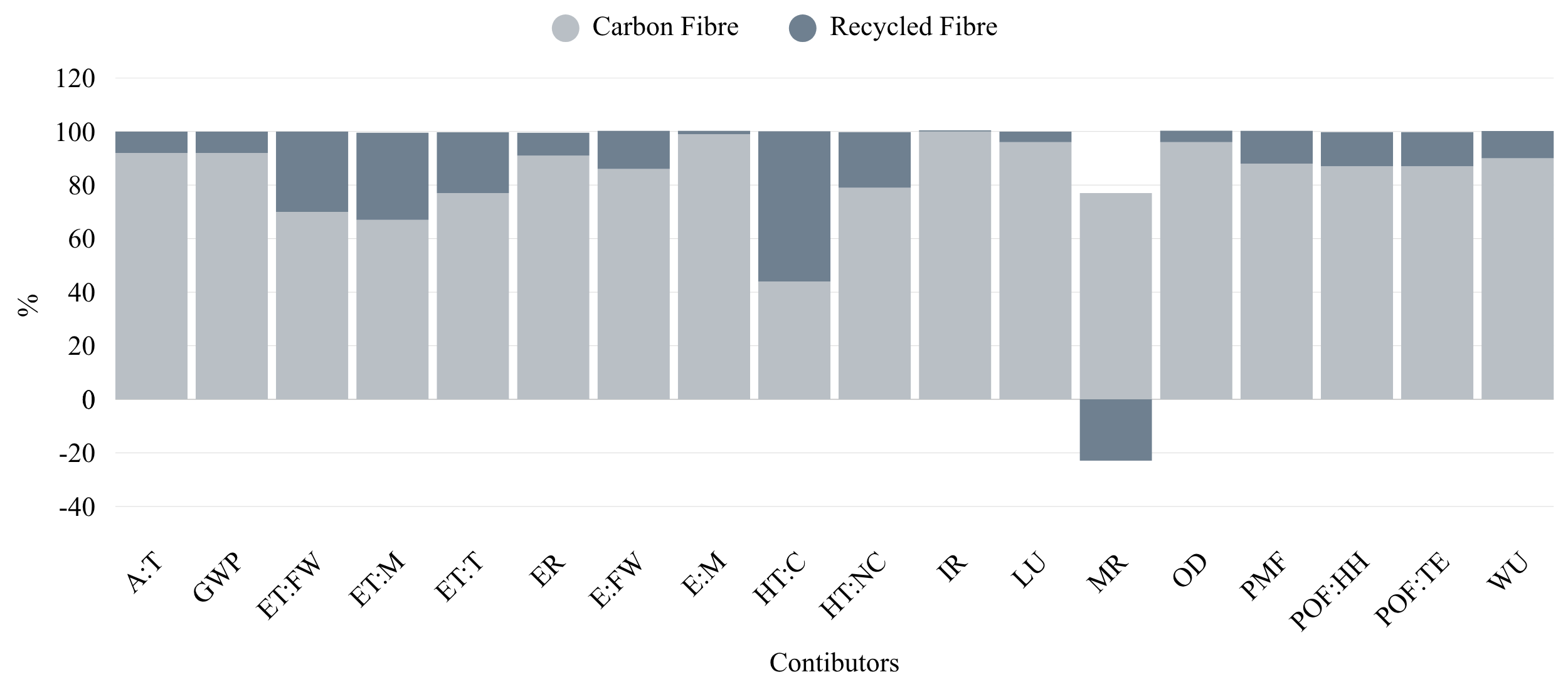
Figure 1 Impact across impact categories for primary production vs. recycled fibres: acidification (A:T), climate change (global warming potential/GWP-100), ecotoxicity (ET:FW/M/T), energy resources (fossil) (ER), eutrophication (E:FW/M), human toxicity (HT:C/NC), ionising radiation (IR), land use (LU), material resources (MR), ozone depletion (OD), particulate matter formation (PMF), photochemical oxidant formation (POF:HH/TE), and water use (WU) © Phoebe Brown.
The main contributors of both processes to global warming potential (GWP) through emissions were also evaluated. CF production has a GWP of 31.2 kg CO2 Eq, caused by:
- feedstock material (52.5 per cent)
- electricity (42.8 per cent)
- natural gas (4 per cent)
The feedstock material evaluated in this assessment was polyacrylonitrile (PAN) fibre, which is the most widely used CF. More specifically, the raw material acrylonitrile was used, which contributes 31.58 per cent to the total GWP of CF production.
Recycling, on the other hand, has a GWP of 2.69 kg CO2 Eq, contributed to mostly by:
- natural gas (85.7 per cent)
- transport (8.6 per cent)
- electricity (5.7 per cent)

Figure 2 Contributors to the primary production and recycling of carbon fibres. © Phoebe Brown.
This comparison highlights the importance of recycling CFs for the health of both the environment and the global population. It also recognises areas with the most impact across both production and recycling, to explore potential improvements in future studies.
Potential improvements I have highlighted are:
- alternative bio-based feedstock materials (lignin)
- net zero energy use
- implementing bio-gas alternatives instead of natural gas
- re-using the byproducts of pyrolysis recycling as fuel back into the process
- implementing alternative recycling operations industrially, such as fluidised bed or chemical recycling
My time researching this topic at BGS has been incredibly rewarding. I have learned so much about the workplace, writing research papers, sustainability and more. I thoroughly enjoyed my experience at BGS’s headquarters; everyone was super friendly and made me feel very welcome.
Thanks go out to Narendra Singh, Gavin Mudd, Evi Petavratzi, Maria Kariuki and the whole CMIC team at BGS for making my placement so rewarding.
Author
Phoebe Brown (undergraduate student)
Friedmann, J, Fan, Z, and Tang, K. 2019. Low-carbon heat solutions for heavy industry: sources, options, and costs today. Center on Global Energy Policy. (New York, USA: Columbia University.) Available: https://www.energypolicy.columbia.edu/publications/low-carbon-heat-solutions-heavy-industry-sources-options-and-costs-today/
Kooduvalli, K, Romero, S, Ford, S, Sloan, I, Coughlin, H, Unser, J, Vaidya, U, and Ozcan, S. 2020. Embodied energy of pyrolysis and solvolysis processes for recycling carbon fiber reinforced polymer waste. SAMPE Virtual Conference Proceedings, 2020. DOI: https://doi.org/10.33599/nasampe/s.20.0371
Meng, F, Olivetti, E A, Zhao, Y, Chang, J C, Pickering, S J, and McKechnie, J. 2018. Comparing life cycle energy and global warming potential of carbon fiber composite recycling technologies and waste management options. ACS Sustainable Chemistry & Engineering, Vol. 6(8), 9854–9865. DOI: https://doi.org/10.1021/acssuschemeng.8b01026
Pender, K, Romoli, F, Martin Rodes, F A, Fuller, J, and Zeolla, M. 2025. Future strategies for decarbonisation of carbon fibre products: a roadmap to net zero 2050. Journal of Cleaner Production, Vol. 486, 144525. DOI: https://doi.org/10.1016/J.JCLEPRO.2024.144525
Wang, S, Zhang, Y, Gao, H, Jin, K, Ao, C, Tian, L, He, Q, Yi, B, Ai, P, Cao, W, Pu, Y, Cheng, Y, and Li, Q. 2025. Replacing polyacrylonitrile with Kraft lignin for sustainable carbon fiber manufacturing mitigates carbon emissions. Green Chemistry, Vol. 27(4), 1031–1043. DOI: https://doi.org/10.1039/D4GC04579C
Relative topics
Related news
Measuring the environmental impacts of carbon fibre: life cycle assessment
01/09/2026
Undergraduate student Phoebe Brown visited BGS to understand the life cycle of carbon fibre, from primary production to recycling.
BGS research into drought-exposed soils wins award
26/08/2026
A research paper investigating how temperate soils respond to drought has been announced as the winner of the Land Best Paper Award.
UK Critical Minerals Intelligence Centre makes recommendations for the next UK criticality assessment
01/07/2026
CMIC has outlined the enhancements made to the next assessment update to ensure it is better tailored to the structure of the UK economy.
From archive to discovery: historical mineral reports support gold exploration in Scotland
25/06/2026
Digitised geological records show potential to unlock untapped mineral resources in Ardlochan, Argyllshire.
Shortage of end-of-life materials presents challenge to UK critical minerals security
17/06/2026
A new report by the UK Critical Minerals Intelligence Centre reveals insufficient end-of-life material stocks present a supply risk over the coming decade, but offer significant long-term potential to meet critical mineral demand through recycling.
Latest research emphasises climate-related subsidence risk to millions of British homes
11/06/2026
New data from BGS highlights the projected future impact of warmer, drier summers and underlines the need for mitigation measures in susceptible regions.
Ukraine and the UK strengthen their commitment to geological cooperation
10/06/2026
A new Memorandum of Understanding reaffirms the UK’s support of Ukraine’s ambitions to develop its critical mineral resources, paving the way for collaboration through capacity-building programmes.
GeoClimate Shrink–Swell
GeoClimate clay shrink-swell provides information on the projected future change in susceptibility of clay shrink–swell across Great Britain due to climate change.
Latest data on world mineral production now available
25/05/2026
BGS has released the updated statistics on the global production of over 70 commodities between 2020 and 2024.
Strengthening capacity through partnership: a critical minerals perspective
28/04/2026
BGS has been working in partnership with the Geological Survey Department of Zambia (GSD) to build national capacity, improve data accessibility and support long-term, sustainable development.

UK Critical Minerals Intelligence Centre 2026 showcase
Event on 31/03/2026
A special live webinar with the team from the Critical Minerals Intelligence Centre showcasing the latest research from 2026 on copper, the future of digital, and what’s next for the criticality assessment. A recording of the event is now available.
PhD adventures in Copenhagen, Denmark: revealing past recovery processes of tropical forest systems through ancient environmental DNA
12/03/2026
PhD student Chris Bengt visited the University of Copenhagen to carry out very delicate extraction of aeDNA from lake-sediment cores, in the hopes of unlocking the secrets of past volcanic eruptions.