

‘Three norths’ set to leave England and not return for hundreds of years
The historic alignment of true, magnetic, and grid north is set to leave England, three years after they combined in the country for the first time since records began.
12/12/2025 By BGS Press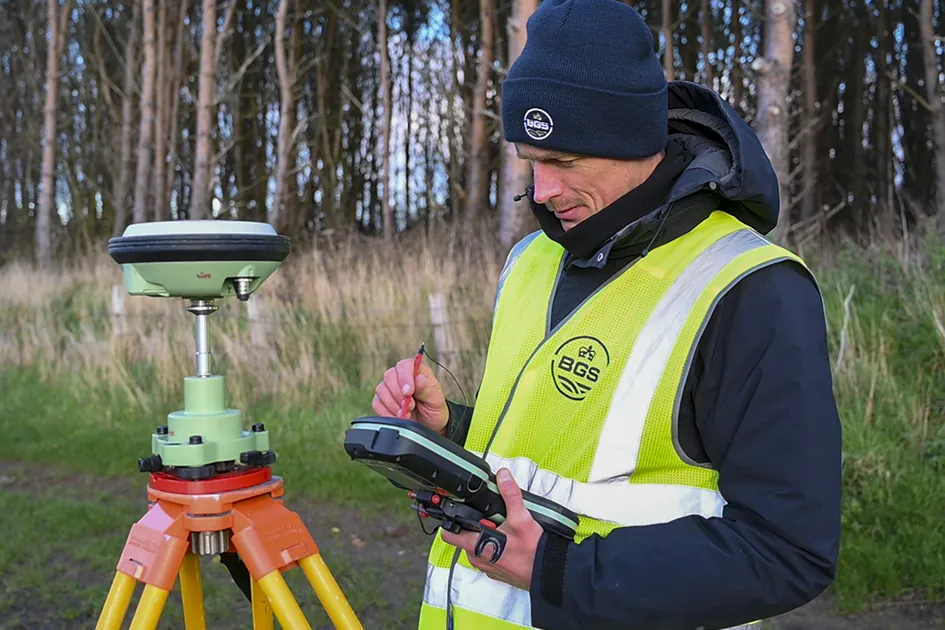

‘True north’ is the direction to the geographic north pole; ‘grid north’ is where the vertical blue lines shown on Ordnance Survey (OS) maps converge, and ‘magnetic north’ is the direction that a compass needle points as it aligns with the Earth’s magnetic field.
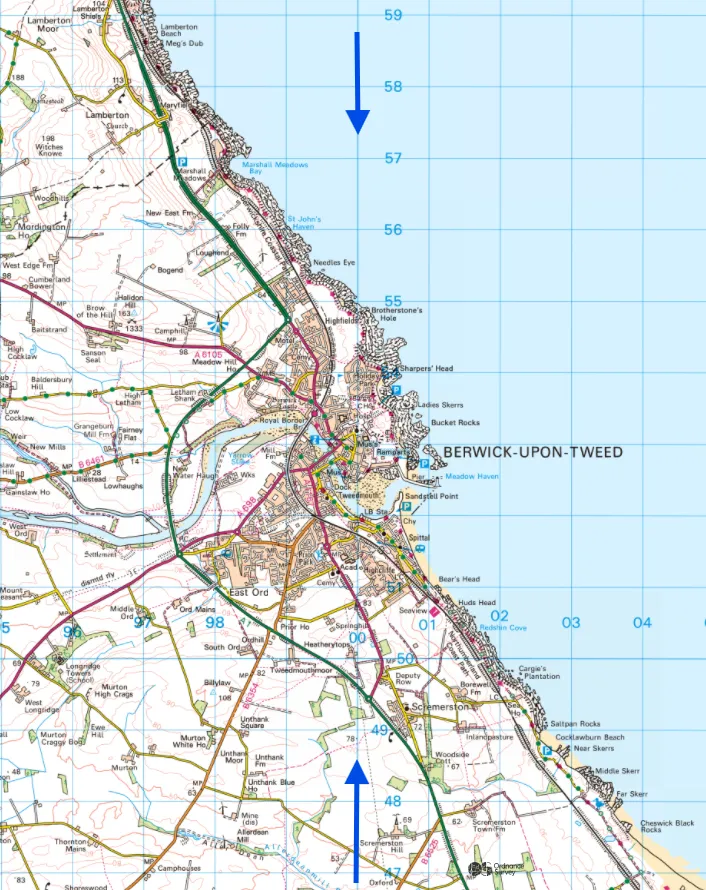
Map of the area around Berwick-upon-Tweed with the position of the grid north and true north line denoted by the blue arrows. © Ordnance Survey
In November 2022, geospatial history was made as all three ‘norths’ aligned and met at a point in Langton Matravers in Dorset, England, for the first time. Now, after three historic years together, new magnetic field data collected by the British Geological Survey (BGS) and calculations made by OS have shown that the triple alignment is set to leave England at Berwick-upon-Tweed on 13 December 2025 and move into the North Sea. It’s predicted that the triple alignment will hit land again at the end of October 2026 in Drums, just south of Newburgh in Scotland. After passing through Mintlaw, its last stop in Scotland will be Fraserburgh around mid-December 2026, before it returns to the North Sea.
Once over the North Sea, the three norths are expected to continue northwards before leaving the British national grid. They will also stay in alignment for another couple of years before magnetic north separates from true north and grid north. Magnetic north moves slowly, so it may be several hundred years before this alignment comes around again.The alignment began back in 2014, when magnetic north became east of grid north for some locations in Great Britain for the first time in more than 350 years. This affected navigators using a compass, who needed to adjust their bearing by subtracting instead of adding the difference between magnetic and grid north.
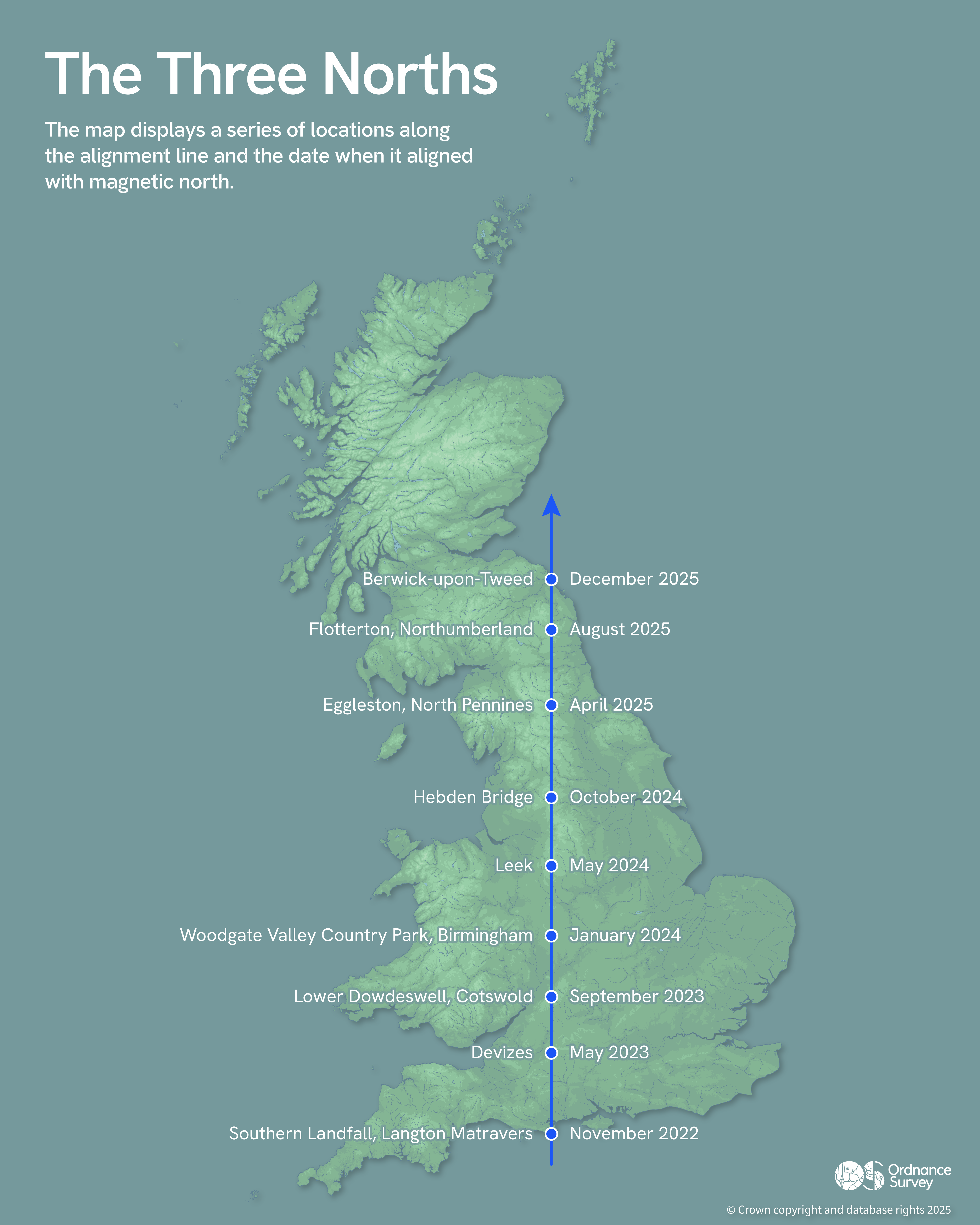
The map displays a series of locations along the alignment line and the date when it aligned with magnetic north. © Ordnance Survey
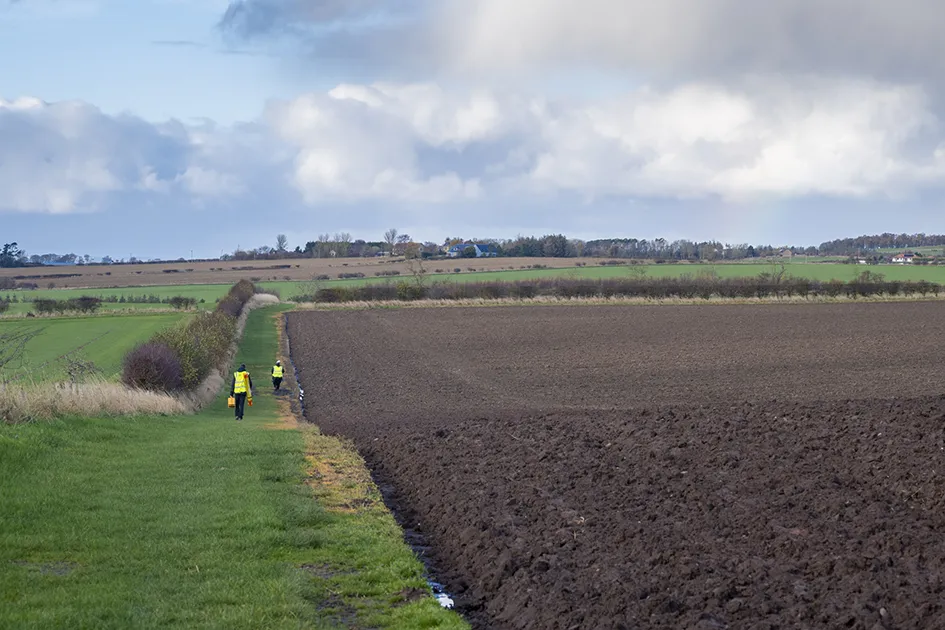
BGS working with OS to calculate when the three norths left England. BGS © UKRI.
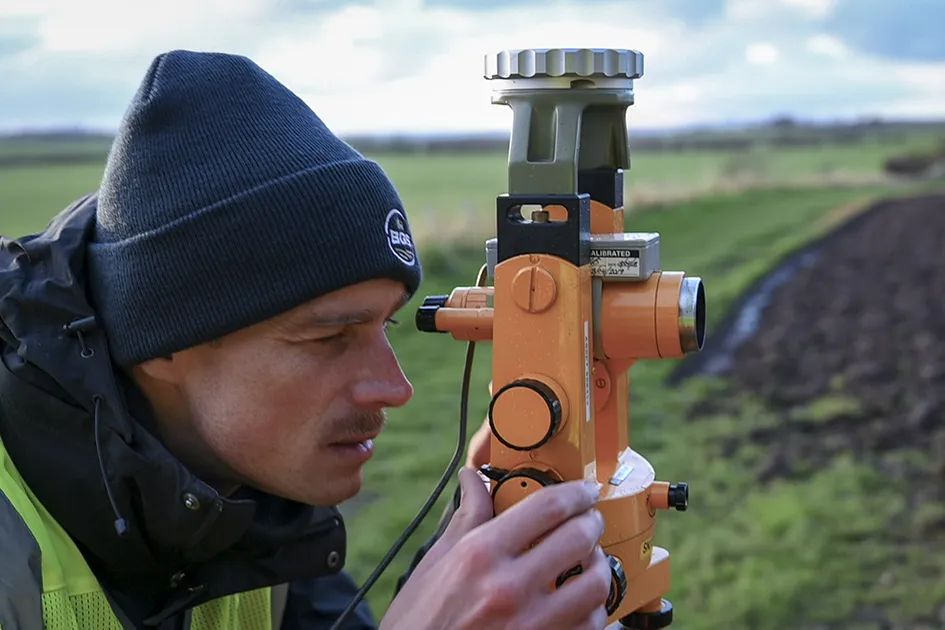
BGS scientist using a non-magnetic theodolite and fluxgate magnetometer to measure magnetic north, working with OS to calculate when the three norths left England. BGS © UKRI.
During the three norths’ time in England, they moved northwards through Poole near the end of 2022, then through Chippenham and Birmingham before reaching Hebden Bridge, West Yorkshire, in October 2024. The triple alignment then passed though the Pennines and will leave England at Berwick-upon-Tweed.

Due to refinement of the underlying models and the prediction data, the alignment’s progress has slowed slightly since the initial predictions back in 2022. When it crosses the coast at Berwick-upon-Tweed it will have travelled 576km (about 358 miles) in 1127 days so that’s about 511m per day (or about 5.9 mm per second or about 0.013 miles per hour). It will likely be a very long time before the alignment comes around again.
Mark Greaves, Earth measurement expert at OS.
The three norths combining in Great Britain has been a once-in-a-lifetime occurrence. Although part of geospatial history, there is no impact for navigators, pilots and captains once the alignment leaves, and people will still need to continue to take account of the variation between magnetic north from a compass and grid (or true) north on a map.
It’s been a privilege to be able to observe this phenomenon over the past few years. The magnetic field is not predictable in the long term, so we don’t know how many hundreds of years it will take for this historic alignment to occur again.
Dr Ciarán Beggan, geophysicist at BGS.
OS and the BGS Geomagnetism team collect detailed measurements of the magnetic field at more than 40 sites around the UK. These enable scientists to create high-resolution maps and make accurate forecasts of the changing declination angle.
Several factors, including changes in the flow of the Earth’s liquid outer core, the iron content of the local rocks and the variations in the magnetic field that are caused by the Sun, mean these predictions have some uncertainty and are a rough estimation of when the three norths are due to leave British soil.
Relative topics
Related news
Mystery of one of the earliest recorded space weather impacts solved
17/09/2026
BGS scientists were part of an international team that has solved a 178-year-old mystery surrounding one of the earliest recorded examples of space weather affecting technology.
‘Three norths’ set to leave England and not return for hundreds of years
12/12/2025
The historic alignment of true, magnetic, and grid north is set to leave England, three years after they combined in the country for the first time since records began.
UK braced for what could be the largest solar storm in over two decades
12/11/2025
Intense geomagnetic activity could disrupt technology such as communication systems, global positioning systems and satellite orbits.

Fieldwork on Volcán de Fuego
13/10/2025
Understanding how one of the world’s most active volcanoes builds up material, and how they collapse to feed hot flows
UK scientists in awe-rora as national coverage of magnetic field complete for the first time
23/09/2025
New sensors being installed across the UK are helping us understand the effects that extreme magnetic storms have on technology and national infrastructure.
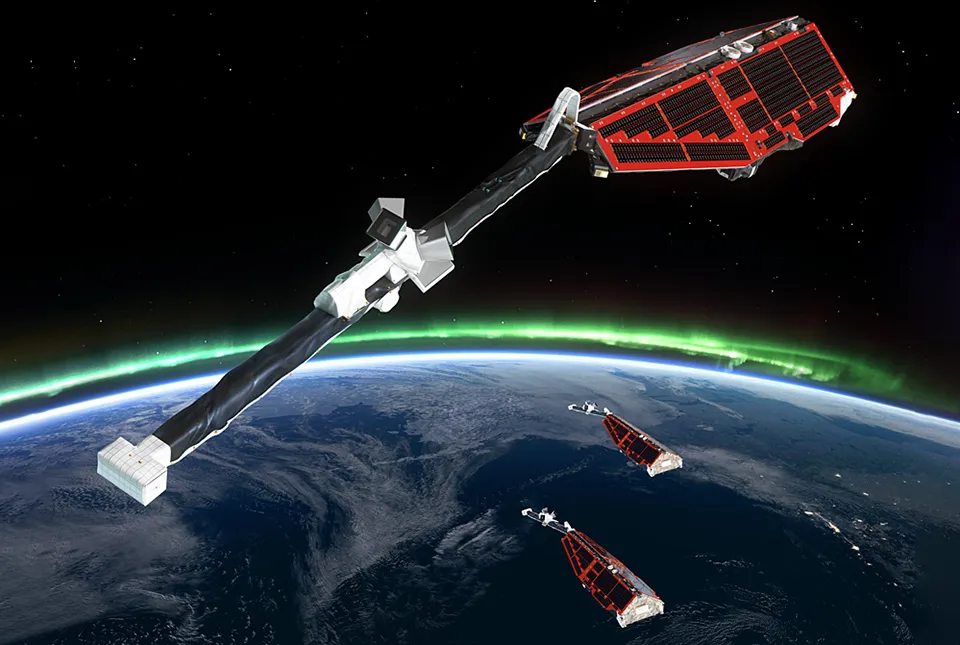
New global space weather hazard index launched
17/01/2025
The new index provides a near-real time, global picture of geomagnetic variations helping to highlight the effects of space weather.
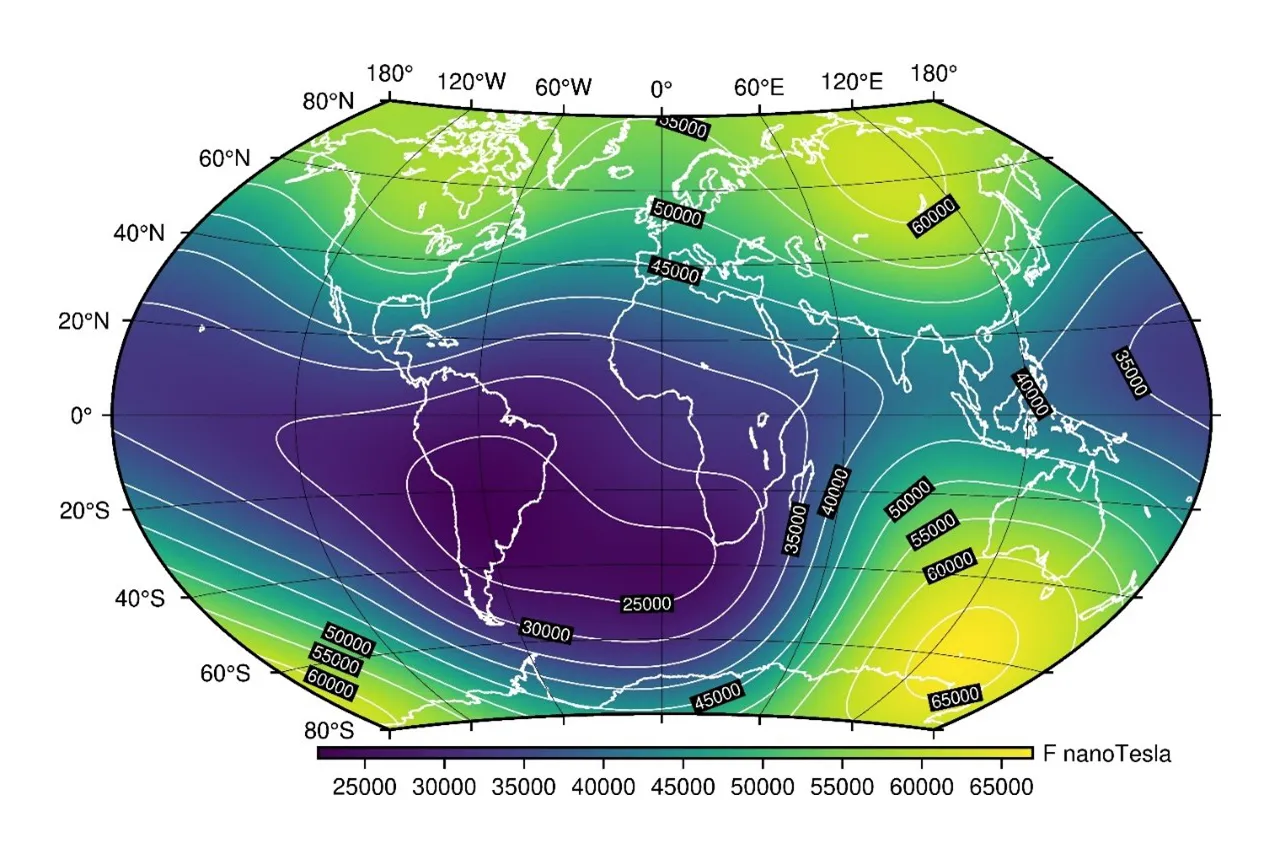
Update to essential scientific reference maps reveals new movement of the Earth’s magnetic field
01/01/2025
The international science community has released an update to the International Geomagnetic Reference Field, a model created for the public good and used by scientists around the world.
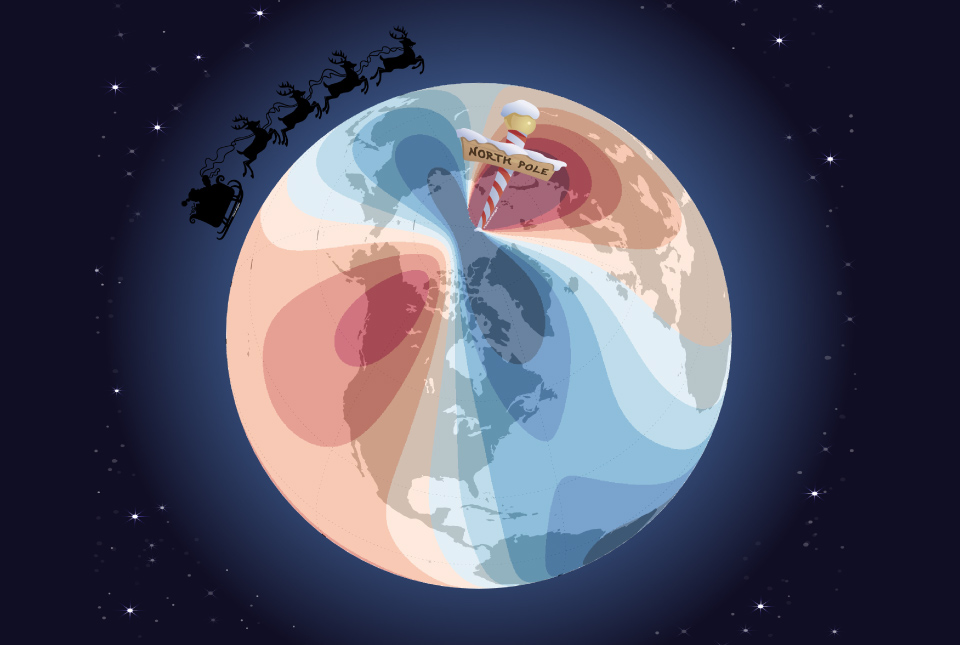
Airlines, shipping companies and sleigh drivers rush to update crucial navigation systems ahead of Christmas rush
17/12/2024
Release of major upgrade to a new model tracking magnetic north prompts global reset of satellite tracking systems across trade and passenger transport routes.
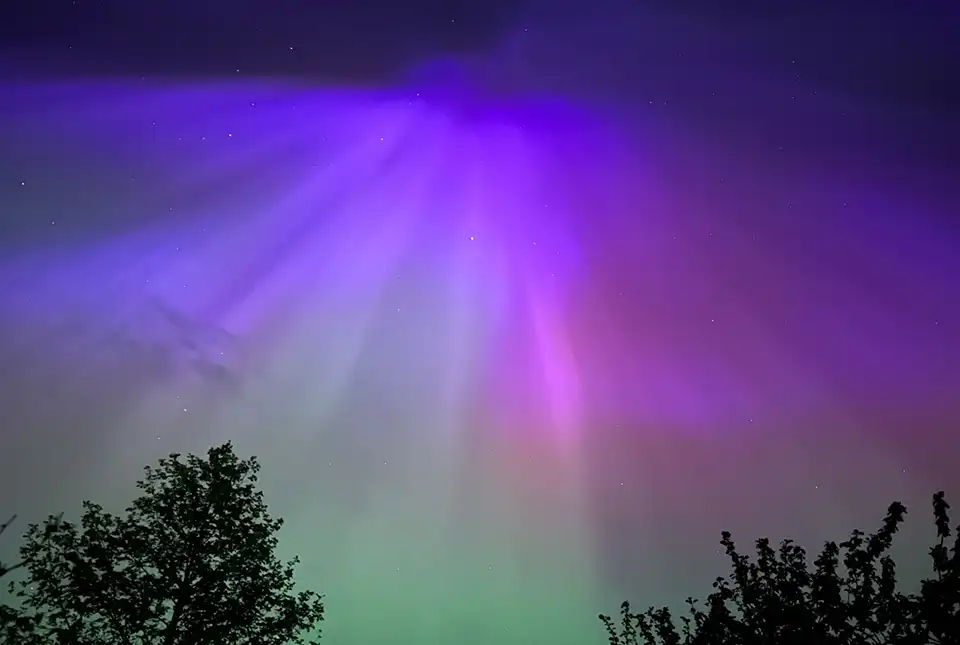
A-roaring display
16/05/2024
The dazzling and colourful aurora borealis, or northern lights, observed by many across the UK last weekend was one of the most extreme and long-lasting geomagnetic storms recorded in the last 155 years.
BGS leads update to maps of the Earth’s magnetic field
04/04/2024
The International Geomagnetic Reference Field, used for navigation on mobile phones and in space, is updated every five years.

Will 2024 be the Year of the Aurora?
23/02/2024
The Sun’s approximate eleven-year activity cycle is predicted to peak this year, prompting BGS scientists to anticipate that 2024 will be the ‘Year of the Aurora’.
From the Earth’s core to outer space: understanding the magnetic field
Event on 26/03/2024
A special webinar focusing on our our geomagnetism research, including how we measure the magnetic field, everyday applications and mitigating the threats of space weather.