

Climate change and human exploitation linked to historic decline in Atlantic salmon
New research reveals that both a change in climate and human exploitation played a role in a decline in North Atlantic salmon populations.
08/06/2022 By BGS Press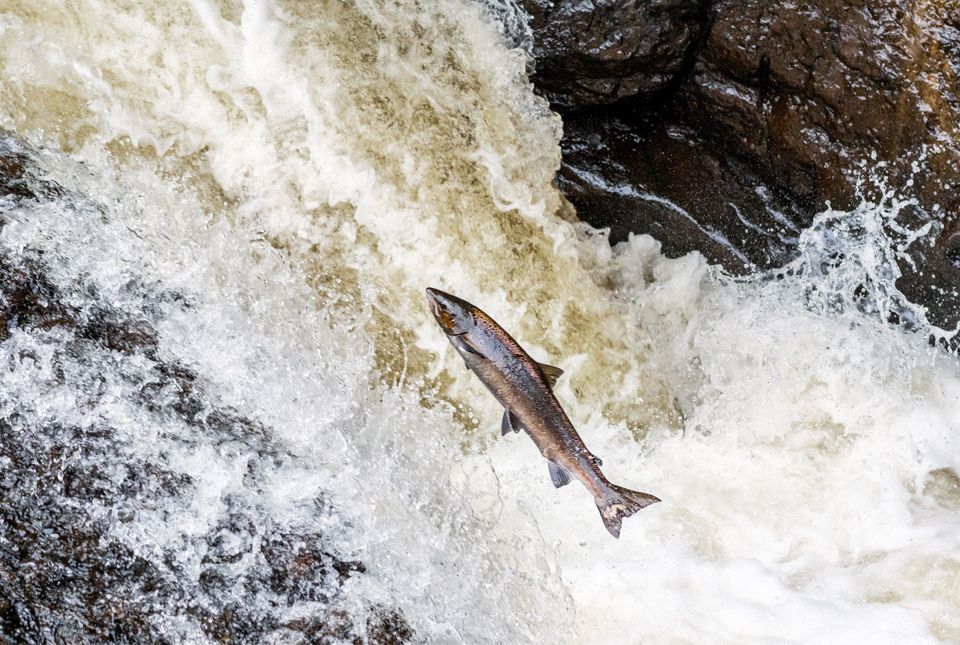

New research has revealed that an abrupt change in climate conditions in the North Atlantic around 800 years ago played a role in a decline in Atlantic salmon populations returning to rivers. Human exploitation reduced their populations still further.
Using state-of-the-art geochemistry, a team of scientists has discovered that large-scale changes in the marine habitat, brought on by a transition from a warm to a cold climate and what is now known as the Little Ice Age (approximately 1300 to 1850 CE), corresponded with a decline in salmon in the River Spey, Scotland. The study, published in the international journal The Holocene, was led by the University of Southampton, working with BGS.

These results can help us understand some of the controls on salmon populations prior to and during major human exploitation.
Our study shows that historically, beavers – common in Scotland hundreds of years ago – do not appear to have significantly impacted salmon numbers. This is very relevant today, as the animals are being reintroduced to UK rivers and a debate continues about their potential impact on migratory species like salmon.
Prof David Sear, professor of geography and environmental science at the University of Southampton and lead author of the study.
This research benefited from state-of-the-art geochemistry which enabled us to fingerprint salmon abundance over hundreds of years. We show that climate has been an important influence of salmon numbers, which is very relevant today due to the speed of climate change.
Prof Melanie Leng, BGS, co-author.
Atlantic salmon lay their eggs in the gravels of headwater streams, where their young live for a year or two before migrating out to sea. Here, they feed and grow into adults, eventually returning to the river to spawn, where many then die. The sperm, eggs and carcasses are rich in marine nutrients, which can be detected in sediment hundreds of years later.
Using core samples from Loch Insh on the River Spey, the scientists collected and measured marine-derived nutrients (MDNs), which give an understanding of the historic population levels of salmon. The team also examined a 150-year record of net-catch data from the lower Spey to help calibrate the MDN record.
The scientists were able to construct a 2000-year record of both salmon-derived nutrients and variations in climate conditions.
The findings show:
- bigger salmon populations (inferred from changes in MDNs) in the past reduced during a cooling climate at around the same time humans began to exploit them, leading to a major decline in the fish over the last 800 years
- larger salmon populations in the past occurred at a time when rivers were also inhabited by beavers, which suggests migratory fish are capable of co-existing with beavers; this is an important concern of anglers around current beaver reintroductions
- migratory fish, such as salmon, bring marine nutrients into our nutrient-poor upland rivers and probably represented a major boost to aquatic and wetland ecosystems in the past, with a decline in nutrients negatively affecting these ecosystems today
It is the first study to use MDNs to measure Atlantic salmon, although the method has previously been used for Pacific salmon in north-west USA and Canada.
Relative topics
Related news

Shortage of end-of-life materials presents challenge to UK critical minerals security
17/06/2026
A new report by the UK Critical Minerals Intelligence Centre reveals insufficient end-of-life material stocks present a supply risk over the coming decade, but offer significant long-term potential to meet critical mineral demand through recycling.
UK geothermal catalogue receives update
16/06/2026
BGS releases the second digital version of the UK geothermal catalogue of subsurface temperature and rock thermal conductivity measurements and heat flow calculations.
Scientists make new discovery in the history of the Giant’s Causeway
15/06/2026
New research is changing our scientific understanding of the formation of one of the UK’s most iconic landmarks and has revealed that Northern Ireland’s volcanic past occurred over a much shorter period than previously thought.

Latest research emphasises climate-related subsidence risk to millions of British homes
11/06/2026
New data from BGS highlights the projected future impact of warmer, drier summers and underlines the need for mitigation measures in susceptible regions.
Ukraine and the UK strengthen their commitment to geological cooperation
10/06/2026
A new Memorandum of Understanding reaffirms the UK’s support of Ukraine’s ambitions to develop its critical mineral resources, paving the way for collaboration through capacity-building programmes.
Newly released core could hold clues on potential mineral prospectivity in Perthshire
05/06/2026
A comprehensive collection of geological samples from the vicinity of a former mine in Scotland is now available to scientists for further research.
Latest data on world mineral production now available
25/05/2026
BGS has released the updated statistics on the global production of over 70 commodities between 2020 and 2024.
International science consortium to survey the health, economic value and social importance of Lake Victoria
22/05/2026
The project will replicate the 1927 survey to assess changes in the lake’s health, economic value and social importance.
New geological maps of Berwick-upon-Tweed to help future-proof natural water supply
20/05/2026
Scientists have mapped the geology under the town to better understand the groundwater system to inform decisions around abstraction.

BGS contributes to UN sand and sustainability report
19/05/2026
The new report highlights the impact of poor governance and unsustainable sand mining practices, calling on policymakers to take action.
BGS engineering geologist elected to CCOP
29/04/2026
Marcus Dobbs has been elected as vice-chair of the advisory group for the Coordinating Committee for Geoscience Programmes in East and Southeast Asia.
UK Minerals Yearbook 2025 now available
21/04/2026
The annual publication provides essential information about the production, consumption and trade of UK minerals up to 2025.