

Natural hydrogen research
BGS Research
Natural hydrogen gas is generated through a range of geochemical and biochemical reactions within rock formations. It has recently gained significant attention as a potential clean energy source following reports of natural hydrogen accumulations and seeps in multiple parts of the world, the most well-known being at Bourakebougou village in Mali, West Africa.
Hydrogen can be generated and concentrated in some geological systems, has a high energy density by mass and does not produce carbon emissions when it is burned. The rising need for cleaner fuels is a key factor driving the exploration of naturally occurring hydrogen.
Hydrogen is the smallest and lightest molecule in existence and, once generated, it can readily migrate in the subsurface. The migrating hydrogen can be trapped in reservoir rocks if they have appropriate cap rocks. Knowledge of the gas’s formation processes, particularly its migration pathways and preservation mechanisms, remains limited. Hydrogen can also be produced in the subsurface through engineered acceleration of geochemical reactions in suitable rocks, typically by applying heat, fluids, or other controls to promote its release (stimulated hydrogen). Considerably more cross-disciplinary research is needed to understand how natural hydrogen systems evolve over time and to determine whether they can be explored and developed in an economically viable way.
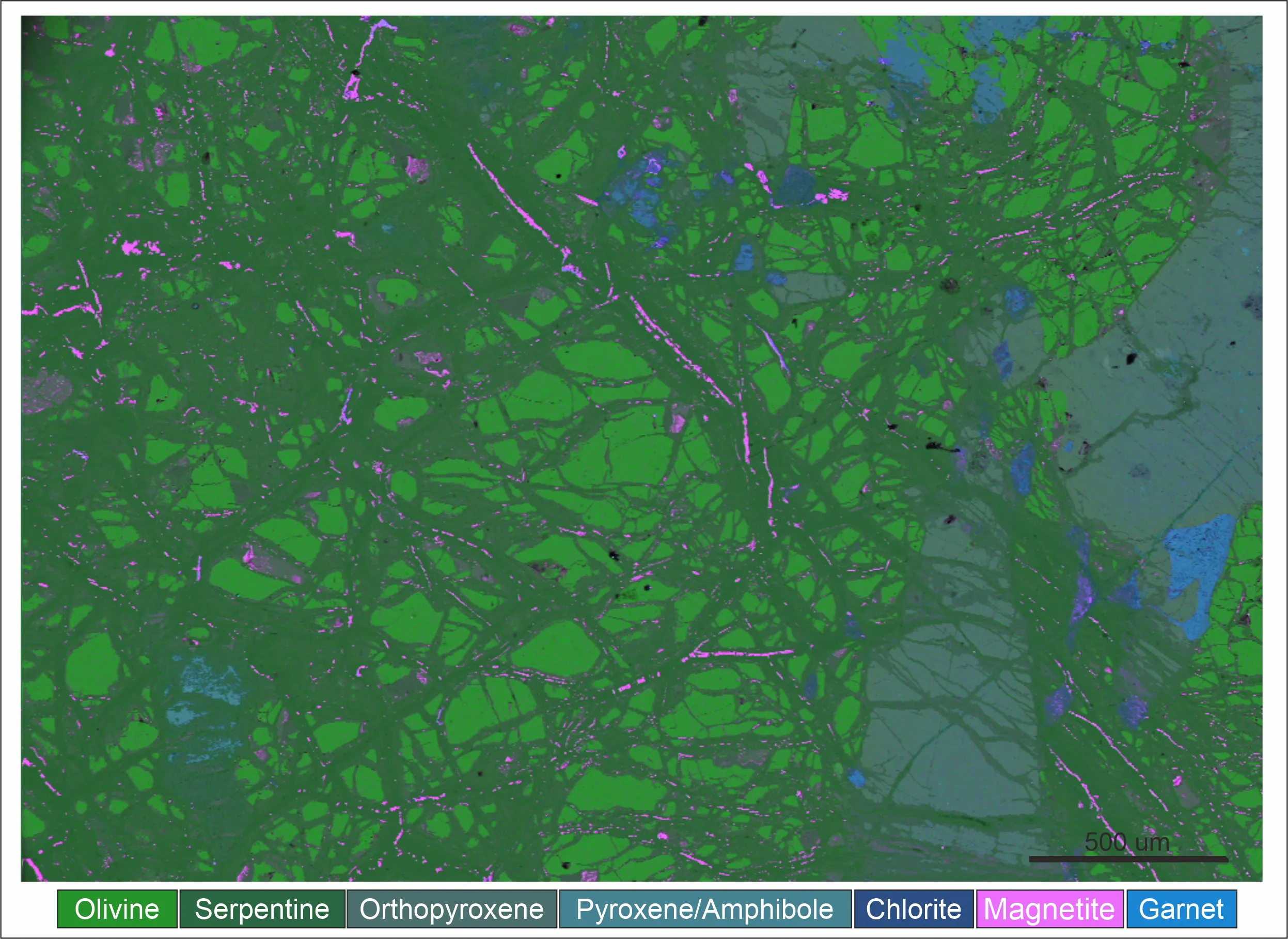

Phase map of minerals in a serpentinite thin section from the Kennack Sands car park borehole, the Lizard, Cornwall. The map was generated by mixing false-colour key element distributions and imagery to identify individual minerals.
BGS sample GSR01572822. Produced using a Zeiss 300VP scanning electron microscope with Bruker Generation 7 X ray detectors at the BGS Petrography Laboratories.

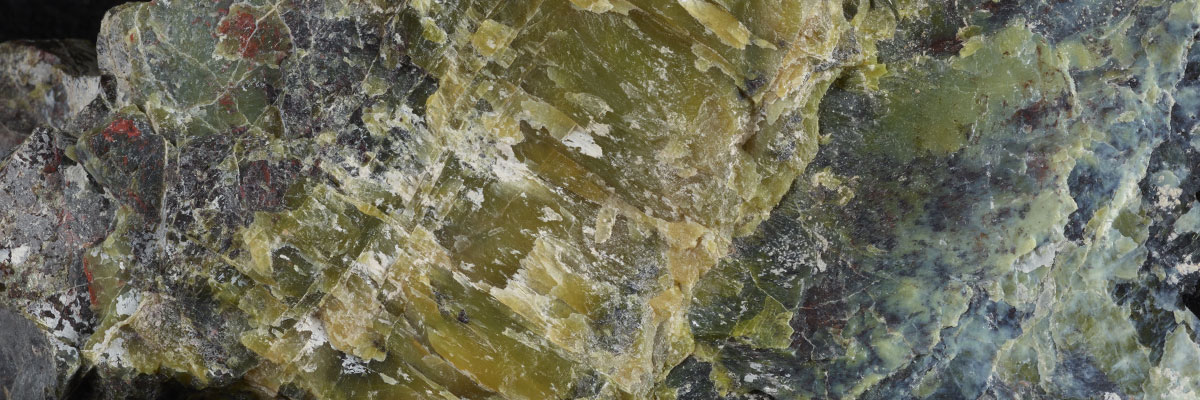
Serpentinite rock sample. Serpentinisation is regarded as the most effective and therefore the most important subsurface process for the generation of natural hydrogen. Sample from the Lizard, Cornwall. BGS collector ID: AML_57
Natural hydrogen system components
A play‑based exploration model is commonly used to understand natural hydrogen systems. This approach provides a structured framework for evaluating all key elements of the system, including hydrogen generation, migration pathways, reservoir rocks and sealing units. For a region to have potential for natural hydrogen accumulation, all of these components must be present in the correct sequence and active within the appropriate geological timescales.
Natural hydrogen is generated through several subsurface processes, including reactions between water and iron rich rocks, radiolysis caused by natural radioactive decay, and other water/rock interactions. Among these mechanisms, the hydration of ultramafic rocks, a process known as ‘serpentinisation’, is considered one of the most effective. In this reaction, hydrogen is released through a redox process involving iron and water.
Once formed, hydrogen moves away from its source. Its extremely small and light molecular structure makes it highly mobile, allowing it to travel through porous rocks and fractures and faults where permeability allows. Depending on the geology, hydrogen may escape to the surface as a seep or become trapped underground.
For hydrogen to accumulate, it must encounter porous and permeable reservoir rocks capable of storing the gas, overlain by impermeable seals that prevent further upward movement. Structural or stratigraphical traps are also required to accommodate hydrogen in place long enough for significant accumulations to form.
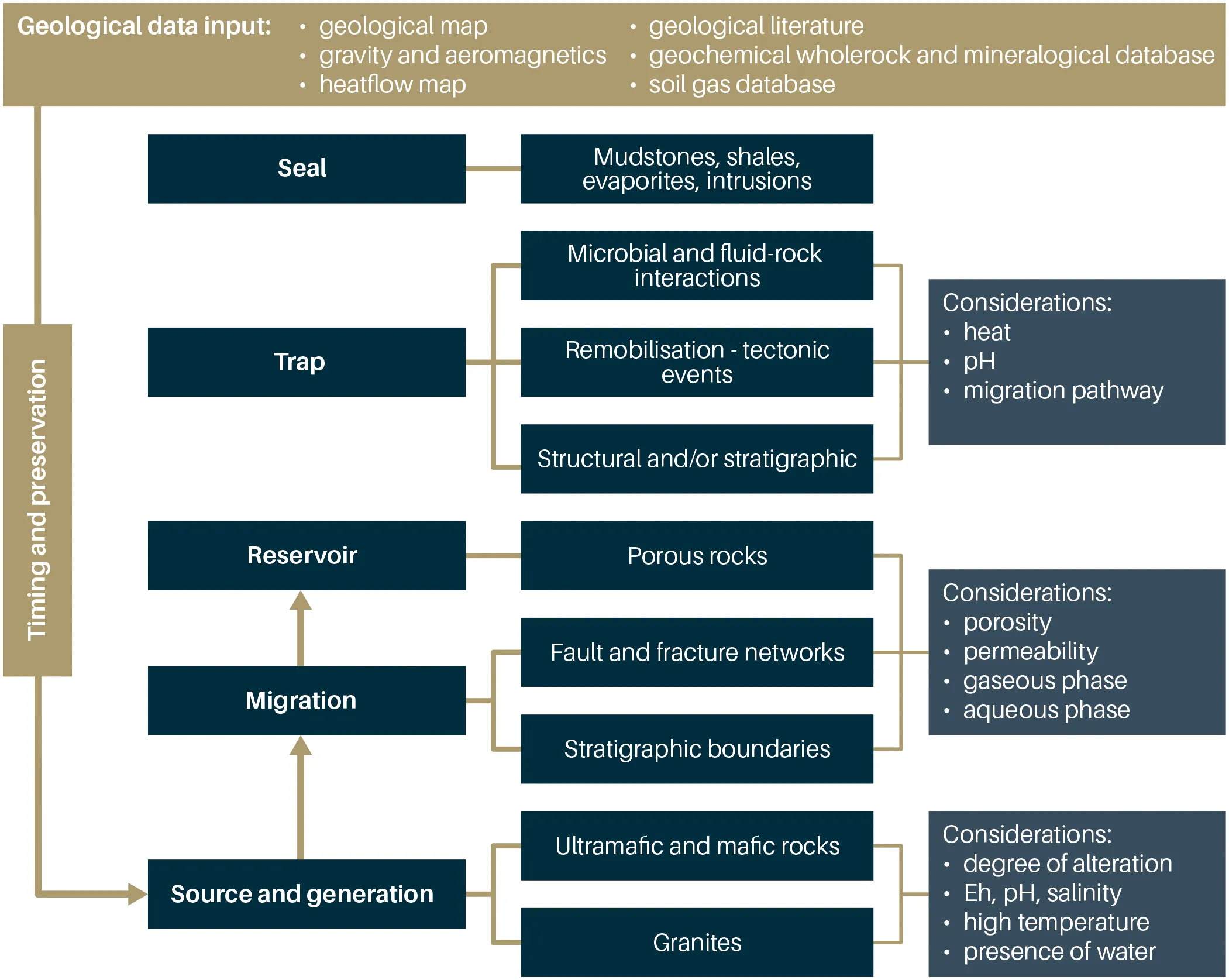
Flow diagram illustrating the standard play-based exploration workflow used to assess natural hydrogen potential in a specific area. The geological data inputs highlight the types of datasets that should be incorporated where available. BGS © UKRI.
Hydrogen as a growing global energy resource
Global hydrogen use currently stands at about 90 million tonnes per year, with nearly all of it produced through industrial processes, such as steam reformation of methane, that generate substantial carbon emissions. Hydrogen is used across several industries, most notably in ammonia manufacturing, oil refining and as an energy source for electric vehicle fuel cells. As the demand for cleaner energy increases, hydrogen consumption is expected to grow significantly, potentially exceeding 400 million tonnes annually by 2050 (Net Zero by 2050). Much of this future demand is anticipated to be met by low‑emission hydrogen sources.
Natural hydrogen research at BGS
We collaborate with government, academia and industry to understand aspects of the natural hydrogen value chain on a national and international level. This includes the geochemistry of source systems, large-scale geological assessment and legacy data that feeds into play-based exploration studies, with a focus on UK potential.
The Review of the UK’s geological potential for the generation and accumulation of natural hydrogen report provides a high-level overview of the geological settings across the UK that may have been conducive to the generation, migration and trapping of naturally occurring hydrogen. The study highlights that, while several geological environments in the UK could theoretically host natural hydrogen, no confirmed accumulations have yet been identified, emphasising the need for systematic exploration, improved data and further research to assess this potential low carbon energy resource.
The Royal Society’s Natural hydrogen: future energy and resources report outlines how naturally occurring hydrogen could become a viable low-carbon energy source for the UK and globally. It provides an overview of processes related to the generation, migration and accumulation of hydrogen in the subsurface. The report also addresses the steps required to create a commercially viable natural hydrogen product, encompassing current production approaches, extraction methods, supporting resource needs, cost considerations, and environmental and waste management issues. Finally, it summarises the factors needed to establish a functioning market and commercial framework, including comparisons with other hydrogen production types, potential market opportunities, financing, regulatory and permitting requirements, and the importance of securing a social licence to operate.
The Lizard serpentinites project is a BGS initiative focused on extracting new scientific value from legacy rock samples. It uses material collected during 1980s drilling campaigns on the Lizard Peninsula, Cornwall, undertaken as part of the Mineral Reconnaissance Programme, and applies a combination of manual and automated analytical workflows to assess the degree of serpentinisation in selected ultramafic samples. This can provide an indication of the remaining potential for hydrogen generation.
In partnership with the Philippines Nuclear Research Institute, this project focuses on using synchrotron-based techniques to determine the speciation of iron and chromium in ultramafic rocks associated with significant hydrogen emissions from seeps and springs within the Zambales ophiolite. This data will shed light on the geochemical relationship between notable hydrogen shows and chromitite bodies, and support more focused exploration targeting.
Further information
- Energy storage research
- Underground hydrogen storage science briefing note
- National Geoscience Data Centre
Contact
If you have any questions about our natural hydrogen research, please contact Alicja Lacinska.
Related news

MaxStoreUK hydrogen geological storage policy roundtable
Event on 08/10/2026
Storage operators, regulators, licensor and Government stakeholders are invited to join our roundtable discussion of hydrogen geological storage policy.

UK and Philippines scientists investigate natural hydrogen generation processes at atomic scale
22/06/2026
BGS researchers were granted access to use the Diamond Light Source facility in order to study hydrogen in light brighter than the sun.
Natural hydrogen research
Understanding aspects of the natural hydrogen value chain on a national and international level.

New funding awarded for UK geological storage research
21/11/2025
A project that aims to investigate the UK’s subsurface resource to support net zero has been awarded funding and is due to begin its research.
Funding awarded for study on hydrogen storage potential in North Yorkshire
22/09/2025
A new study has been awarded funding to explore the potential for underground hydrogen storage near the Knapton power plant.
Making the case for underground hydrogen storage in the UK
03/04/2025
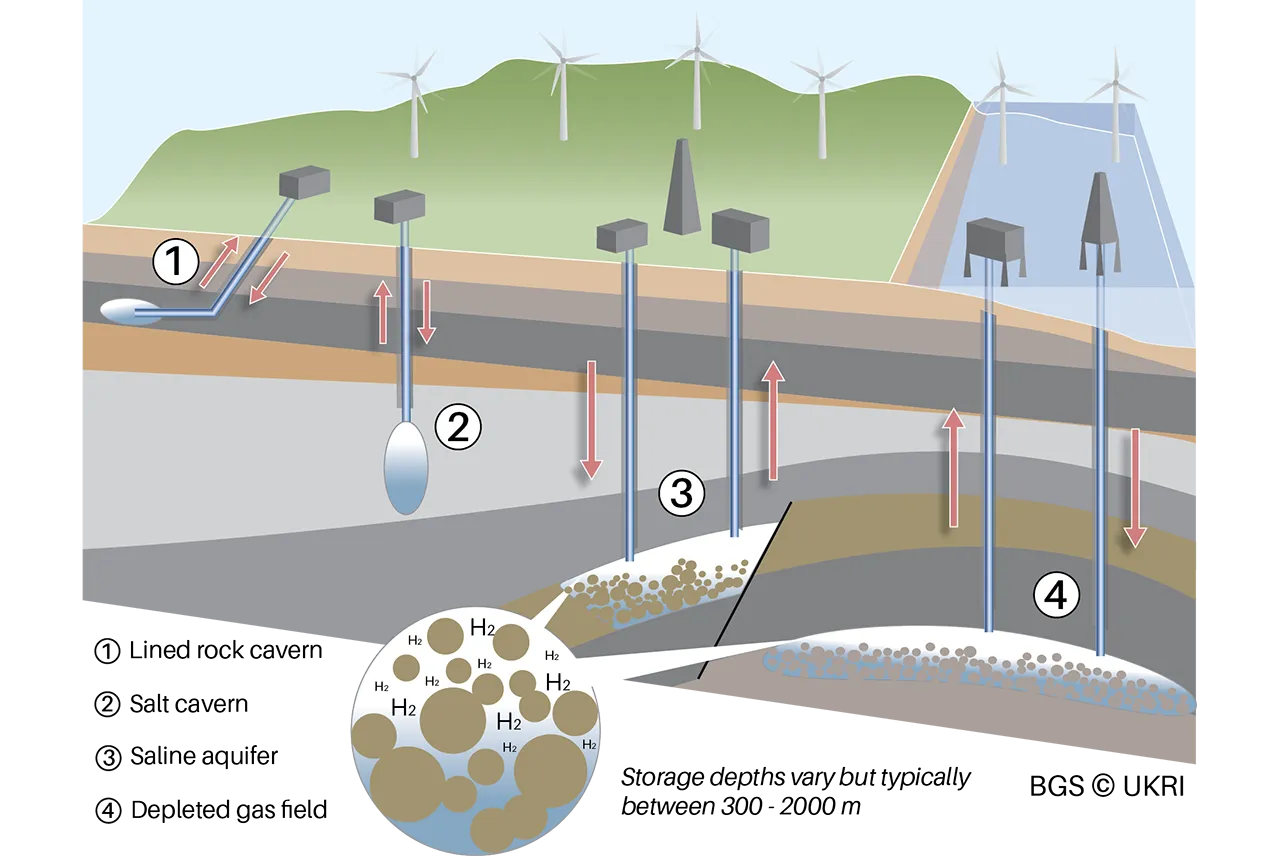
A new BGS science briefing note focuses on the potential of hydrogen storage to support the UK energy transition.

Next stage of funding awarded for project on hydrogen storage potential in the East Midlands
17/10/2024
BGS will conduct essential studies on hydrogen behaviour in the subsurface to predict, measure and monitor underground hydrogen storage.

Funding awarded for study on hydrogen storage potential in the East Midlands
19/08/2024
A new study has been awarded funding to explore the underground hydrogen storage potential in the East Midlands.

Scoping report on the material requirements for a UK hydrogen economy
21/06/2023
The UK Critical Minerals Intelligence Centre has produced a scoping report that examines the aims of the UK with regards to developing a hydrogen economy, the sustainability of these targets, given current metal loadings, and provides some suggestions for overcoming potential challenges that the UK may face in securing raw materials to support this ambition.

Underground energy storage: supporting the transition to net zero carbon emissions
25/08/2021
Underground storage for renewable energy resources could be a viable green solution as we transition to a net zero UK.

Safe storage of hydrogen in porous rocks: the challenges and knowledge gaps
12/02/2021
Increasing the amount of renewable energy that generates clean electricity will require a transition from natural gas to hydrogen and to store heat/cool in rocks.
Energy storage
Continuing BGS’s sustained track record of energy storage research, which will underpin future laboratory, field and GIS-based activities and commissions.
You may also be interested in

Geothermal energy
Investigating geothermal energy — energy stored in the form of heat beneath the surface of the solid Earth.
Carbon capture and storage
Studying carbon dioxide storage as a recognised European centre of excellence in a number of research areas.
Energy storage
Continuing BGS’s sustained track record of energy storage research, which will underpin future laboratory, field and GIS-based activities and commissions.
Critical raw materials
Addressing global concerns over the long-term availability of secure and adequate supplies of the minerals and metals needed by society.