

Scientists gain access to ‘once in a lifetime’ core from Great Glen Fault
The geological core provides a cross-section through the UK’s largest fault zone, offering a rare insight into the formation of the Scottish Highlands.
01/12/2025 By BGS Press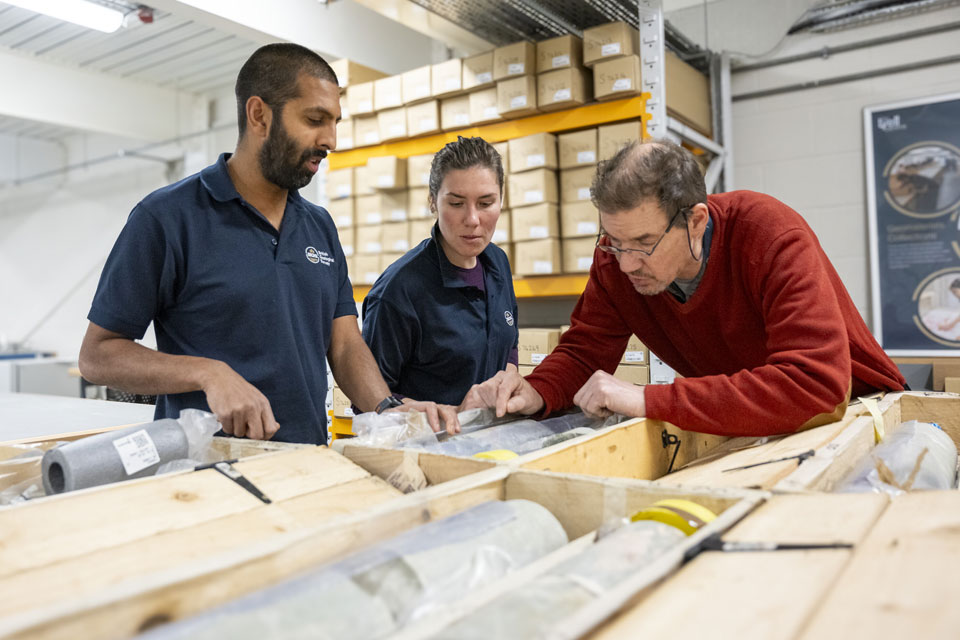

At over 1000 km long and 40 km deep, the Great Glen Fault is the largest geological fault structure in the UK. As part of ground investigations for SSE Renewables’ proposed pumped hydro storage scheme at the Coire Glas site on the shores of Loch Lochy in the Highlands, deep drill core was extracted from beneath the Great Glen. BGS scientists were granted a unique opportunity to study the newly drilled fault rocks that are part of the Great Glen Fault Zone. These ‘first of their kind’ core samples have lived up to their billing, with experts claiming that they give unprecedented insight into the inner workings and behaviour of crustal-scale faults worldwide.
The Great Glen Fault formed around 400 million years ago in a massive mountain-building event, as the ancient continental plates of Laurentia (North America and Scotland) and Baltica (Scandinavia, England, Wales and Europe) collided. This tectonic event is known as the Caledonian Orogeny. The fault stretches from Ireland, all the way through Scotland, to Norway. Today, the fault underlies the major valley of the Great Glen, which crosses the whole of Scotland and was scoured out by glaciers during the last ice age. Generally, rocks associated with the Great Glen Fault Zone remain mostly hidden to the human eye by the waters of Loch Ness, Loch Oich and Loch Lochy, along with ice age deposits along the valley floor.
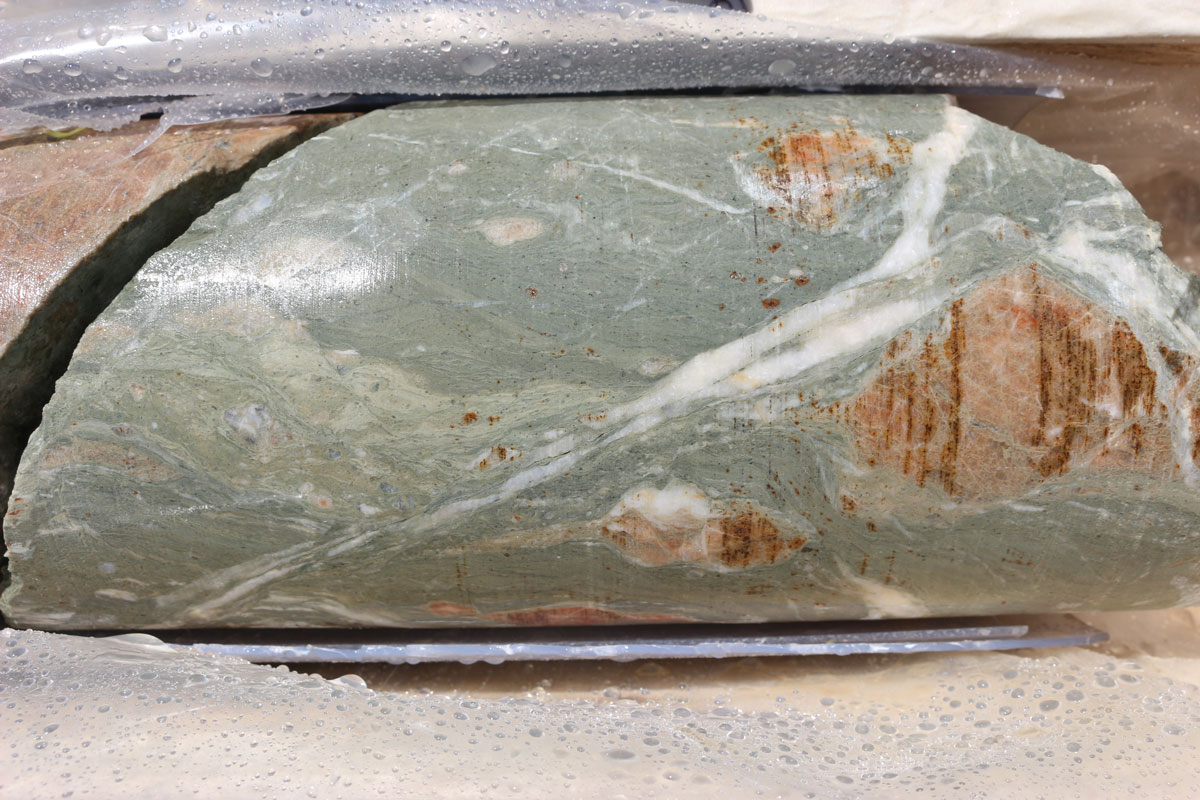
A sample of the LCW03 core with pale green fault gouge (a fault rock where the parent rock is ground to a very fine paste, then hardened) with remnant clasts of granite (red) and cross-cut by later veins of calcium-magnesium carbonate (white). BGS © UKRI.
The new drill core from the Coire Glas Project offers the tantalising prospect of furthering our understanding of how these fault systems work and how fluids emerging from deep within the Earth’s crust change the properties of the rock. Over 1500 m of core were recovered, reaching depths of 650 m below ground level. Core was drilled on the shore of Loch Lochy and from within an underground tunnel at the base of the mountain. Drilling geological core is expensive and is normally only justifiable to such extensive depths as part of major energy or infrastructure projects. The added difficulty in relation to the Great Glen Fault is that, in addition to being located in remote parts of the Highlands, fault rock can be very weak and presents a technical challenge to drill successfully.
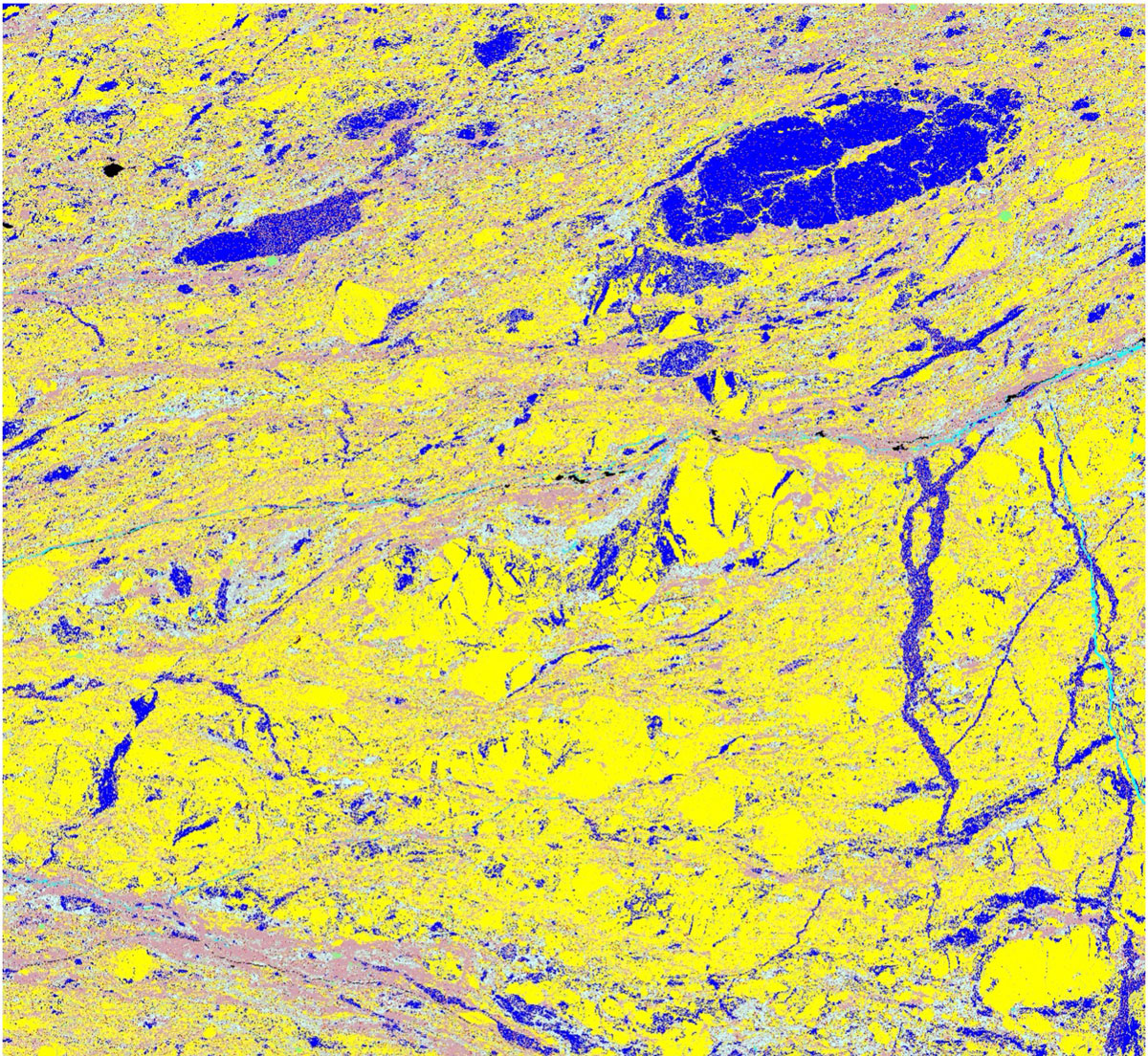
Mineral map image of Great Glen Fault rock generated using a scanning electron microscope. The pale purple-pink areas are formed by interconnected networks of weak clay minerals formed due to alteration of the host rock, which shearing has localised. Pale and dark blue areas are regions of later carbonate veins and cement. Image is 5mm wide. BGS © UKRI.
The new geological samples provide an opportunity to understand the geological processes happening deep in the Earth’s crust. This is also relevant for understanding other major crustal faults, such as the San Andreas and Anatolian faults. Several key questions remain:
- does this fault connect all the way to the Earth’s mantle, thought to be at more than 30 km depth?
- what is the source of fluids in crustal fault zones?
- how do hot fluids interact and change the mechanical properties of the rocks in a fault zone?
- how many times has the fault moved in its long geological history?
- how have the hundreds of earthquakes that likely made the fault zone changed the properties of the rock?

I have had the privilege to study the first samples of these Great Glen Fault rocks using state-of the-art microscope facilities at BGS. Our findings give strong clues as to how ancient deformation processes and fluid/rock chemical reactions caused the fault to initially weaken associated with displacements of hundreds of kilometres. Remarkably, it then appears to have been cemented following later tectonic movements that channelled deeply sourced carbonate mineralisation. Much more remains to be discovered, but it is clear that these cores have the potential to elevate the Great Glen Fault to one of the great natural laboratories for fault zone studies worldwide.
Professor Bob Holdsworth, Durham University
Newly drilled core from the Coire Glas site has provided a unique opportunity to study fundamental geological processes occurring in the UK’s biggest fault zone. The storage of the Coire Glas core at BGS will allow access for the scientific community and will ensure that these rocks are preserved for future generations.
Romesh Palamakumbura, BGS Geologist
SSE Renewables is delighted to support the advance in scientific understanding of the Great Glen Fault and similar structures worldwide, thanks to the core that was recovered during the ground investigation for Coire Glas. As well as being of scientific value, the recovered core has been critical for understanding ground conditions and managing ground risk as the project progresses towards a final investment decision.
SSE Renewables
The Coire Glas core will be stored and made available for future research purposes at the BGS National Geological Repository, a bespoke facility that is publicly funded through UKRI and houses the UK’s foremost collection of geological samples. This will enable long-term preservation of the core, allowing scientists to study and attempt to unlock its secrets long into the future.
The core has the potential to help us answer fundamental geological questions about the history of the Earth as well as better understand major crustal-scale faults in seismically active regions elsewhere. It will also enable us to understand rock properties that are important for major renewable infrastructure projects, energy storage and geothermal targets. These cylinders of rock truly are one-of-a-kind windows back into our distant geological past.
For more information, please contact BGS press (bgspress@bgs.ac.uk) or call 07790 607 010.
About the Coire Glas project
The Coire Glas Hydro Pumped Storage project is a proposed pumped hydro storage scheme with a potential capacity of up to 1300 MW being developed by SSE Renewables. It is the first large-scale pumped storage project to be developed in the UK for more than 40 years and would more than double Great Britain’s existing electricity storage capacity. Further information about the project can be found at www.coireglas.com
About the British Geological Survey (BGS)
The British Geological Survey is a world-leading geological survey and global geoscience organisation, focused on public-good science for government and research to understand earth and environmental processes.
We are the UK’s premier provider of objective, impartial and authoritative geoscientific data, information and knowledge to help society to use its natural resources responsibly, manage environmental change and build resilience capabilities.
From resource management and environmental protection to natural hazard mitigation and climate change adaptation, our work underpins many of the key challenges and opportunities facing the UK today.
Relative topics
Related news
UK geothermal catalogue receives update
16/06/2026
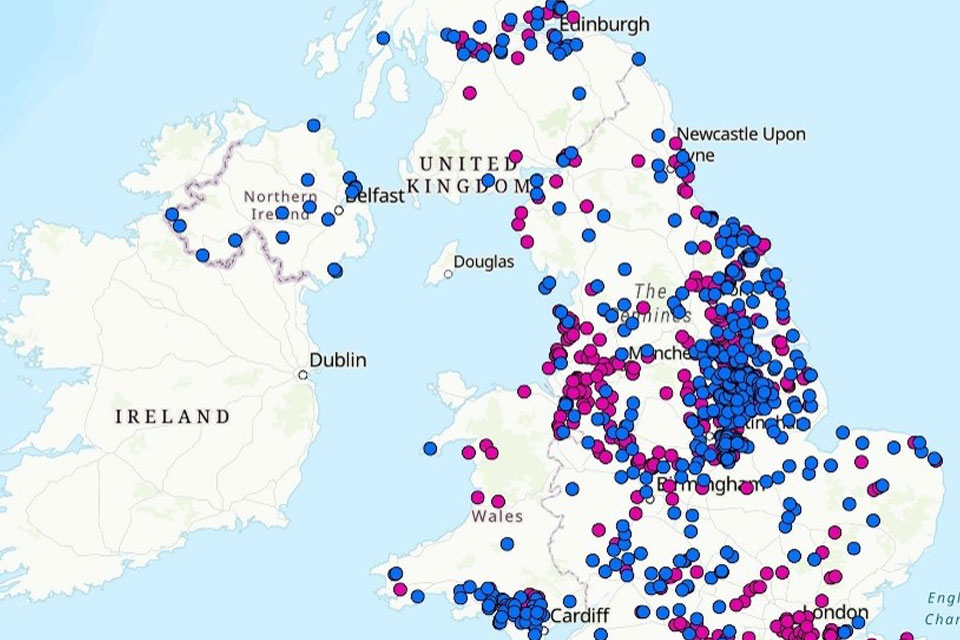
BGS releases the second digital version of the UK geothermal catalogue of subsurface temperature and rock thermal conductivity measurements and heat flow calculations.
Making research matter: BGS joins leading research organisations in new national initiative
10/12/2025
A new alliance of 35 organisations has been formed that is dedicated to advancing science for the benefit of people, communities, the economy and national priorities.
Scientists gain access to ‘once in a lifetime’ core from Great Glen Fault
01/12/2025
The geological core provides a cross-section through the UK’s largest fault zone, offering a rare insight into the formation of the Scottish Highlands.
Artificial intelligence helps scientists identify 3000 moving slopes potentially at risk of landslide
25/09/2025
A new approach that combines AI and satellite data has been used by scientists to detect actively moving landslides at a national scale.
New BGS GeoIndex viewer released for user testing
24/09/2025
The premium map-viewing application has been given a major upgrade and made available as a beta release.

New seabed sediment maps reveal what lies beneath the waves
03/09/2025
Marine ecosystem science and offshore infrastructure will be boosted by a new dataset showing sediment composition across the UK continental shelf.
Is your region susceptible? Britain’s geohazard hotspots revealed
14/08/2025
From sinkholes to radon: new maps highlight the most geologically at-risk regions
New platform highlights geothermal potential across the UK
11/08/2025
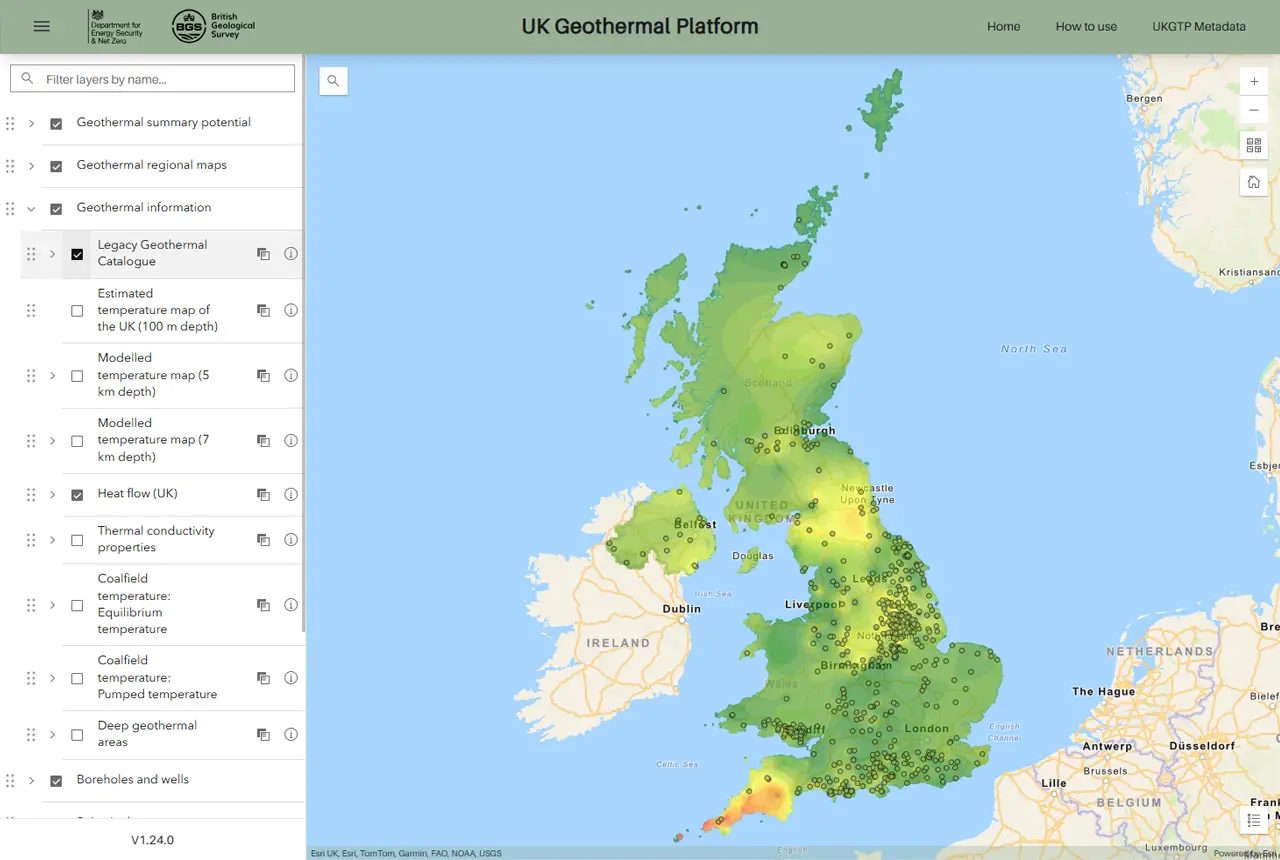
A new government-funded geothermal initiative, which includes an interactive map, has launched to help decision makers assess the geothermal potential across the UK.
New tool helps identify coal mine gas risk for housing developments in Scotland
05/08/2025
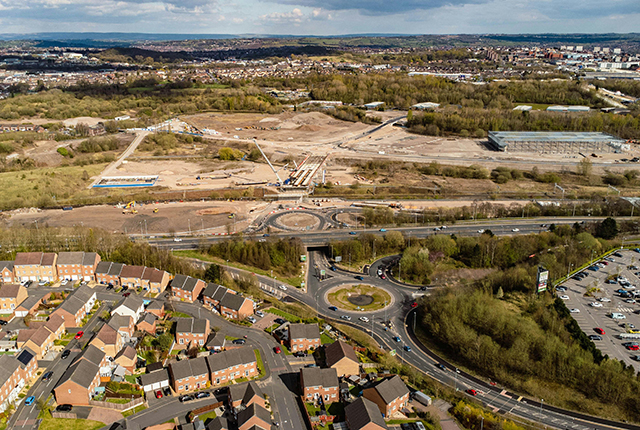
Scientists have co-developed a new tool for North Lanarkshire Council to help screen coal mine gas emissions prior to the development of new houses and buildings.
New journal article reveals snapshot of forever chemicals in shallow English soils
31/07/2025
Data on the presence of per- and polyfluoroalkyl substance concentrations in English soils has been released.

Modern pesticides found in UK rivers could pose risk to aquatic life
17/06/2025
New research shows that modern pesticides used in agriculture and veterinary medicines have been found for the first time in English rivers.
Goldilocks zones: ‘geological super regions’ set to drive annual £40 billion investment in jobs and economic growth
10/06/2025
Eight UK regions identified as ‘just right’ in terms of geological conditions to drive the country’s net zero energy ambitions.