

Can sandstones under the North Sea unlock the UK’s carbon storage potential?
For the UK to reach its ambitious target of storing 170 million tonnes of carbon dioxide per year by 2050, it will need to look beyond the current well-studied geographical areas.
02/02/2026 By BGS Press

As the UK works toward its net zero ambitions, attention is increasingly turning offshore, where geological formations under the sea floor may hold the key to long-term carbon dioxide (CO₂) storage.
Carbon capture and storage (CCS) encompasses a range of technologies designed to significantly reduce emissions from large industrial sources such as steelworks, cement plants and thermal power stations. CO₂ is captured at source, transported and then injected into suitable rock formations deep beneath the surface, typically at depths of over 800 m. Geologists at BGS are working to better understand the subsurface geology of the Central North Sea and its suitability for storing CO₂ captured from major industrial sources. This work could release one of the UK’s largest, yet least-developed, carbon storage resources and underpin the Government’s £21.7 billion investment in CCS projects.
Despite accounting for approximately 60 per cent of the UK’s total estimated CO₂ storage capacity, the Central North Sea remains under-represented and highlights a major opportunity for the Government’s clean energy growth agenda.
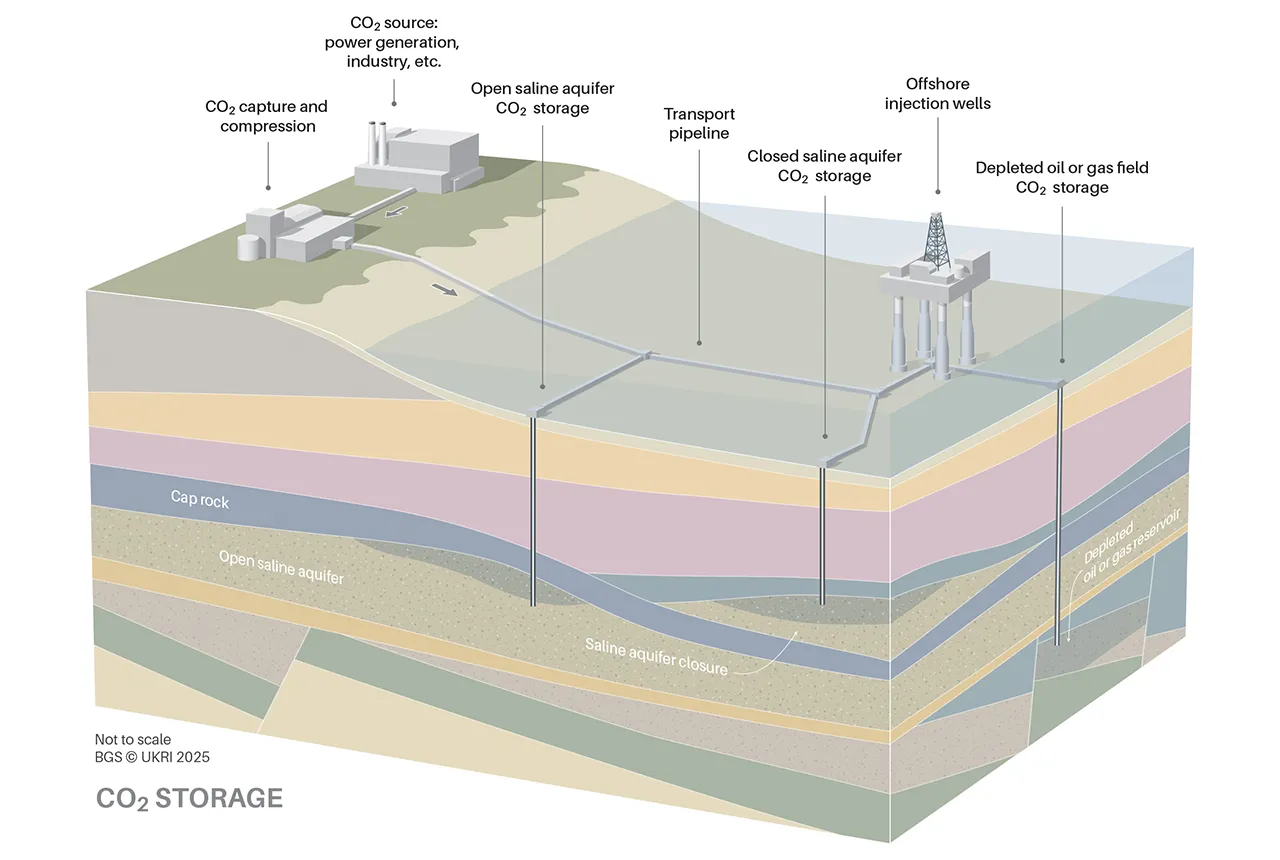
Schematic of the CCS process including capture of CO2 from industrial sources and transport to offshore CO2 storage sites where the CO2 is injected into geological reservoirs deep beneath the seabed. BGS © UKRI.
A nation rich in storage potential
Deploying CCS at scale is a key pillar of the UK Government’s clean growth strategy. Current ambitions are to store at least 50 million tonnes of CO₂ per year by 2030, rising to as much as 170 million tonnes annually by 2050.
The UK is exceptionally well positioned for offshore CO₂ storage. Estimates suggest that total theoretical storage capacity exceeds 70 billion tonnes. The North Sea Transition Authority (NSTA), which regulates offshore CO₂ storage, launched its first competitive licensing round in 2022 and followed this with a second round announced in December 2025.
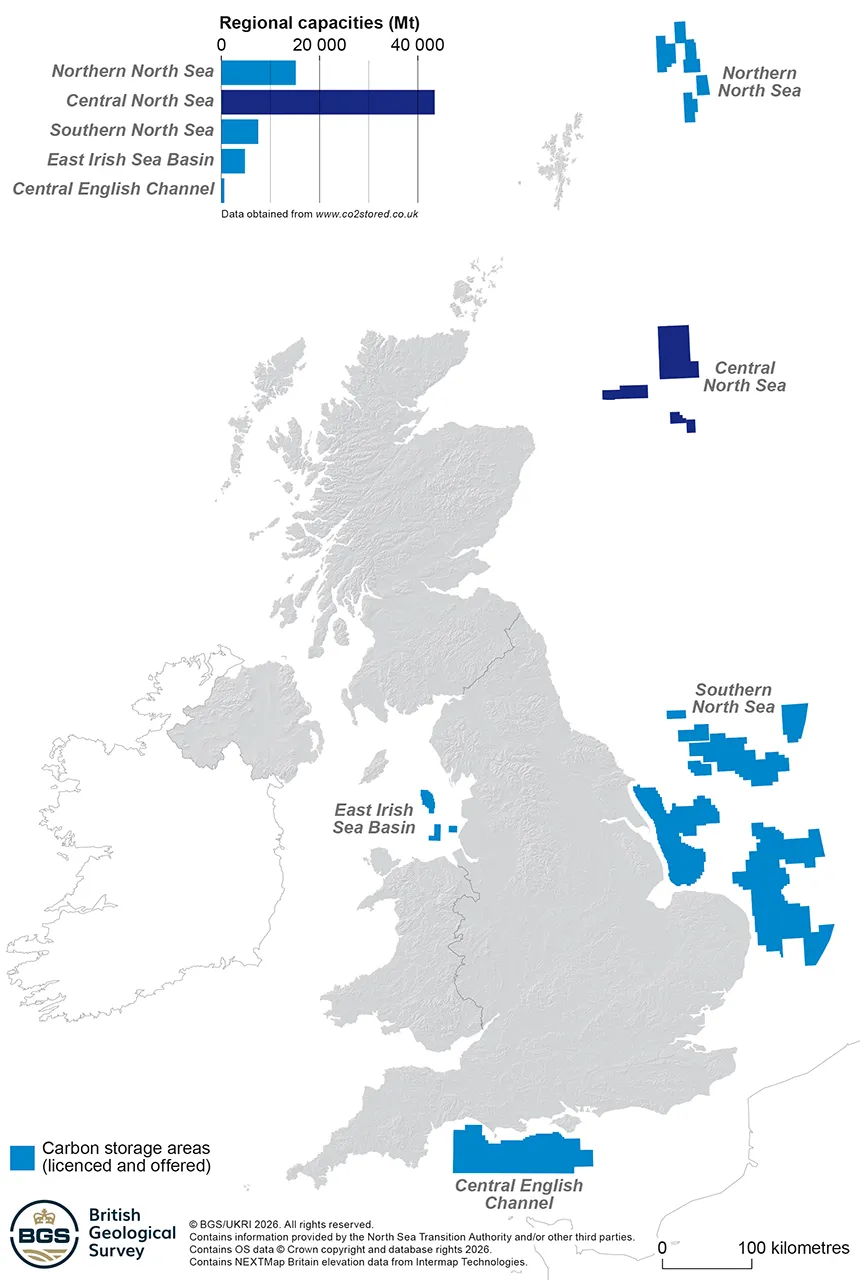
The distribution of carbon storage licence areas offered by the North Sea Transition Authority (NSTA)and indicative theoretical storage capacity for each of the main areas. (Storage capacity data taken from the CO2Stored database.)
These licences allow operators to explore and appraise potential storage sites as a precursor to applying for permits that enable CO₂ injection. Due to favourable geology and proximity to onshore emission hubs, most licences to date have been located in the Southern North Sea, with additional clusters in Liverpool Bay, Morecambe Bay and the Northern North Sea. However, the region with most storage potential lies elsewhere.
The drive to map this untapped potential
The enormous, currently untapped potential beneath the Central North Sea lies in extensive sandstone formations in the region. Multiple sequences of stacked Palaeogene sandstone units represent a vast potential CO₂ storage resource, with more than 10 billion tonnes of theoretical capacity (approximately one quarter of the basin’s total regional storage capacity). These sandstones were deposited between 40 and 65 million years ago in deep-water marine fan systems. The complex stacked and interdigitated nature of these sandstone bodies raises important geological questions that must be resolved before large-scale storage can proceed.
Key considerations include:
- the degree of connectivity between sandstone units, which has a bearing on pressure during CO2 injection
- balance between pressure dissipation and pressure interference between neighbouring storage sites, which affects storage capacity
- the effectiveness of the vital sealing layers above and between the sandstone formations, which might be prone to disruption by various geological phenomena
- legacy oil and gas wells, which could act as pathways for CO2 to escape if not properly assessed
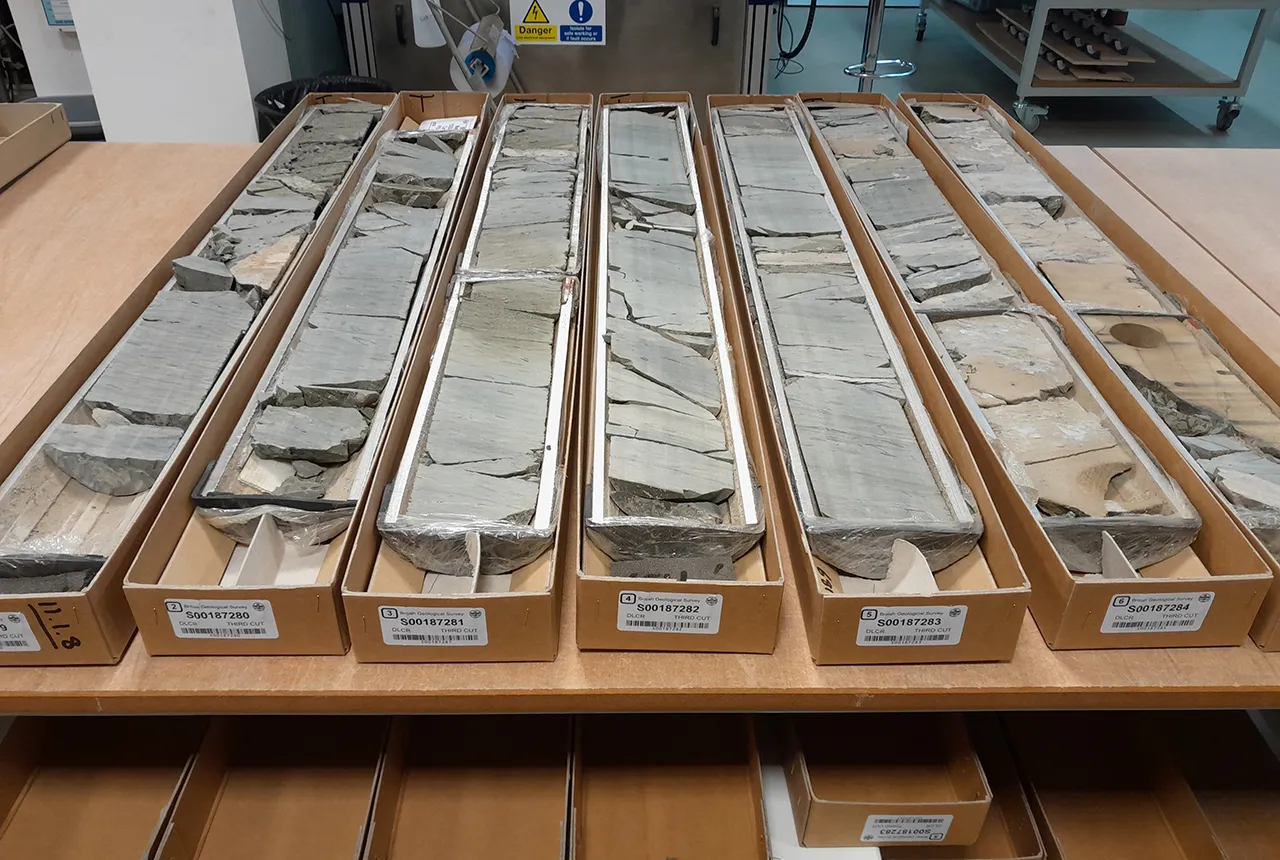
Rock core material from the study region showing grey claystones of the Lista Formation grading into light brown sandstones of the Mey Sandstone Member, which is one of the potential reservoirs for CO2 storage. BGS © UKRI.
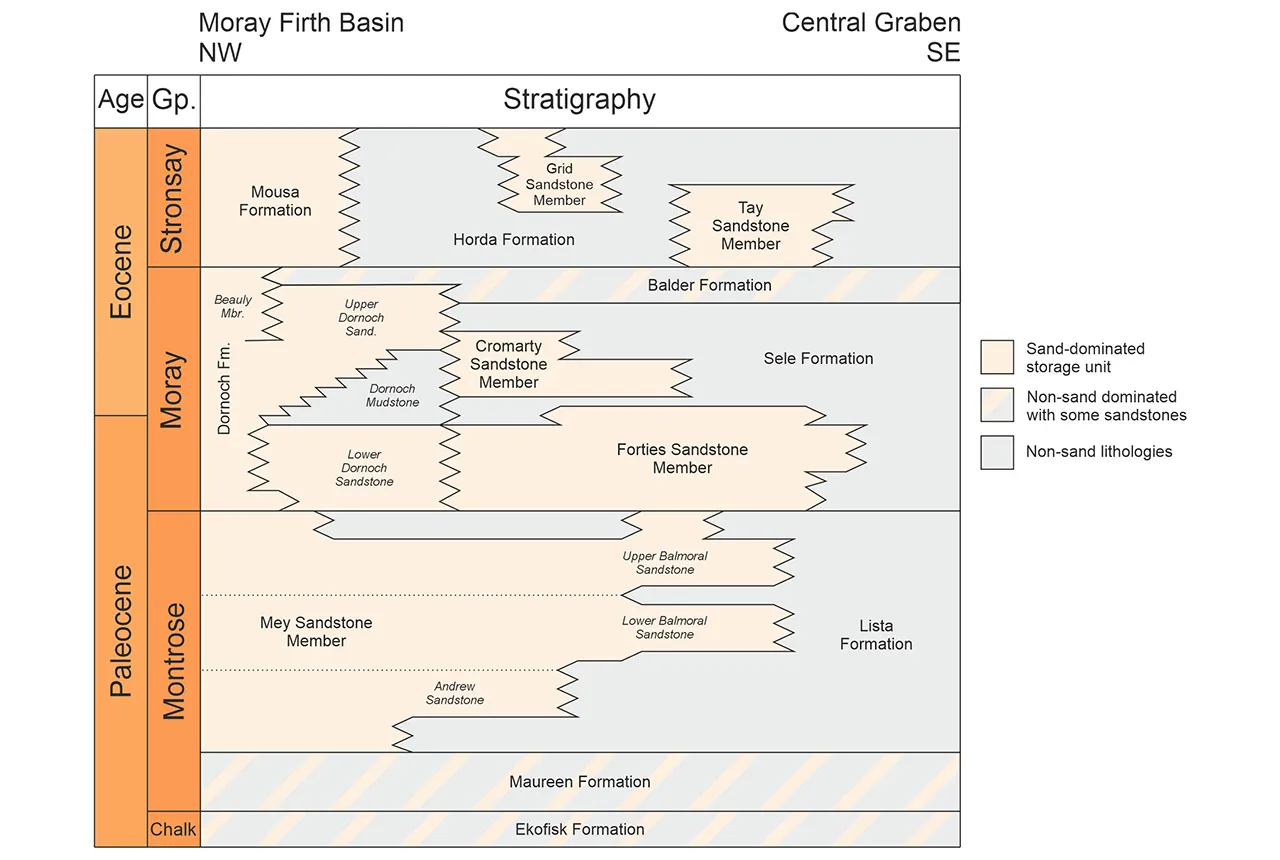
Representative geological section indicating the potential CO2 storage formations of Paleocene and Eocene age in the Central North Sea region, extending from the Moray Firth to the Central Graben. The image highlights the potential degree of lateral and vertical connectivity between different sandstone units. BGS © UKRI.

With relatively few licences currently issued in the Central North Sea, robust pre-competitive geological understanding is essential to realise the region’s storage potential. BGS geologists have therefore begun a comprehensive programme to better understand the Palaeogene storage system. This work will also help to address regulatory and operational challenges, particularly those related to pressure effects and interactions between disparate storage projects.
John Williams, senior geoscientist at BGS.
Decades of oil and gas exploration have generated a wealth of subsurface data, including drill core that is curated in BGS’s National Geological Repository. Drilling core is expensive, costing as much as £20 to 30 million for a single offshore borehole, so the ability to access pre-drilled material is invaluable, both in terms of avoided drilling costs and time saved. Alongside this archived material, BGS has also developed an integrated subsurface database and interpretations comprising existing 3D seismic and well data, and a stratigraphical framework to ensure accurate regional interpretation.
From the late 1990s to the early 2000s, BGS undertook pioneering work to evaluate the potential to reduce greenhouse gas emissions by storing CO₂ in rocks offshore UK, to help mitigate climate change and develop clean energy. This early work focused on the geological storage opportunities in the Southern North Sea and East Irish Sea regions.
Potential storage sites in these regions, first identified by BGS, are among the first to be licensed and permitted by the NSTA for CO₂ storage. For the UK to reach its ambition of storing 170 million tonnes of CO₂ a year by 2050, it will need to look beyond the current well-appraised geographical areas.
The stacked sandstones of the Central North Sea are relatively under-studied, with huge CO₂ storage potential. Our ambition is to assess and characterise the potential geological storage system in this region to enable future CO₂ storage in the UK, fast-tracking the nation’s CCS industry.
Michelle Bentham, chief scientist for decarbonisation and resource management at BGS.
BGS is seeking to establish partnerships to help unlock this nationally significant CO₂ storage resource, which could play a crucial role in the UK’s transition to a low-carbon future. Interested parties should contact John Williams via enquiries@bgs.ac.uk
Relative topics
Related news
Can sandstones under the North Sea unlock the UK’s carbon storage potential?
02/02/2026
For the UK to reach its ambitious target of storing 170 million tonnes of carbon dioxide per year by 2050, it will need to look beyond the current well-studied geographical areas.
Making research matter: BGS joins leading research organisations in new national initiative
10/12/2025
A new alliance of 35 organisations has been formed that is dedicated to advancing science for the benefit of people, communities, the economy and national priorities.
New funding awarded for UK geological storage research
21/11/2025
A project that aims to investigate the UK’s subsurface resource to support net zero has been awarded funding and is due to begin its research.
How the geology on our doorstep can help inform offshore infrastructure design
19/11/2025
BGS is part of a new collaboration using onshore field work to contextualise offshore data and update baseline geological models which can inform the sustainable use of marine resources.
Funding awarded for study on hydrogen storage potential in North Yorkshire
22/09/2025
A new study has been awarded funding to explore the potential for underground hydrogen storage near the Knapton power plant.
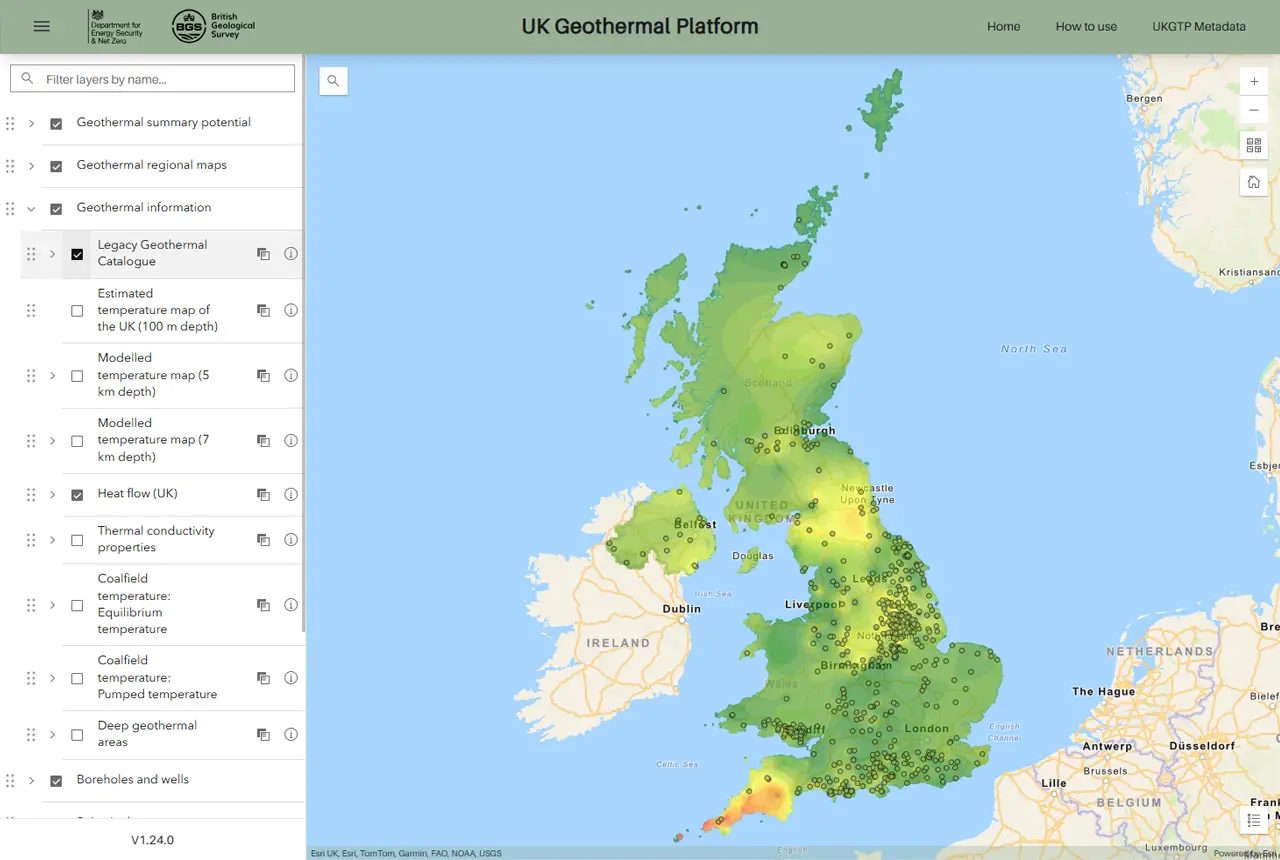
New platform highlights geothermal potential across the UK
11/08/2025
A new government-funded geothermal initiative, which includes an interactive map, has launched to help decision makers assess the geothermal potential across the UK.
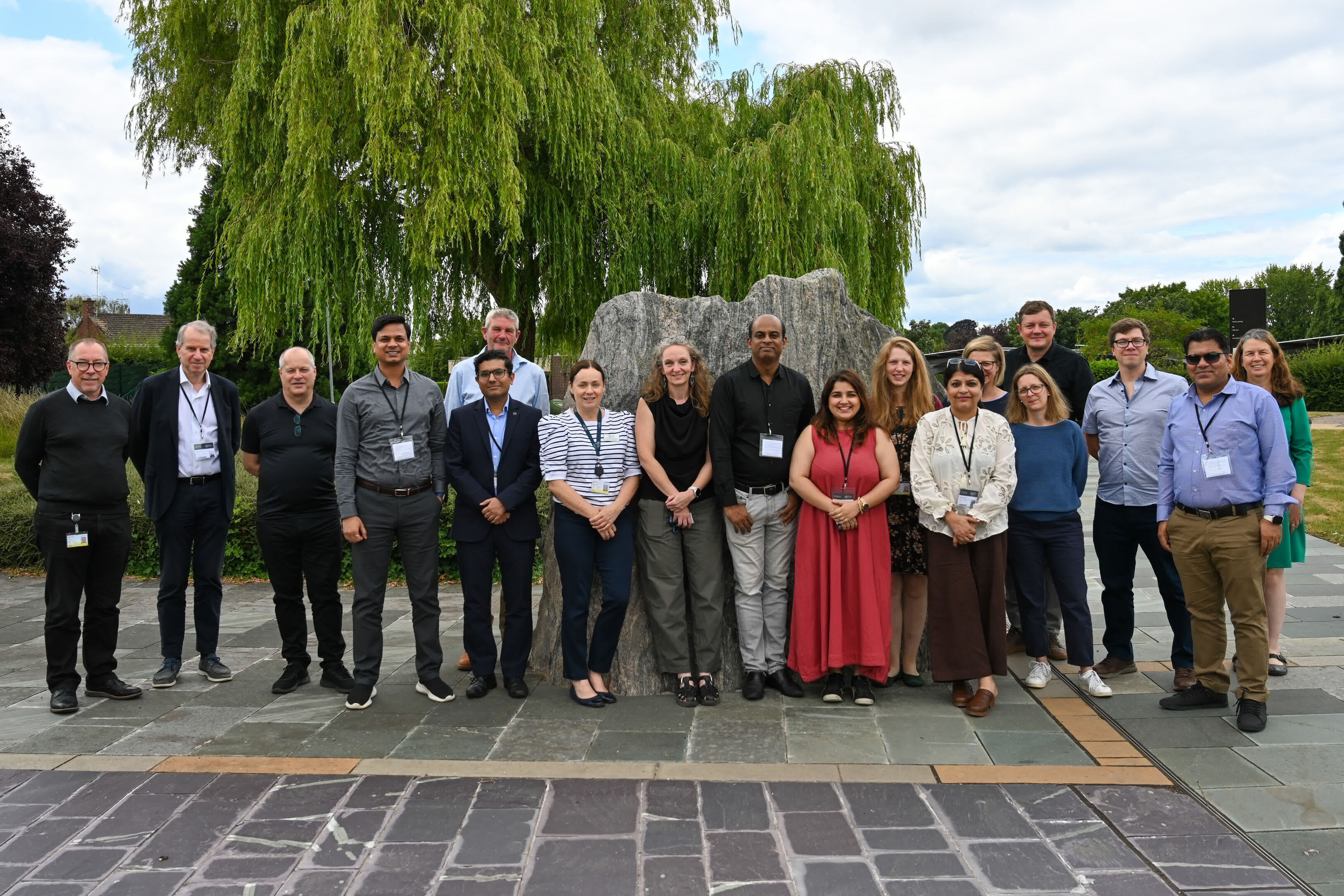
BGS hosts India for ‘deep dive’ on carbon capture and storage
30/07/2025
Some of India’s top scientists visited BGS to explore the UK’s carbon dioxide storage research potential.
Goldilocks zones: ‘geological super regions’ set to drive annual £40 billion investment in jobs and economic growth
10/06/2025
Eight UK regions identified as ‘just right’ in terms of geological conditions to drive the country’s net zero energy ambitions.
New interactive map viewer reveals growing capacity and rare earth element content of UK wind farms
16/05/2025
BGS’s new tool highlights the development of wind energy installations over time, along with their magnet and rare earth content.
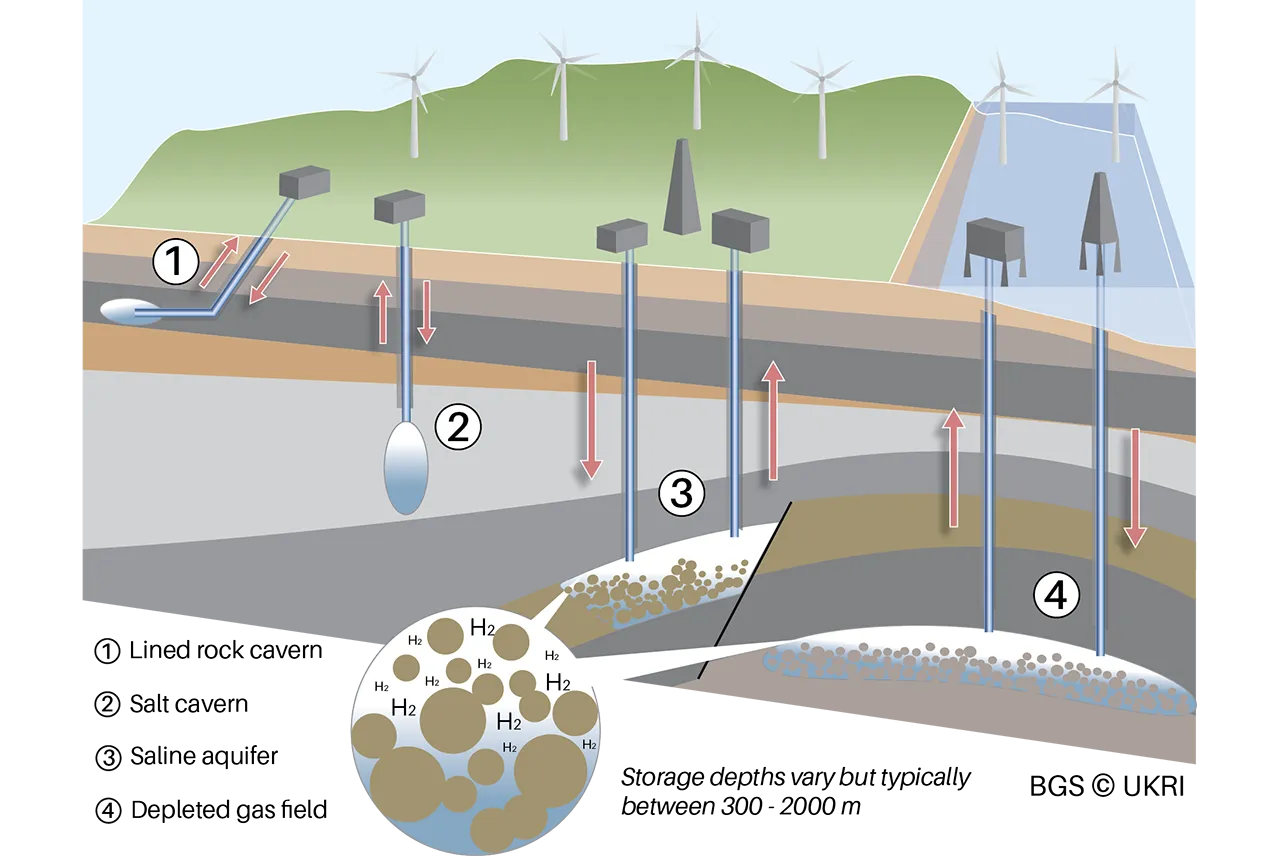
Making the case for underground hydrogen storage in the UK
03/04/2025
A new BGS science briefing note focuses on the potential of hydrogen storage to support the UK energy transition.

Exploring Scotland’s hidden energy potential with geology and geophysics: fieldwork in the Cairngorms
31/03/2025
BUFI student Innes Campbell discusses his research on Scotland’s radiothermal granites and how a fieldtrip with BGS helped further explore the subject.

Future projections for mineral demand highlight vulnerabilities in UK supply chain
13/03/2025
New Government-commissioned studies reveal that the UK may require as much as 40 per cent of the global lithium supply to meet anticipated demand by 2030.