

The BGS uses cutting-edge technology in Iceland to monitor how glaciers and their surrounding landscape change over time and how they respond to climate.
Glacier monitoring: the BGS observatory at Virkisjökull, Iceland
Between 2009 and 2018, we operated an observatory site at Virkisjökull in south-east Iceland, studying the evolution of the glacier (Icelandic: jökull) and the surrounding landscape and their responses to regional climate.
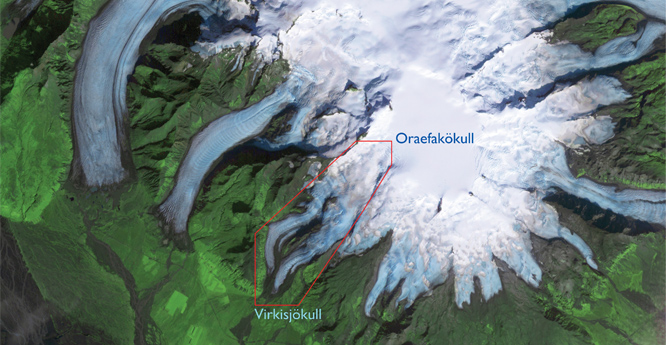

False-colour satellite image of the Öræfajökull ice cap, sitting on top and filling the crater of the Öræfi volcano. Several outlet glaciers drain radially from the crater, including Virkisjökull (outlined). Source: The ASTER L1B data product was retrieved from the online Data Pool, courtesy of the NASA Land Processes Distributed Active Archive Center (LP DAAC), USGS/Earth Resources Observation and Science (EROS) Center, Sioux Falls, South Dakota.
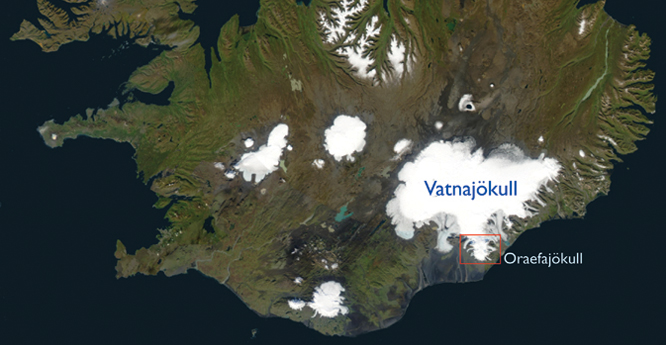
Satellite image of the location of the Vatnajökull and Öræfajökull ice caps in Iceland. Source: Vidiani.com
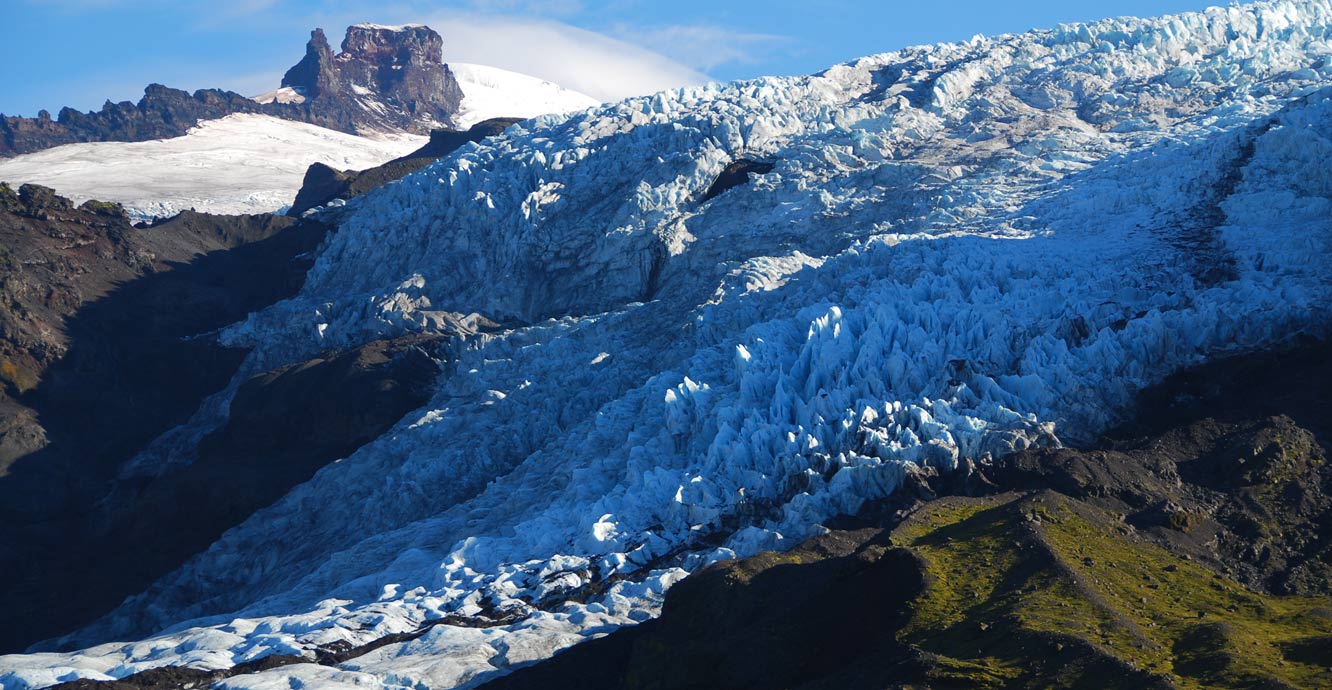
The icefall of Falljökull, part of Falljökull–Virkisjökull looking towards the summit of Öræfajökull in the background. Jez Everest, BGS © UKRI.
Sensors at the site operated continuously, collecting climate, hydrological, GPS and seismic data. Repeated high-resolution surveys showed how the glacier, its drainage and meltwater, the land surface and the deposits beneath are changing over time.
The observatory was groundbreaking and used cutting-edge technologies not applied in such a combination anywhere else in the world. Over the life of the project, these gave unique insights into the processes of landscape formation and the responses of glacial systems to changing climate.
Virkisjökull: a glacier in decline
Virkisjökull is retreating rapidly, like most glaciers in Iceland. Since 1996, the glacier margin has retreated over 1000 m and it appears that this rate has accelerated over the last ten years.
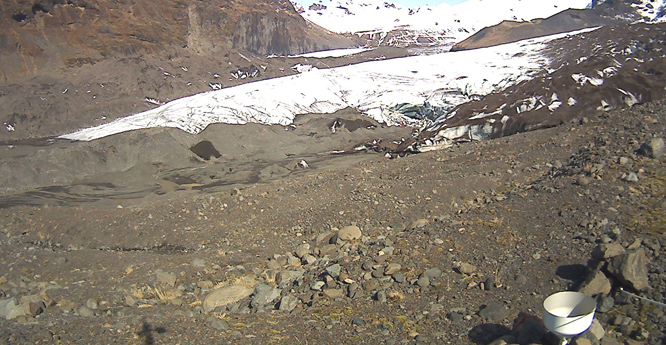
Image taken from the BGS’s Automated Weather Station 1 (AWS1) at the margin of Virkisjökull in 2011. The clean ice (white) and debris-covered (reddish-brown) parts of the glacier are clearly visible in the middle of the image and an ice cored, debris-covered esker (grey-brown) can be seen emerging from the clean ice margin and extending to the left of the image. BGS ©UKRI.
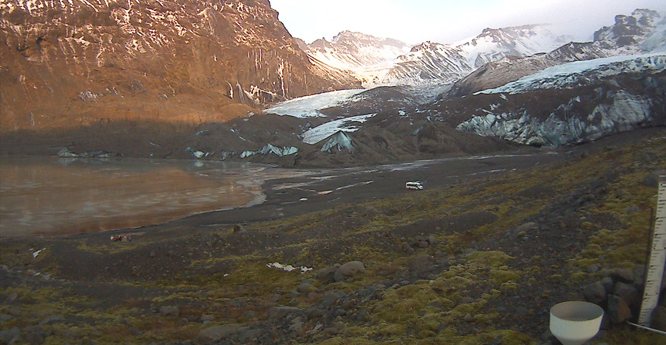
Image taken from AWS1 from the same location in 2019. The esker has melted into the proglacial lake, which formed between 2013 and 2019, and the glacier margin has retreated significantly. At the same time, the entire glacier has thinned, melting down vertically. BGS ©UKRI.
Why is this important?
Globally, glaciers and ice sheets help to regulate Earth’s climate.
- They are highly reflective, bouncing large amounts of solar energy back into space, keeping the Earth cooler.
- Melting glaciers and ice caps on land leads to meltwater flowing into the oceans, causing sea level rise.
- In many countries, including Iceland, glaciers are a major source of water for both domestic use and power generation.
- Melting glaciers can cause large-scale flooding, which affects roads and other infrastructure.
Observatory science
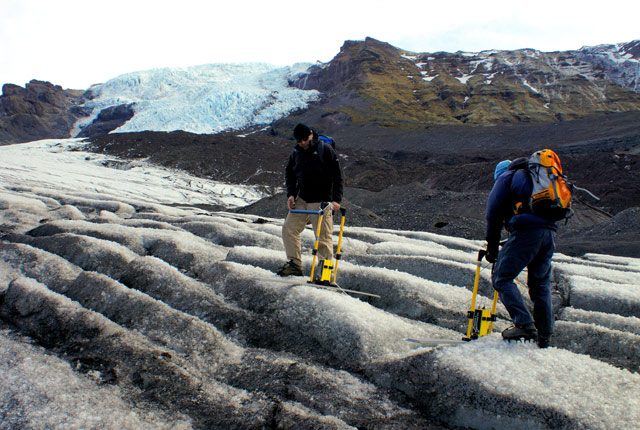
BGS scientists, along with researchers from the University of Dundee and the Icelandic Meteorological Office, gathered data through continuous monitoring, using automatic systems including weather stations, on-ice GPS, stream gauging and seismometers. Every year, this was supplemented with field surveying of land-surface change, measuring and sampling glacier and meltwater hydrology and hydrogeology, and investigating evolution of the shallow subsurface with ground penetrating radar.
Publications
Mackay J.D., Barrand, N.E., Hannah, D.M., Krause, S., Jackson, C.R., Everest, J., MacDonald, A. M., Ó Dochartaigh, B. É. (in press). Proglacial groundwater storage dynamics under climate change and glacier retreat. Hydrological Processes.
Finlayson, A., Everest, J., 2020. Ground Penetrating Radar Data from BGS Iceland Glacier Observatory Project, 2012-2014. British Geological Survey, Dataset,
Ó Dochartaigh B.É., MacDonald A.M., Black A.R., Everest J., Wilson P., Darling W.G., Jones L. & Raines M. 2019. Groundwater – meltwater interaction in proglacial aquifers amid rapid glacier retreat, Hydrology and Earth System Sciences., 23, 4527–4539, https://doi.org/10.5194/hess-23-4527-2019, 2019.
Mackay J.D., Barrand, N.E., Hannah, D.M., Krause, S., Jackson, C.R., Everest, J., Aðalgeirsdóttir, G., Black, A. 2019. Future evolution and uncertainty of river flow regime change in a deglaciating river basin. Hydrology and Earth System Sciences, 23 (4). 1833-1865. https://doi.org/10.5194/hess-23-1833-2019
MacDonald, A. M., Ó Dochartaigh, B. É., and Fallas, H. C.: Water chemistry and stable isotope data, Virkisjokull Glacier Observatory, 2011–2018, British Geological Survey, Dataset, https://doi.org/10.5285/14da9c02-c5ec-4019-8e5c-06c744d8be9d, 2019.
Mackay J.D., Barrand, N.E., Hannah, D.M., Krause, S., Jackson, C.R., Everest, J., Aðalgeirsdóttir, G. 2018. Glacio-hydrological melt and run-off modelling: application of a limits of acceptability framework for model comparison and selection. The Cryosphere, 12 (7). 2175-2210. https://doi.org/10.5194/tc-12-2175-2018
Everest, J., Bradwell, T., Jones, L. & Hughes, L. 2017. The geomorphology of Svínafellsjökull and Virkisjökull-Falljökull glacier forelands, southeast Iceland (1:10,000 Map and paper) Journal of Maps, 3:2, 936-945 https://doi.org/10.1080/17445647.2017.1407272
Krabbendam, M., Bradwell, T., Everest, J. & Eyles, N. 2017 Joint-bounded crescentic scars formed by subglacial clast-bed contact forces: implications for bedrock failure beneath glaciers. Geomorphology, 290, 114-127.
https://doi.org/10.1016/j.geomorph.2017.03.021
Flett, V., Maurice, L., Finlayson, A., Black, A.R., MacDonald, A.M., Everest, J. & Kirkbride, M.P. 2017. Meltwater flow through a rapidly deglaciating glacier and foreland catchment system: Virkisjökull, SE Iceland. Hydrology Research Feb 2017, nh2017205; DOI: 10.2166/nh.2017.205
MacDonald, A.M., Black, A.R., Ó Dochartaigh, B.É., Everest, J., Darling, W.G., Flett, V. and Peach, D.W. 2016. Using stable isotopes and continuous meltwater river monitoring to investigate the hydrology of a rapidly retreating Icelandic outlet glacier. Annals of Glaciology, 57(72), pp. 151–158. doi: 10.1017/aog.2016.22.
Phillips, E., A. Finlayson, T. Bradwell, J. Everest, and L. Jones (2014), Structural evolution triggers a dynamic reduction in active glacier length during rapid retreat: Evidence from Falljökull, SE Iceland, J. Geophys. Res. Earth Surf., 119, 2194–2208, doi:10.1002/2014JF003165.
Phillips, E., A. Finlayson, and L. Jones (2013), Fracturing, block faulting, and moulin development associated with progressive collapse and retreat of a maritime glacier: Falljökull, SE Iceland, J. Geophys. Res. Earth Surf., 118, 1545–1561, doi:10.1002/jgrf.20116.
Bradwell, T., Sigurðsson, O., & Everest, J. 2013. Recent, very rapid retreat of a temperate glacier in SE Iceland. Boreas, 42: 959–973. doi:10.1111/bor.12014
Everest, J. 2011 High-resolution monitoring of rapid glacier and foreland evolution: a multiple sensor observatory at Virkisjökull, southeast Iceland, INQUA, 2011, Berne,
Switzerland. Quaternary International, Volumes 279–280, 16 November 2012, Page 135, ISSN 1040-6182, http://dx.doi.org/10.1016/j.quaint.2012.08.070.
Mackay J.D., Barrand, N.E., Hannah, D.M., Krause, S., Jackson, C.R., Everest, J., Aðalgeirsdóttir, G. 2018. Signature-based decomposition of uncertainties in 21st century projections of a glacier-fed river flow regime. American Geophysical Union, Fall Meeting 2018, Washington D.C.Mackay J.D., Barrand, N.E., Hannah, D.M., Krause, S., Jackson, C.R., Everest, J., Aðalgeirsdóttir, G. 2018. Future evolution and uncertainty of river flow signatures in a deglaciating river basin. European Geophysical Union, April 2018, Vienna, Austria.
Everest, J; Bradwell, T; Finlayson, A; Jones, L; O’Dochartaigh, B; Hughes, L; Black, A; Flett, V; Phillips, E; Maurice, L; Raines, M; MacDonald, A; Bergsson, B; Ofeigsson,
- 2014 Detailed monitoring of rapid deglaciation: Virkisjökull-Falljökull catchment,
SE Iceland. Nordic Geological Winter Meeting, Lund Sweden (abstract volume p. 10) Link
Ó Dochartaigh, Brighid; MacDonald, Alan; Andrew Black; Everest, Jez; Wilson, Paul 2014.
Groundwater – meltwater coupling in an active proglacial sandur in SE Iceland
Nordic Geological Winter Meeting, Lund Sweden (abstract volume p. 10) Link
Finlayson, Andrew; Phillips, Emrys; Jones, Lee. 2014 Fracturing, block-faulting and moulin development associated with the retreat a maritime glacier: Falljökull, SE Iceland. Nordic Geological Winter Meeting, Lund Sweden (abstract volume p. 10) Link
Phillips, Emrys; Finlayson, Andrew; Tom, Bradwell; Jones, Lee; Everest, Jez. 2014 Glacier
Downsizing” – the structural response of a maritime glacier to a prolonged period of retreat: evidence from Falljökull, SE Iceland. Nordic Geological Winter Meeting, Lund Sweden (abstract volume p. 10) Link
Flett, Verity; Kirkbride, Martin; Black, Andrew; Everest, Jez; MacDonald, Alan. 2016 Glacier retreat and projected river regime changes in the hydrologically highlycoupled Virkisjökull catchment, Iceland. EGU. Link
O Dochartaigh, Brighid; MacDonald, Alan; Wilson, Paul; Black, Andrew; Everest, Jez. 2015
Groundwater – meltwater coupling in an active proglacial sandur aquifer in southeast
Iceland [Abstract only]. In: International Symposium on Hydrology of Glaciers and
Ice Sheets, Höfn in Hornafjörður, Iceland, 21–26 June 2015. (Unpublished) Link
Everest, J. Bradwell, T., Finlayson, AS., Jones, L., Pearson, S., Raines, M., Shanahan, T. 2012. Glacier retreat and ice-front evolution at Virkisjokull since 1990. Nordic Geological Winter Meeting, Reykjavik, 2012. (abstracts volume p.158) Link.
O Dochartaigh, B.E.; MacDonald, A.M.; Black, A.; Everest, J.; Wilson, P.; Darling, W.G.;
Raines, M.; Jones, L.. 2016 Groundwater : meltwater interaction in a proglacial
aquifer. [Poster] In: Rain, Rivers and Reservoirs, Edinburgh, UK, 27 – 29 September
- British Geological Survey. (Unpublished) Link Poster pdf
MacDonald, A.M.; Everest, J.D.; Black, A.R.; O Dochartaigh, B.E.O.; Bonsor, H.C.; Darling, W.G.; Gooddy, D.. 2012 Glacial meltwater and groundwater interactions : evidence from the Virkisjokull observatory in Iceland. [Poster] In: 39th IAH Congress, Niagara, Canada, 16-21 Sept 2012. (Unpublished) Link Poster pdf
Mackay J.D., Barrand, N.E., Hannah, D.M., Krause, S., Jackson, C.R., Everest, J., Aðalgeirsdóttir, G. 2018. Glacio-hydrological melt and runoff modelling: a limits of acceptability framework for model selection. European Geophysical Union, April 2018, Vienna, Austria.
O Dochartaigh, B.E.; MacDonald, A.M.; Wilson, P.R.; Bonsor, H.. 2012 Groundwater investigations at Virkisjokull, Iceland : data report 2012. Nottingham, UK, British Geological Survey, 48pp. BGS Open Report OR/12/088
Mcdonald, Alistair and Wynn, Peter and Tuffen, Hugh and James, Michael (2015) Geochemical signals of volcanic unrest at the Virkisjökull Glacier Iceland. Masters thesis, Lancaster University. Link Thesis pdf
Tomkins, Matt (2017) Tracking retreat processes at the Falljökull Glacier, SE Iceland.
Masters thesis. Lancaster University. Link Thesis pdf
Flett, V.T. 2016. Glacier retreat and projected river regime changes in the hydrologically highly-coupled Virkisjökull catchment, SE Iceland. Unpublished PhD Thesis, University of Dundee, Department of Geography
Contact
If you want to discover more then please contact Jeremy Everest.
Find out more about our glacier monitoring research
Observatory science
The BGS monitors glaciers and the landscape that surrounds them in a number of ways, such as boreholes, ground penetrating radar and hydrometric monitoring.
Glacier timelapse movies
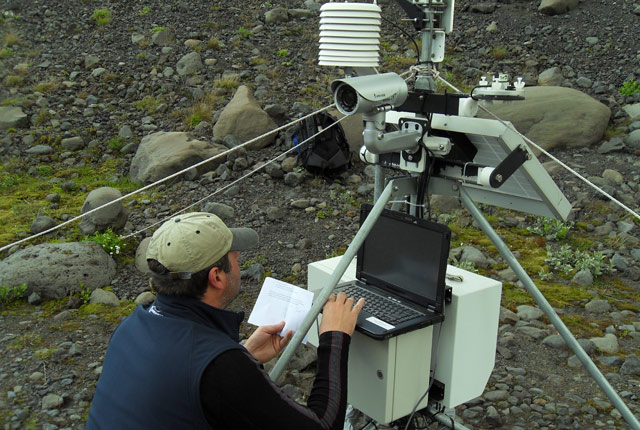
The BGS used robust security cameras to automatically take photos of the Virkisjökull glacier and send them back to scientists in Edinburgh.
Virkisjökull Glacier Observatory weather station data and daily images
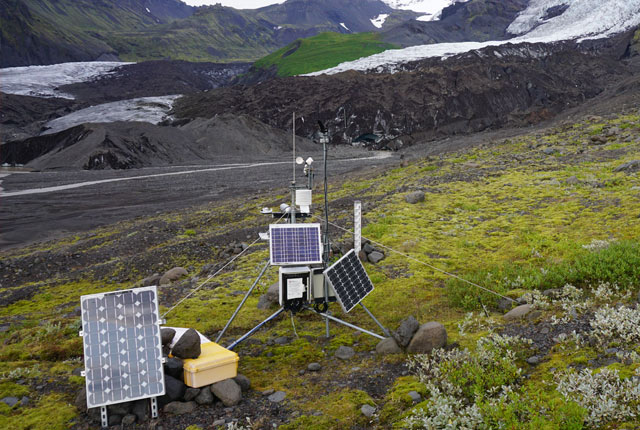
The BGS Virkisjökull Glacier Observatory operated three automated weather stations (AWS), positioned at different heights, around the glacier.
You may also be interested in
Impacts of climate change
Temperature rises can affect agriculture, sea levels and the frequency of extreme weather incidents. We can study past climate change by looking at the evidence in rocks, fossils and changes in the landscape.