

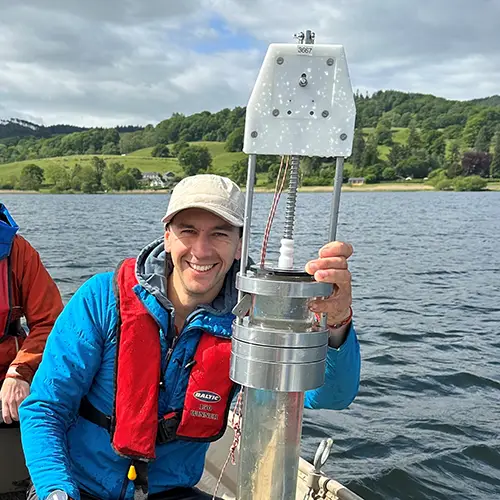
My research is focused on the use of stable isotopes as an analytical tool to address key issues in environmental and climate systems. Particular areas of specialty include 1) tracing nutrient (C, N, P) cycles and pollution in waters, 2) greenhouse gas source identification in waters and the atmosphere (CH4 and N2O), 3) palaeoclimate reconstruction using speleothem carbonates. I work with a range of partners in academia, industry and the public sector to deliver bespoke stable isotope solutions. I am a member of the NERC peer review college, the Envision doctoral training program management board and supervise NERC PhD students.
Andrew Smith’s biography
- 2015 to present: Stable Isotope Geochemist, British Geological Survey
- 2010 to 2014: PhD Environmental Science, Lancaster University
- 2007 to 2020: BSc. Lancaster University, First Class Hons.
Research interests
- Nutrient tracing
- Speleothem Climate Science
- NERC Environmental Isotope Facility – Stable isotope node of the NEIF facility
- Establishing a new palaeothermometer from the speleothem archive of phosphate-oxygen isotopes – NERC Exploring the frontiers of environmental research
Current projects and collaborations
- Project: Volcanic fertilisation of tropical forest biomes – PI for PhD studentship pioneering the use of PO4 isotope methods in identifying the impact of volcanism on lake systems
- Project: Establishing a new palaeothermometer from the speleothem archive of phosphate oxygen isotopes
- Project: British Cave Science Centre – PI for the British Cave Science Centre an open access cave research site in the UK
- Collaboration: Evaluating internal lake nutrient cycling under environmental pressure: A stable isotope perspective – Role of legacy nutrient release on lake degradation, project PI Savannah Worne Loughborough University (NERC IRF)
- Collaboration: Determining the existence of nocturnal foliar water uptake in the crop plant, Triticum aestivum, using 18O enriched water – Tracing night time water uptake into crop plants as a possible critical source of plant hydration, project PI Lorna McAusland University of Nottingham
- Collaboration: Understanding the formation of Borneo’s cave systems – Part of a national team looking into the role that bat and bird guano plays in ever expanding cave systems in Borneo
ORCID: 0000-0002-7658-6234
ORCID: 0000-0002-7658-6234
Published outputs
NERC Open Research Archive – Dr Andrew C Smith
Google Scholar
Research Gate
Key papers
- Bengt, C, Worne, S, Wynn, P, Prohaska, A, Sexton, T, and Smith, A C. 2026. Phosphate oxygen isotopes in lake sediments: stability and application for assessing palaeo nutrient dynamics. Biogeochemistry.
- Gooddy, D C, Tye, A M, Smith, A C, Chenery, S R, and Surridge, B J W. 2026. Deciphering phosphorus dynamics in impacted river systems using phosphate oxygen and lead isotope analysis, Applied Geochemistry, 203.
- McAusland, L, Smith, A C, and Murchie, E. 2025. Nocturnal foliar water uptake: an unexplored process in crops?, Journal of Experimental Botany, 77.
- Stuart, C E, Pittman, S J, Stamoulis, K A, Benkwitt, C E, Epstein, H E, Graham, N A J, Smith, A C, Lacey, J H, Bistolas, K S I, DeVore, J L, Ducatez, S, and Wedding, L M. 2025. Seascape configuration determines spatial patterns of seabird-vectored nutrient enrichment to coral reefs. Ecography, e07863.
- Farrant, A R, Koether, M J, Barton, H A, Lauritzen, S, Pennos, C, Smith, A C, White, J, McLeod, A, and Eavis, A J. 2025. Pervasive speleogenetic modification of cave passages by nitrification of biogenic ammonia. Geomorphology, 483.
- Smith, A C, and Lacey, J H. 2024) Tracing anthropogenic climate and environmental change using stable isotopes. Quaternary Science Reviews, 346.
- Smith, A C, et al. 2024. Identifying the controls on nitrate and metabolic state within the Red River delta (Vietnam) with the use of stable isotopes. Journal of Hydrology, 628.
- Prohaska, A, Seddon, A W R, Rach, O, Smith, A C, Sachse, D, and Willis, K J. 2023. Long‐term ecological responses of a lowland dipterocarp forest to climate changes and nutrient availability. New Phytologist, 240 (6).
- Smedley, P L, Bearcock, J M, Ward, R S, Crewdson, E, Bowes, M J, Darling, G W, and Smith, A C. 2023. Monitoring of methane in groundwater from the Vale of Pickering, UK: Temporal variability and source discrimination. Chemical Geology, 636.
- Karlović, I, Marković, T, Smith, A C, and Maldini, K. 2023. Impact of gravel pits on water quality in alluvial aquifers. Hydrology, 10.
- Wells, N S, Gooddy, D C, Reshid, M Y, Williams, P J, Smith, A C, and Eyre, B D. 2022. δ18O as a tracer of PO43− losses from agricultural landscapes. Journal of Environmental Management, 317.
- Smith, A C, Welsh, S, Atkinson, H, Harris, D and Leng, M J. 2021. A new automated method for high‐throughput carbon and hydrogen isotope analysis of gaseous and dissolved methane at atmospheric concentrations. Rapid Communications in Mass Spectrometry, 35 (11), e9086.
- Smith, A C, Pfahler, V, Tamburini, F, Blackwell, M S A, and Granger, S J. 2021. A review of phosphate oxygen isotope values in global bedrocks: characterising a critical endmember to the soil phosphorus system. Journal of Plant Nutrition and Soil Science, 184 (1), 25–34.
- Smith, A C, Wynn, P M, Barker, P A, Leng, M J, Noble, S R, and Tych, W. 2016. North Atlantic forcing of moisture delivery to Europe throughout the Holocene. Scientific Reports, 6, 24745
- Phosphate oxygen isotope analysis
- Dual carbon and hydrogen isotope analysis in methane
- Carbon isotope analysis in C1-C3 gases
- Nitrogen isotope analysis from nitrate and ammonia
- Methods and instrument development
Boards and committees
- 2026 to present: NERC peer review college member
- 2021 to present: Envision management board member
- 2026 to present: Member of the East Midlands Water steering group
- 2018 to present: PI British Cave Science Centre