

The BGS palaeontology and biostratigraphy collections are split between Keyworth and Edinburgh, with the former holding most of the English and Welsh material, and the latter the majority of the Scottish material. Most of the type, figured and cited material is stored centrally at Keyworth.
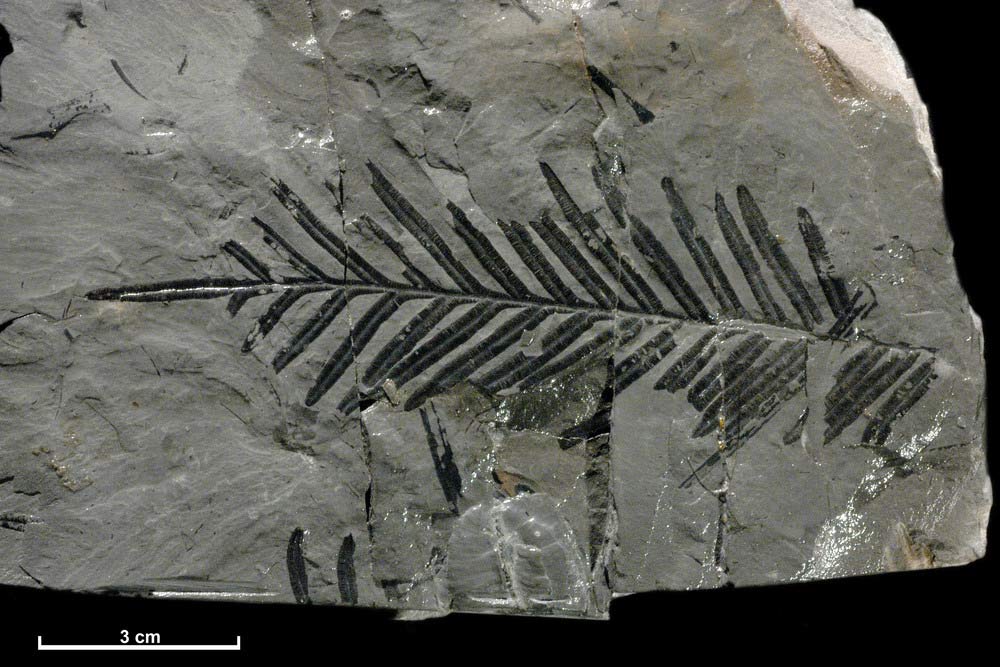

A fossil specimen of Alethopteris lonchitica (Schlotheim) from the BGS Biostratigraphy Collection (UK.BGS.GSE4736). BGS © UKRI.
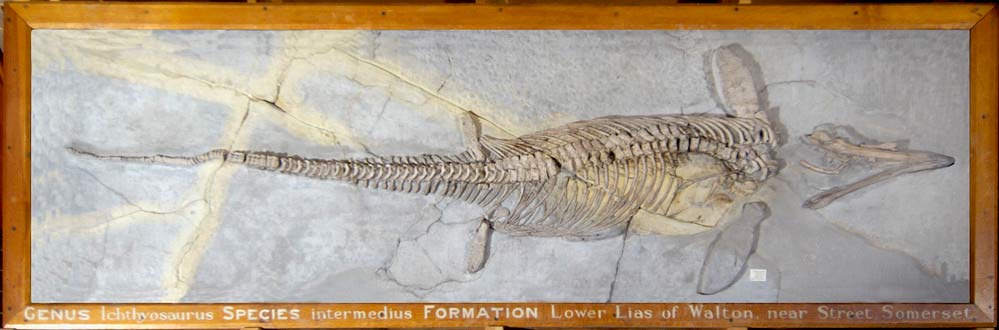
A fossil of Ichthyosaurus intermedius from the BGS Biostratigraphy Museum. BGS © UKRI.
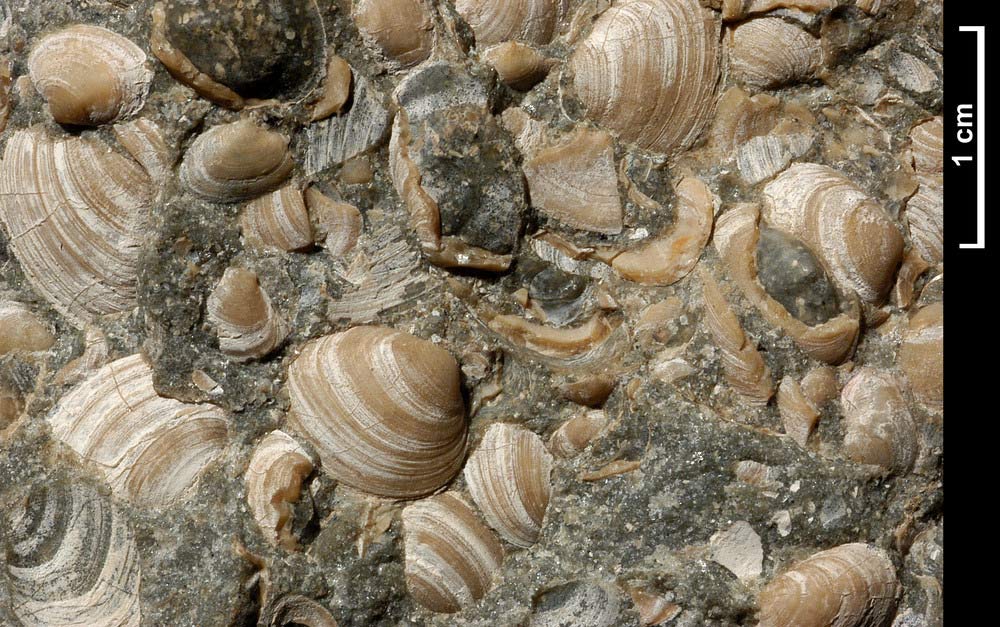
Fossilised Protomiodon spp. bivalves from the BGS Stratigraphy Collection (UK.BGS.GSE5438). BGS © UKRI.
The collections
- Type and Stratigraphic Collection: all type, figured and cited macrofossils, plus other museum-quality material selected for its stratigraphical importance. There are over 250 000 specimens in Keyworth and about 5000 in Edinburgh. They are a useful starting point for many palaeontological studies.
- Survey Collection: material collected by survey officers for biostratigraphical study. There are about 1.25 million specimens in Keyworth and 400 000 in Edinburgh.
- Micropalaeontology Collection: includes type, figured and cited material. There are about 240 000 slides in Keyworth and 6450 in Edinburgh.
- Donated collections, including the important John Smith Collection in Edinburgh.
- Catalogue of the BGS ‘Purbeck’ and ‘Wealden’ ostracod collection: specimens are available for study at either Keyworth or Edinburgh and a loan system is available to accredited scientists.
- Murchison’s Silurian Fossils: a supplement to the 1989 catalogue of fossils illustrated in The Silurian System.
The Biostratigraphy Museum contains approximately 250 000 selected fossil specimens, including much type, figured and cited material. Initial enquiries should be made to:
The Edinburgh Biostratigraphy Collection is housed in an environmentally monitored fossil store that is close to a fully equipped palaeontology laboratory.
The biostratigraphical material is almost exclusively derived from exposures and boreholes in Scotland. It comprises three main collections:
- Survey Collection: about 430 000 registered specimens (including 30 000 specimens donated by the late John Smith)
- Type and Stratigraphical Collection: about 16 000 registered specimens (about 11 000 of which now reside at Keyworth)
- Palaeontological Slides Collection: about 6500 registered micropalaeontological slides and fossil thin sections.
There are several digital datasets associated with the Murchison House Biostratigraphical Collection.
The Survey Collection, which has been in existence since 1869, is stored in mobile racks with trays ordered by locality and registration number.
The Type and Stratigraphical Collection, which is very largely derived from the Survey Collection and comprises taxonomic types and generally well-preserved comparative material, is stored chronostratigraphically and taxonomically in six cabinets in a museum area within the fossil store.
The Palaeontological Slides Collection, which includes donations from eminent workers such as Garwood, Lee, Clough and Smith, is stored in a wooden cabinet in the museum area, the trays being ordered by registration number.
Whilst the collections were developed primarily for BGS use, application for a loan may be requested by anyone. The materials can be studied in the Palaeontology Laboratory where bench space, a binocular microscope, scientific literature and records, and a conservation facility are available. Please contact the Edinburgh collections manager.
The GB3D type fossils online project aims to develop a single database of the type specimens held in British collections of macrofossil species and subspecies found in the UK, including a selection of 3D digital models.
Specimens’ registration numbers consist of a prefix (usually one or more letters), a sequential number (usually within the range 1—9999) and occasionally a suffix. Note that the use of a suffix is mostly restricted to Scottish material and that, for example, T123a and T123b are not part of specimen T123, but completely different and unrelated samples. Some prefix codes indicate individual collectors and others indicate major archival collections. Prime specimens may have both a collector’s number and an archival number.
Significant prefixes
| Prefix | Description |
| GSE | Museum reference collection, Edinburgh (now mostly held at Keyworth) |
| GSL | Museum reference collection, Leeds (now held at Keyworth) |
| GSM | Museum reference collection (Keyworth) |
| 1EE–20EE | Scottish general collections (Edinburgh) |
| Geol Soc Coll | Geological Society of London Collection — British material donated to the BGS in 1911. |
| GSa–Gsd | Geological Society of London Collection — British material donated to the BGS in 1911. |
| Mik, Mil | Microfossils (Keyworth) |
| MPA | Microfossils (Keyworth) |
| Mic | Microfossils (Edinburgh) |
| MPK | Micropalaeontological type, figured and cited collection (Keyworth) |
| B, Ba–Bz, | Borehole collection (Keyworth) |
| BDA–BDZ | Borehole collection (Keyworth) |
| BKA–BKK | Borehole collection (Keyworth) |
| BLA–BLM | Former Leeds Borehole Collection (Keyworth) |
| LZA–LZB | Donations (Keyworth) |
| SAA–SAZ | Microfossils (Keyworth) |
Search the BGS PalaeoSaurus collections database
Get in touch
For general NGR enquiries or to arrange a visit, please contact:
enquiries@bgs.ac.uk or 0115 936 3143
You may also be interested in

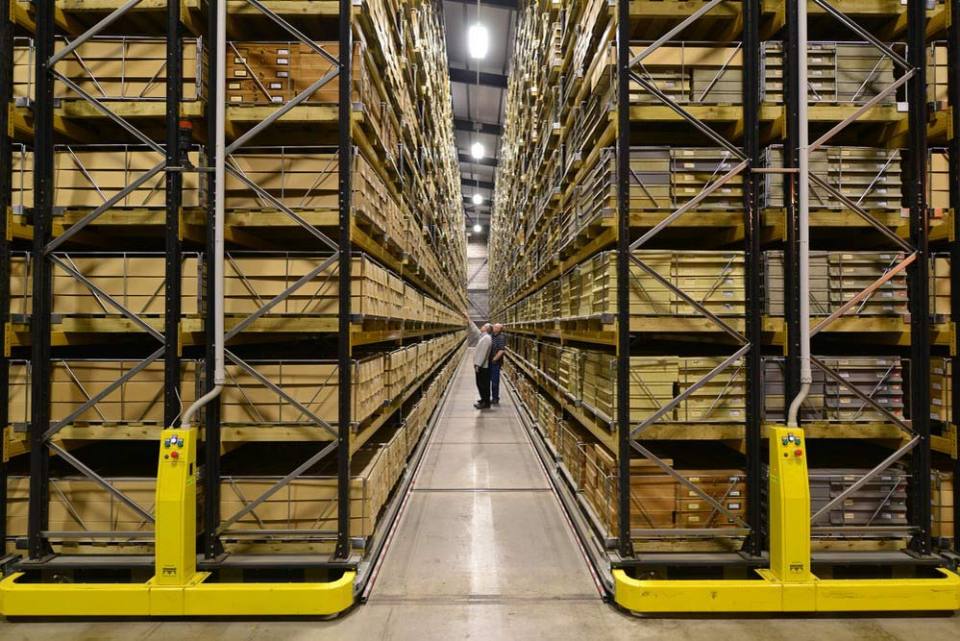
National Geological Repository
Hosting BGS’s collections of borehole cores, cuttings, samples, specimens, and related subsurface information from the UK landmass and continental shelf.