
The National Geological Repository (NGR) holds the UK’s largest collection of geological materials. This includes 600km of geological core and over 16 million specimens, including 3 million fossils.
Responsible management of the collection, to ensure it continues to be a resource for public, industry and academia is our priority. New materials of scientific and commercial importance are added to the collection on a regular basis, and maintaining capacity within the repository for the national good is an ongoing consideration.
The rationalisation of our existing collections is an important part of this process and at times it is necessary to deaccession materials and formally remove it from the national collection.
In situations where materials are identified for deaccessioning, efforts will be made to relocate material. Preference in such re-distribution lies with organisations where academic, scientific or educational benefit is clearly identifiable, before the materials are offered more widely. This is in line with existing legal and ethical guidelines, such as the Museums Association toolkit for ethical transfer, reuse and disposal.
BGS is currently examining deaccessioning for cases where there is a surplus of materials from a particular formation or location, or where condition limits scientific value.
Materials currently available
Rookhope core halves
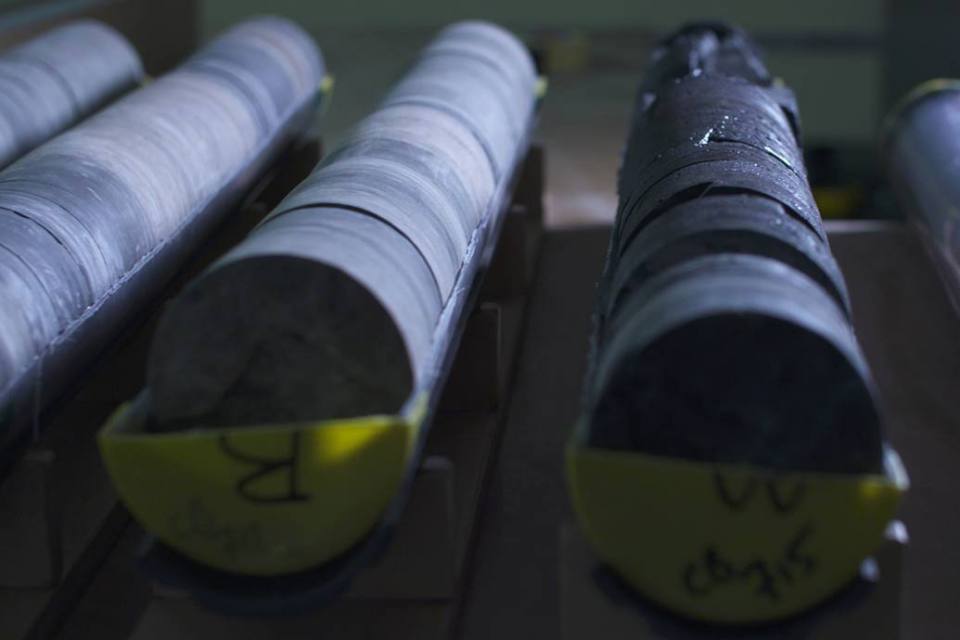
BGS have taken the decision to slab the core held in the NGR from the Rookhope borehole. The core consists of sections with diameters of 8, 7 and 6 inches (203, 177 and 152 mm respectively) and is exceptionally heavy, with individual sections weighing up to c.70 kg. Slabbing will significantly improve the safe handling and accessibility of the material, and ease of study, without compromising its scientific value.
The Rookhope borehole is approximately 800 m deep and was drilled in 1960–61 in the North Pennines. It is one of the most important research boreholes in the UK. Funded by government, its primary objective was to prove the existence of the Weardale Granite. Data derived from the borehole led to a fundamental re‑evaluation of mineralisation models in the Northern Pennines, with international implications for deposits classified as Mississippi Valley Type.
Earlier work by Kingsley Dunham (a Director of the British Geological Survey between 1967–1975) demonstrated concentric mineral zonation across the North Pennines, from fluorite through galena to barium minerals. By analogy with the Cornubian mineral field, this led to the hypothesis of a mineralising granite at depth. Subsequent gravity studies by M. H. P. Bott and colleagues indicated the presence of a concealed granite at approximately 2,000 ft (610 m).
The borehole intersected the granite at 1,281 ft (390 m); however, rather than an intrusive contact with the Carboniferous sediments, a strongly weathered unconformity was encountered. Interpretative models have since evolved, including hypotheses involving elevated heat flow from the granite driving groundwater circulation, and more recent work (e.g. Dempsey et al., 2021) linking mineralisation to magmatic activity associated with the intrusion of the Whin Sill (c. 297–294 Ma).
The Rookhope material, together with the associated data and research outputs, continues to underpin our understanding of mineralisation processes associated with igneous bodies and has also contributed to assessments of the UK’s geothermal potential.
Register your interest in these materials*
A list of material from the Rookhope is available via the BGS borehole materials search and the borehole log is available via the BGS Onshore Geoindex
The surplus core halves will be made available to external organisations such as museums and universities. If you or your organisation is interested in this material, please complete this form.
*Please note that the core halves will still be heavy c.35 kg per meter. In addition, BGS cannot cover or contribute to the cost of transporting material, though we are able to assist with the loading of vans or lorries. BGS will consider requests for material until 02-Oct-2026
Bott, M. H. P. (1967). “Geophysical investigations of the Northern Pennine basement rocks.” Proceedings of the Yorkshire Geological Society 36(2): 139–168. https://doi.org/10.1144/pygs.36.2.139
Dempsey, E D, Holdsworth, R E, Selby, D, Bird, A, Young, B & Le Cornu, C. 2021. A revised age, structural model and origin for the North Pennine Orefield in the Alston Block, northern England: intrusion (Whin Sill)-related base metal (Cu–Pb–Zn–F) mineralization. Journal of the Geological Society of London, 178 (4): 202-206. https://doi.org/10.1144/jgs2020-226
Downing, R A, and Gray, D A. 1986. Geothermal energy: the potential in the United Kingdom. (London: HMSO for the British Geological Survey.) https://nora.nerc.ac.uk/id/eprint/537257
Dunham, K.C. 1934. The genesis of the north Pennine ore deposits. Quarterly Journal of the Geological Society of London 90: 689 – 720. https://doi.org/10.1144/GSL.JGS.1934.090.01-04.23
Dunham, K. C., et al. (1965). “Granite beneath Viséan sediments with mineralization at Rookhope, northern Pennines.” Quarterly Journal of the Geological Society of London 121(1-4): 383–414. https://doi.org/10.1144/gsjgs.121.1.0383
(1965). “Discussion.” Quarterly Journal of the Geological Society of London 121(1-4): 414–417. https://doi.org/10.1144/gsjgs.121.1.0414
Join our mailing list
Would you like to be notified when deaccessioned geological materials become available? If so please join our mailing list.
You may also be interested in
Accessing the NGR material collections
Rates and conditions for accessing our borehole and well core sample collections.
Borehole core collections
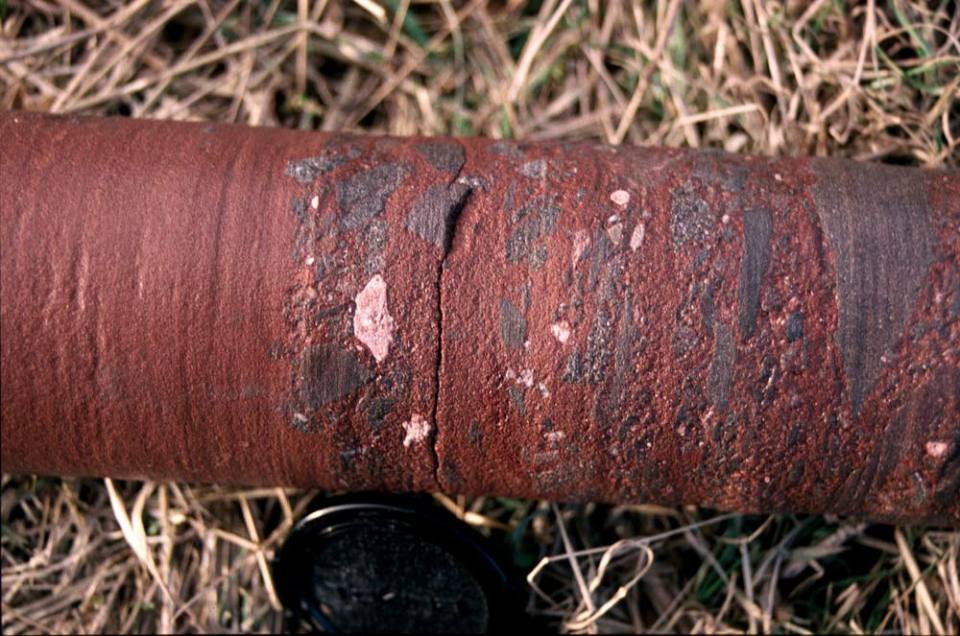
The BGS collections include continuous borehole core, broken core, cuttings and hydrogeological core and borehole material.