

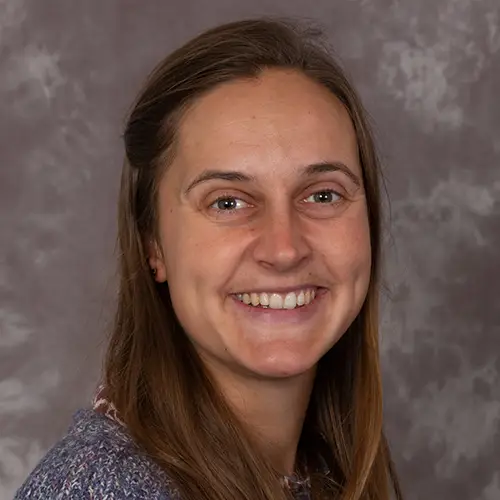
I am a marine geoscientist interested in sediment dynamics, geomorphology, and organic carbon fluxes. My current research focuses on subaqueous mass movement geohazards in UK waters, the role of marine and freshwater sediments in the organic carbon cycle, and sediment dynamics in estuarine environments. I utilise a range of approaches to address research questions on these topics, including geological mapping of the seabed, sedimentological and geochemical analysis of sedimentary deposits, and oceanographic observations. I have strong skills in marine science data collection and analysis, gained through multiple research cruises, geological fieldwork, and laboratory flume experiments.
Prior to joining BGS, I used field measurements to directly measure underwater landslides and underwater avalanches of sediment called turbidity currents. My research focused on understanding the flow dynamics of these events and their role in transporting and burying organic carbon.
Megan Baker’s biography
- 2025 to present: Marine geoscientist, British Geological Survey
- 2022 to 2025: Independent Research Fellow, Durham University
- 2019 to 2022: Postdoctoral Research Associate, Durham University
- 2015 to 2019: PhD Oceanography, Bangor University
- 2014 to 2015: MSc Applied Marine Geoscience, Bangor University
Research interests
- Using process-based sedimentology to understand sediment dynamics and geomorphology
- The role of marine and freshwater sedimentary environments in organic carbon transport and burial
- Assessing marine geohazards to offshore infrastructure
- Investigating subaqueous mass movements to determine their triggers, flow dynamics, and deposits
- Erosion, transport, and deposition of fine-grained cohesive sediment
- Utilising geophysical monitoring techniques (e.g. passive seismic monitoring) to study sediment transport processes
- Quaternary history and glacial processes on NW European Shelf
ORCID: 0000-0002-8003-3587
Key papers
- Baker, M L, Talling, P J, Burnett, R, Pope, E L, Ruffell, S C, Urlaub, M, Clare, M A, Neasham, J, Dietze, M, Jenkins, J, Silva Jacinto, R, Heijnen, M S, Hage, S, Simmons, S M, Hasenhündl, M, Heerema, C J, Mcghee, Cartigny, M J B, Parsons, and Peirce, C. 2024. Seabed seismometers reveal duration and structure of longest runout sediment flows on Earth. Geophysical Research Letters, 51(23), e2024GL111078
- Baker, M L, Hage, S, Talling, P J, Acikalin, S, Hilton, B, Ruffell, S C, Pope, E L, Silva Jacinto, R, and Clare, M A. 2024. Globally Significant Mass of Terrestrial Organic Carbon Efficiently Transported by Canyon-Flushing Turbidity Currents. Geology, 52(8), 631–636
- Bricheno, L, Yeo, I, Clare, M, Hunt, J, Griffiths, A, Carter, L, Talling, P J, Baker, M L, Wilson, S, West, M, and Panuve, S. 2024. The diversity, frequency and severity of natural hazard impacts on subsea telecommunications networks. Earth-Science Reviews, p.104972
- Hage, S, Baker, M L, Babonneau, N, Soulet, G, Dennielou, B, Silva Jacinto, R, Hilton, B, Galy, V, Baudin, F, Rabouille, C, Vic, C, Sahin, S, Açikalin, S, and Talling, P J. 2024. How is particulate organic carbon transported through the river-fed Congo Submarine Canyon to the deep-sea? Biogeosciences, 21(19), 4251–4272
- Talling, P J, Hage, S, Baker, M L, Bianchi, T S, Hilton, R G, and Maier, K L. 2023. The global turbidity current pump and its implications for organic carbon cycling. Annual Review of Marine Science, 16
- Talling, P J, Baker, M L, Pope, E L, Ruffell, S C, Silva Jacinto, R, Heijnen, M S, Hage, S, Simmons, S M, Hasenhündl, M, Heerema, C J, Mcghee, C, Apprioual, R, Ferrant, A, Cartigny, M J B, Parsons, D R, Clare, M A, Tshimanga, R M, Trigg, M A, Cula, C A, Faria R, Gaillot, A, Bola, G, Wallance, D, Giffiths, A, Nunny, R, Urlaub, M, Peirce, C, Burnett, R, Neasham, J, and Hilton, R J. 2022. Longest sediment flows yet measured show how major rivers connect efficiently to deep sea. Nature Communications 13, 4193
- Baker, M L, and Baas, J H. 2020. Mixed sand–mud bedforms produced by transient turbulent flows in the fringe of submarine fans: Indicators of flow transformation. Sedimentology, 67, 2645–2671
- Baas, J H, Baker, M L, Malarkey, J, Bass, S J, Manning, A J, Hope, J A, Lichtman, I D, Ye, L, Davies, A G, Parsons, D R, Paterson, D M, Peakall, J, and Thorne, P D. 2019. Integrating field and laboratory approaches for ripple development in mixed sand–clay–EPS. Sedimentology. 66, 2749–2768
- Baker, M L, Baas, J H, Malarkey, J, Jacinto, R S, Craig, M J, Kane, I A, and Barker, S. 2017. The effect of clay type on the properties of cohesive sediment gravity flows and their deposits. Journal of Sedimentary Research, 87, 1176–1195
Chapters
- Clare, M A, Lintern, G, Pope, E, Baker, M L, Ruffell, S, Zulkifli, M Z., Simmons, S, Urlaub, M, Belal, M, and Talling, P J. 2024. Seismic and Acoustic Monitoring of Submarine Landslides: Ongoing Challenges, Recent Successes, and Future Opportunities. Noisy Oceans: Monitoring Seismic and Acoustic Signals in the Marine Environment, 59–82
- Marine geophysical data acquisition, processing, and interpretation
- Sediment core description and interpretation
- Organic carbon geochemical analysis
- Laboratory flume experiments
- Associate Editor for Journal of Sedimentary Research
- Member of the Editorial Board for Ocean Challenge, Challenger Society publication