

BGS GeoSchool offers a wide-ranging programme of both field and classroom-based, professional-development training courses. Contact our learning and development coordinator for course fees, scheduling and availability.
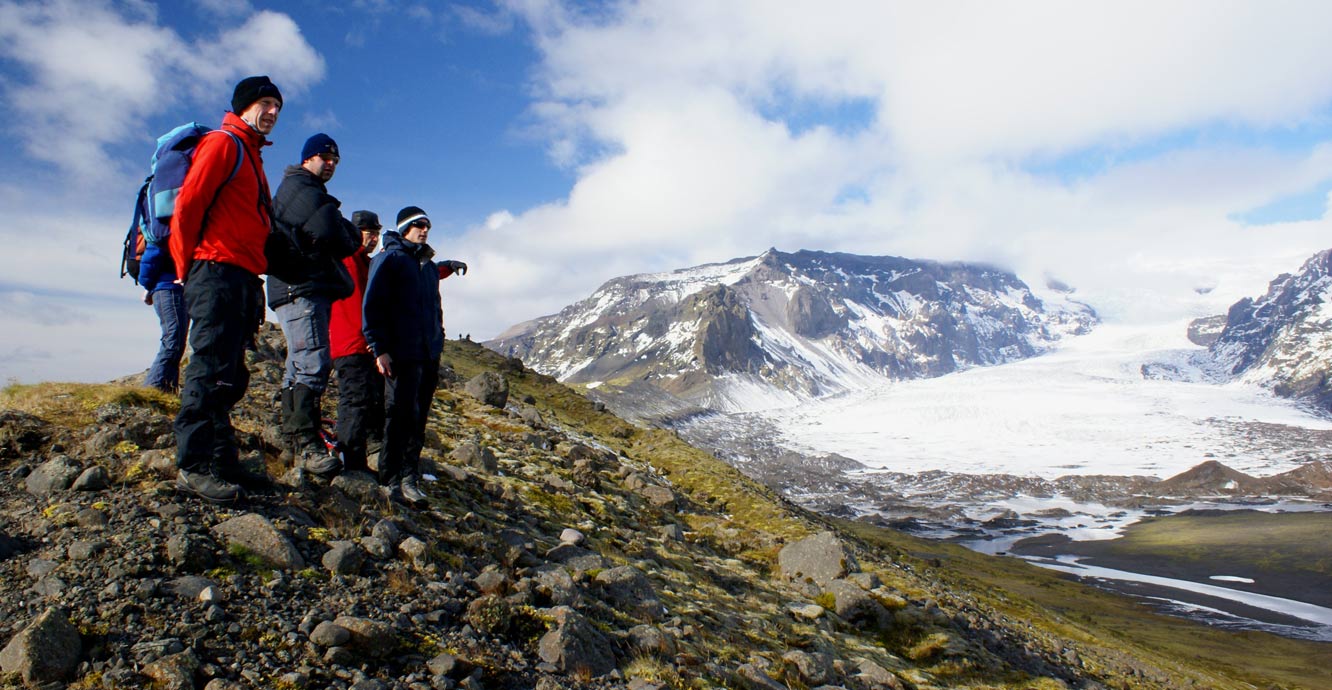

BGS staff on a training course in south-east Iceland, discussing ice-marginal deposition at Kviarjökull. BGS © UKRI.
Training catalogue
Description and classification of rocks and soils for engineering purposes
This introductory course provides an understanding of how earth materials are described and classified for engineering purposes. It is based on the recently revised BS5930:1999 — Code of Practice for Site Investigation.
Introduction to groundwater
This introductory course provides an overview of the main concepts of groundwater occurrence and flow.
Introduction to hydrogeology
Provides participants with a grounding in the principles of hydrogeology and the skills to make sound hydrogeological decisions, including when to call in a specialist hydrogeologist.
Introduction to physical hydrogeology
This course provides an introduction to the theory and practice of physical hydrogeology. The course is aimed principally at those involved in the geosciences and related disciplines with little or no previous experience of groundwater.
Introduction to GeoVisionary
Aimed at geoscientists, environmental scientists and engineers who need to learn how to use the GeoVisionary 3D visualisation package for virtual field reconnaissance.
Introduction to GoCAD
Provides geoscientists with an introduction to the GoCAD 3D geological modelling software.
Introduction to groundwater modelling
Provides hydrogeologists and groundwater professionals with an introduction to all aspects of groundwater flow modelling, from recharge modelling and the creation of a water balance through to setting up and running a groundwater flow model.
Modelling with ZOOM
Suitable for hydrogeologists and modellers wishing to gain an understanding of groundwater systems through the application of the ZOOM suite of object-oriented modelling software.
Biostratigraphy for non-biostratigraphers
The course provides an understanding of biostratigraphy principles, how to use the data, available tools and integration with other disciplines. It is suitable for geoscientists, post graduate students and management.
Core description workshops
Provides geoscientists with the skills to describe and interpret core material obtained from boreholes and hydrocarbon wells.
Extensional tectonics in the field: Utah and Nevada
The course will equip participants with a three-dimensional understanding of the principles and geometries involved, allowing them to make rigorous, three-dimensionally sound, geological interpretations in areas of limited data and from spatially limited, remotely sensed datasets such as seismic sections, satellite imagery and air photographs.
Glacial sediments and glaciogenic reservoirs
Observe, describe, interpret and classify processes and products in a modern terrestrial glacial environment. This is a nine-day, fully residential course based in south-east Iceland within walking distance of Vatnajokull, Europe’s largest glacier!
Introduction to carbon capture and storage (CCS)
This course is recommended for consultancies, regulators, power and energy companies with an interest in the geological aspects of carbon capture and storage (CCS).
Introduction to petroleum data management
Provides participants with an understanding of management issues pertinent to the main types of data utilised in petroleum geoscience.
Introduction to sequence stratigraphy in the field: Utah
This course will enable participants to develop an understanding and appreciation of the role of sedimentology studies in building genetic sequence stratigraphic models and defining parasequences.
Seismic reflection interpretation
Suitable for geologists who wish or need to become acquainted with the seismic reflection method.
Specialist training for biostratigraphers
Suitable for biostratigraphers who need focused training in unfamiliar fossil groups in order to undertake new projects and assignments. Training on a variety of fossil groups within the expertise of BGS biostratigraphy is available.
Tectono-sedimentary architecture and modelling applied to exploration, carbon sequestration and fluid flow
Enables geoscientists to understand the relationship between facies development, tectonic control, fluid flow, fluid flow barriers, fault development and linkage.
Training in non-acid palynological preparation techniques
This course disseminates information on palynology samples and preparation techniques that avoid the use of acids.
Geological field surveying
Designed for geoscientists needing to gain a practical understanding of the principles of geological feature mapping in the field.
Geological mapping in deformed terrains: foundation skills
This course is aimed at both student and professional geologists who are expected to work, or anticipate working, in regions where polyphase deformation and metamorphism have affected mainly metasedimentary sequences.
Quaternary field mapping: lowland Britain
This course is suitable for student geologists, professional geologists, environmental scientists and geoengineers who need to gain understanding of Quaternary mapping techniques.
Quaternary field mapping: upland Britain
This field course is suitable for student geologists, professional geologists, environmental scientists and geoengineers wishing to gain a greater understanding of upland Quaternary deposits and the techniques used to map them.
Introduction to photogeology and remote sensing
This course introduces participants to concepts and geological applications in remote sensing with an emphasis on aerial photography, although other airborne and satellite imagery are also included.
Photogeology and SOCET
This course provides a practical introduction to geomorphological interpretation, primarily using UK examples.
Satellite image interpretation
The course introduces participants to concepts and geological applications in remote sensing, with an emphasis on satellite imagery.
Geostatistics
Provides geoscientists with a knowledge of how geostatistics can help with the analysis and interpretation of spatially distributed scientific data.
Statistics for geoscientists: basic
Suitable for geoscientists who routinely work on the interpretation of dataset and wish to gain a basic knowledge of statistics or who would like to refresh their knowledge in this area.
Sampling design and interpretation of sampled data
This course covers the principles and pitfalls of designing sampling programmes and interpreting sampled data.
Contact
Contact BGS Learning and Development for course fees, scheduling, and availability:
Learning and Development Coordinator
British Geological Survey
Keyworth
Nottingham
NG12 5GG
UK
E-mail: BGS Learning and Development
Telephone: 0115 936 3185
Fax: 0115 936 3064
Find out more about our work
Our data and services
The BGS offers a range of services and information for businesses, home-owners, policymakers and the general public.