
Nitrate contamination of groundwater has long been recognised as an important public health issue. The majority of nitrate in groundwater in the UK is derived from diffuse pollution from agriculture, with the rest from sewage sludge disposal on land, atmospheric deposition and point sources. The loading has significantly increased due to post-1945 agricultural intensification, due both to ploughing of grassland and increased fertiliser application.
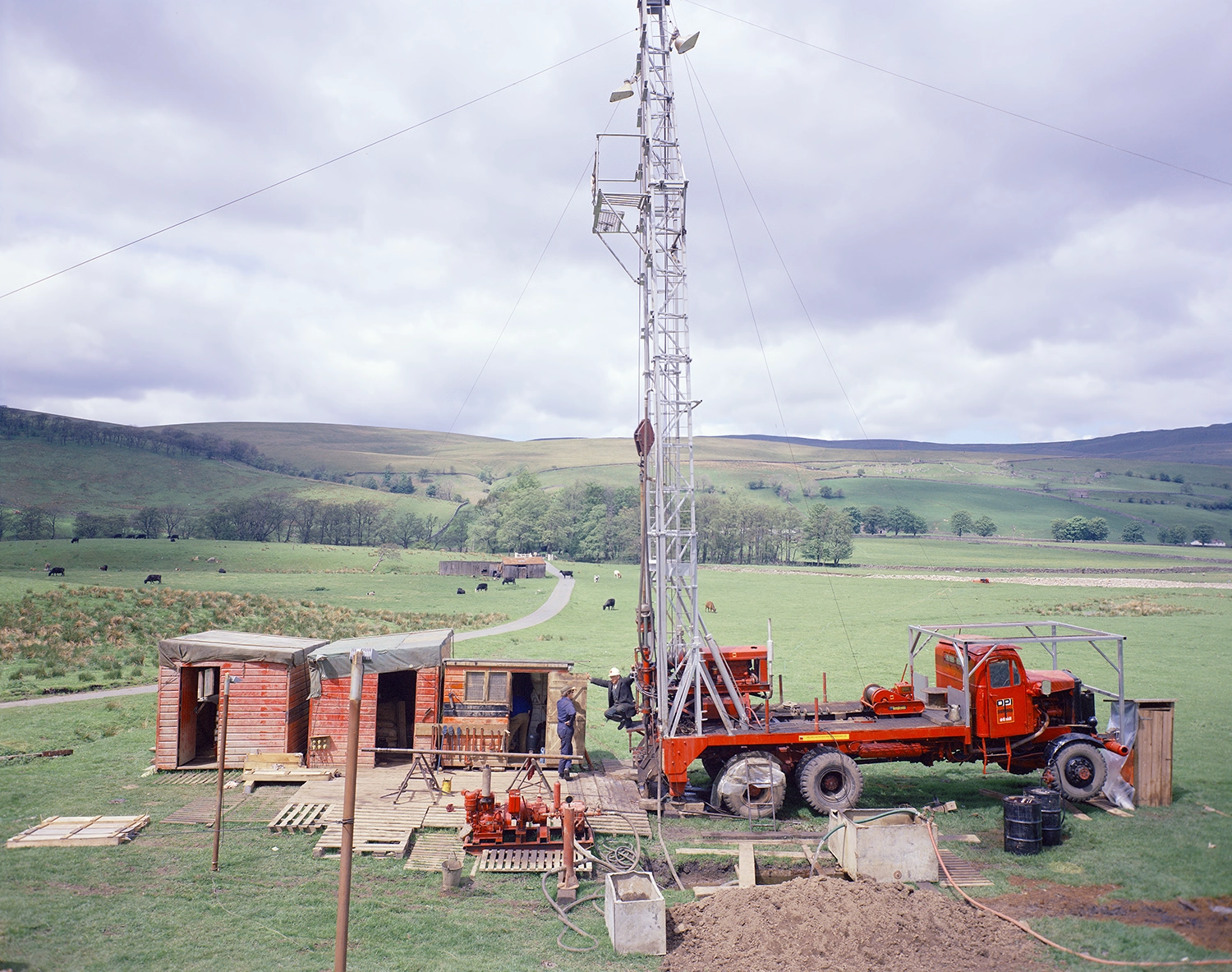

Borehole drilling in Raydale in the Yorkshire Dales, 1973. BGS used cored boreholes to obtain profiles of the unsaturated zone pore-water nitrate concentration as a function of depth in work pioneered in the 1970s. BGS © UKRI.
Assessing trends in nitrate concentrations in groundwater
Since the early 2000’s BGS have undertaken a wide range of studies to assess nitrate trends in groundwater in aquifers used for drinking water in the UK as well as assess the impact of climate change and land use change on future groundwater nitrate concentrations. BGS has also undertaken catchment monitoring, experimental investigations and modelling studies to assess the impact of policies to reduce nitrate inputs to soil and groundwater through improved land management. BGS has undertaken global groundwater nitrate storage assessments and many studies in other regions assessing the presence of nitrate in groundwater systems used for public supply, often with limited treatment.
In the UK groundwater nitrate concentrations at some locations, particularly where there are deep unsaturated zones, are high and can still be rising and are often approaching, or have already exceeded statutory limits for drinking water. In some situations nitrate concentrations are still rising at an average of c. 0.3 mg/L/year. At other sites with limited unsaturated zones or limited storage and higher travel times, the peak nitrate pulse from the agricultural intensification after the 1930’s has already passed through the groundwater system and trends are either stable or reducing. Many sites show pronounced seasonal variation, with highest concentrations during the winter and spring corresponding to high water levels. However, there is considerable spatial variability due to differences in hydrogeological setting, pumping conditions, land use controls as well as the degree of aquifer confinement. Where aquifers are confined or semi-confined, this can lead to conditions where nitrate is reduced or removed within the aquifer leading to low nitrate concentrations in groundwater.
Recent BGS led research has indicated that climate change is likely to lead to increased nitrate leaching in the UK from soil under future climate scenarios, affecting the rate of leaching to groundwater. The changes are expected to be variable spatially, and may modify pathways by which nitrate enters groundwater and potentially impact groundwater dependant receptors such as surface water and wetlands.
Nitrate in the unsaturated zone
Pioneering work was done in the 1970s to understand how different UK land-use practices affected nitrate leaching to groundwater and how nitrate moves through the unsaturated zone of major aquifers. BGS used cored boreholes to obtain profiles of the unsaturated zone pore-water nitrate concentration as a function of depth.
Sequential profiles can be used to estimate unsaturated zone travel time. BGS holds a nitrate profiles database containing over 350 nitrate profiles.
This research showed that downward movement of nitrate stored in the aquifer matrix to the water table was only about 0.7 to 2 m per year for the major aquifers of the Chalk and Permo-Triassic sandstone.
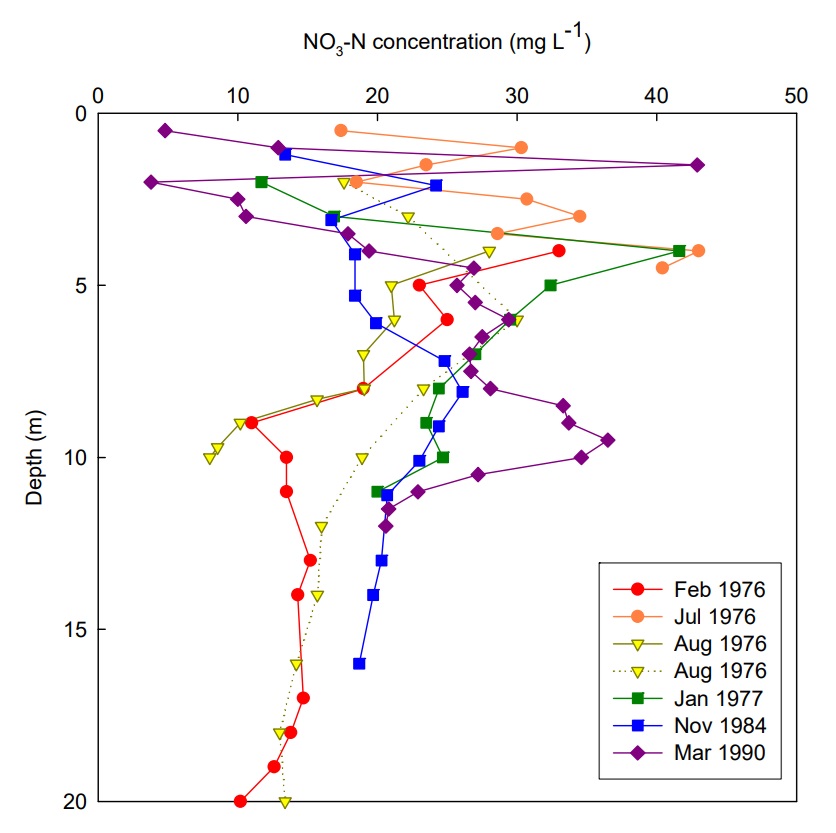
Sequential nitrate profiles from Site NN1, Bircham, Norfolk, England, from 1976 to 1990. From Stuart, 2005. BGS © UKRI.
Where the unsaturated zone is thick, this stored nitrate will continue to arrive at the water table for many years to come: we call this the nitrate time bomb. BGS has also quantified the amount of nitrate stored in the unsaturated zone globally for the first time.
This delay has implications for groundwater management and meeting the requirements of the Water Framework Directive.
Rising nitrate concentrations in groundwater
Groundwater nitrate concentrations in some locations are now high and are often approaching, or have already exceeded, statutory limits for drinking water. They are rising at an average 0.3 mg/L/year and many sites show seasonal variation, with highest concentrations during the winter and spring corresponding to high water levels. It is likely that climate change is affecting nitrate leaching to groundwater.
- Trends in nitrate concentrations in UK groundwater
- Nitrate fluctuations in groundwater
- Predicting the arrival of peak nitrate concentrations at the water table
- Climate change effects on nitrate concentrations in groundwater