
Groundwater contains distinctive animals known as ‘stygobites’, which are adapted to live in the dark, have no pigment and no eyes, and are able to feel their way around. They range in size from less than 1 mm to around 1 cm and occur in porous, fractured and karst aquifers. Stygobites can be found — and sampled — in caves, springs and boreholes.
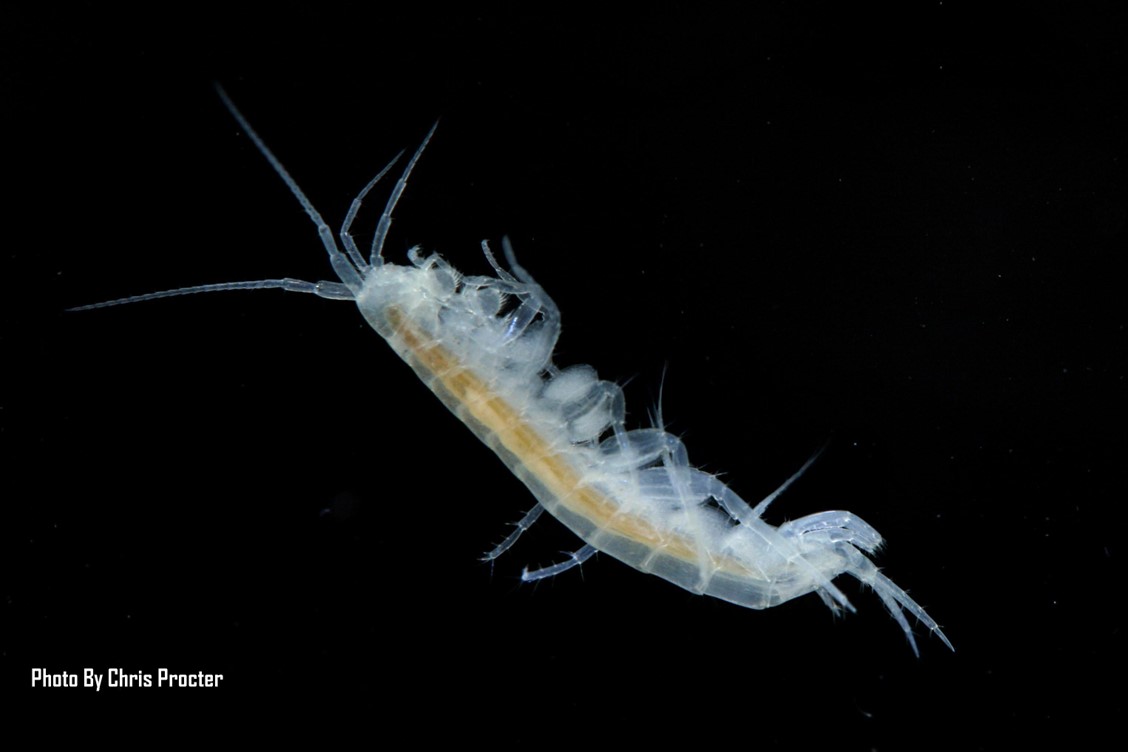

The stygobite species Niphargus aquilex, which lives in groundwaters in England and Wales. © Chris Proctor.
BGS scientists have worked with a range of partners, including Roehampton University, the Hypogean Crustacea Recording Scheme and the UK Centre for Ecology & Hydrology, to:
- investigate the occurrence and distributions of stygobite species in groundwater (Johns et al., 2015; Maurice et al., 2016; Weitowitz, 2017)
- assess their importance for UK biodiversity (McInerney et al., 2014)
- investigate their role in subsurface food webs (Weitowitz et al., 2019)
As some of the only truly endemic UK species, stygobites provide a unique and important contribution to UK biodiversity. Living in groundwater, sometimes far below the surface, they have survived millions of years of glaciations and climate change because groundwater is somewhat protected from the more extreme temperatures above ground (McInerney et al., 2014). Most UK fauna arrived at the end of the last ice age, when there was a land bridge to mainland Europe, but genetic studies have shown that some stygobite species are ancient endemics that have been here for millions of years (McInerney et al., 2014).
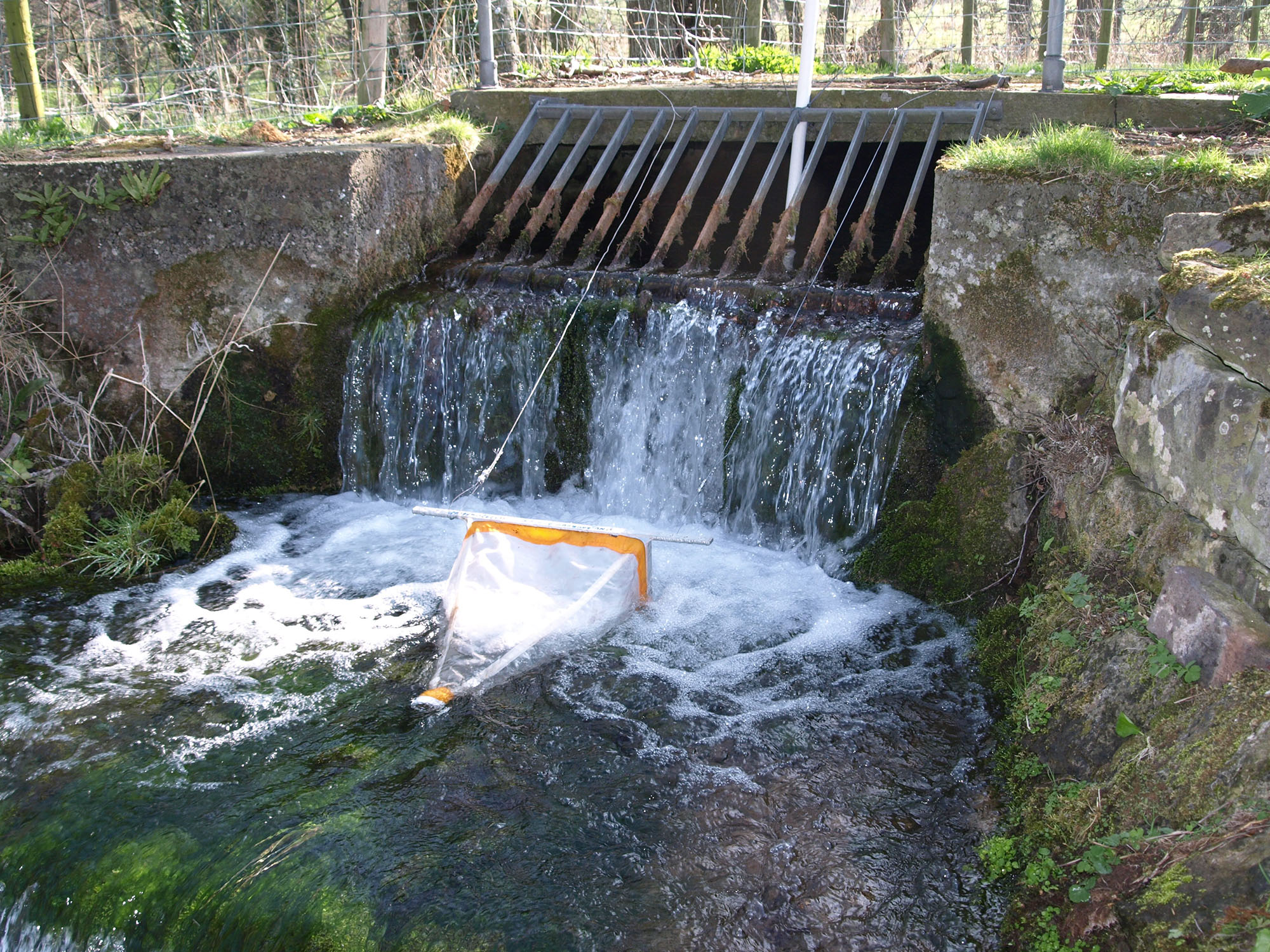
A public water supply spring for Welsh Water called Ffynnon Asaph. It is pictured here with an ecological drift net in place to sample for stygobites. BGS © UKRI.
Hydrogeology and groundwater ecology
Groundwater ecology is often the domain of biologists and ecologists, but hydrogeological expertise can improve understanding of groundwater ecosystems (Maurice and Bloomfield, 2012). Working with UKCEH and using hydrogeological tools (for example, borehole packer testing and imaging), we developed new methods to investigate biological communities at different depths within the Chalk aquifer at a site in southern England (Sorensen et al., 2013).
Work was also undertaken using geological and hydrogeological information to investigate habitat suitability for stygobite species and and identify potential geological barriers to dispersal, where low permability strata that form poor habitats are present (Johns et al., 2015; Weitowitz et al., 2017).
Distribution and controls on stygobites in the UK
Between 2009 and 2017, BGS and partners undertook surveys of stygobites in many different geological settings. The data from this work is available in the UK Hypogean Crustacea Recording Scheme database and discussed in Weitowitz (2017).
In a project led by Roehampton University, extensive sampling in south-west England revealed that stygobite species were signficantly less likely to be found in mudstone/siltstone or sandstone aquifers compared to carbonates and granites. In some areas, poor geological habitats appeared to create barriers that prevented species from colonising the adjacent, more suitable habitats (Johns et al., 2015).

Sampling for stygobites in a Chalk borehole, southern England. BGS © UKRI.
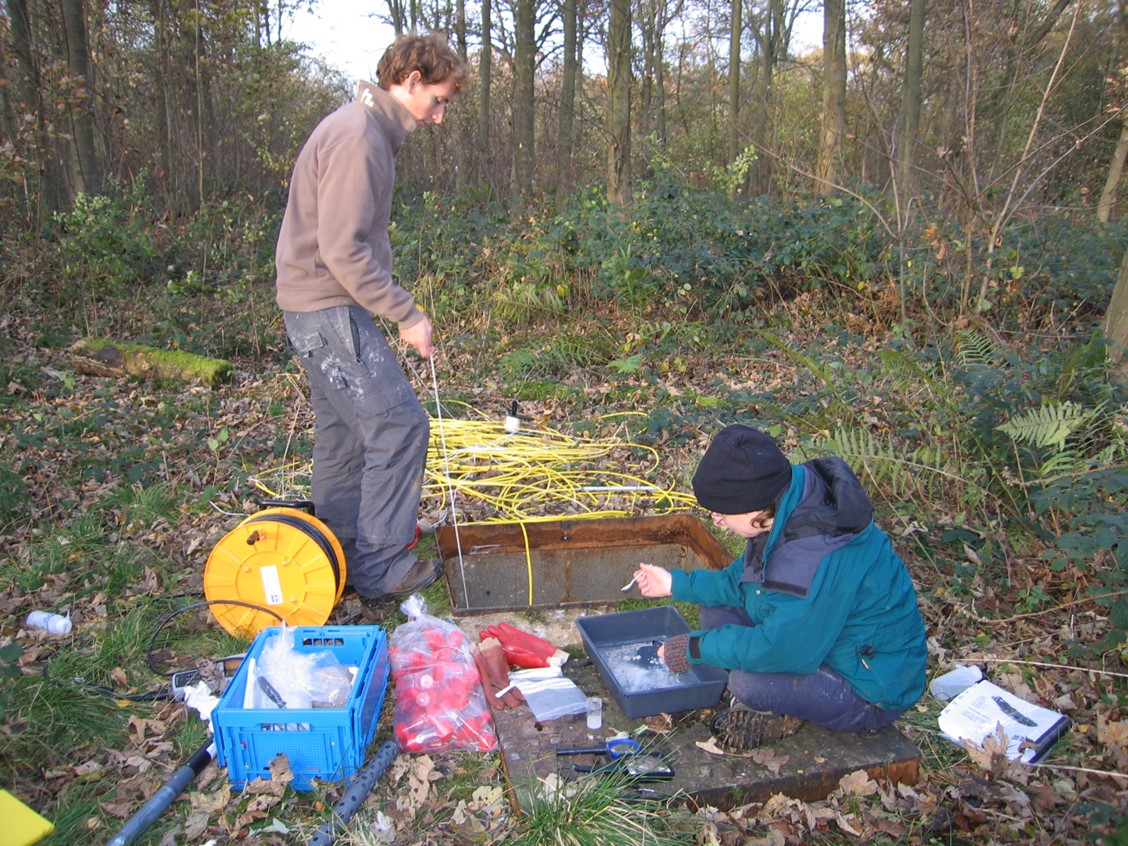
Borehole sampling and collection of stygobites in the field. BGS © UKRI.
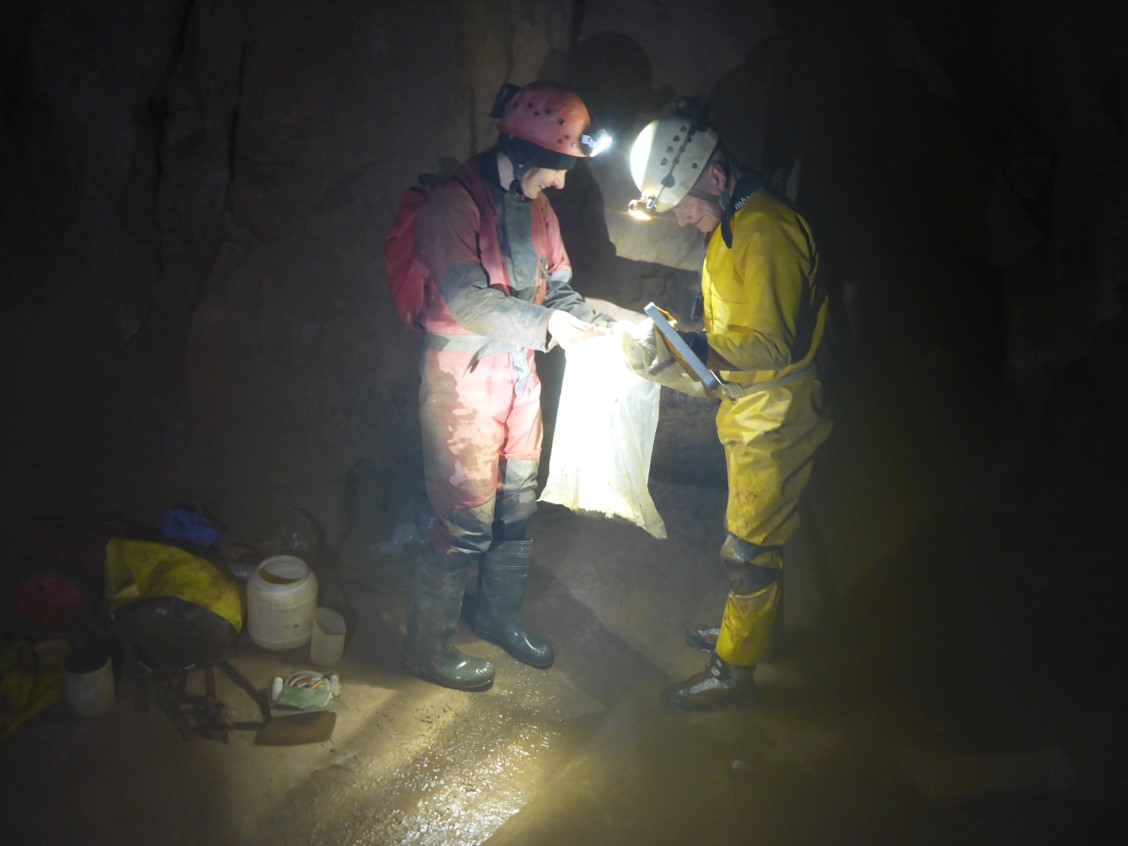
Stygobite sampling in a cave stream. © Tim Guilford
The Chalk is a vital water resource in England and investigations of this aquifer, sampling 198 boreholes, revealed that it is also an important stygobite habitat (Maurice et al., 2016): 67 per cent of boreholes in the unconcealed Chalk contained stygobites. There was a clear north/south divide, which is thought to reflect effects of recent (Devensian) glaciation in northern England. Of the sampled Chalk boreholes in southern England, 77 per cent contained stygobites compared to 38 per cent in northern England. Only two stygobite species were found in northern England compared to six in southern England.
Surveying of 59 sites within the Ogof Draenen cave system near Abergavenny, south Wales, revealed high species diversity and abundance, suggesting that invertebrate communities in caves may have a role in biogeochemical cycles (Knight et al., 2018).
Further reading
Durkota, J M, Wood, P J, Johns, T, Thompson, J R, and Flower, R J. 2019. Distribution of macroinvertebrate communities across surface and groundwater habitats in response to hydrological variability. Fundamental and Applied Limnology, Vol. 193(1), 79–92. DOI: https://doi.org/10.1127/fal/2019/1156
Gregory, S P, Maurice, L D, West, J M, and Gooddy, D C. 2014. Microbial communities in UK aquifers: current understanding and future research needs. Quarterly Journal of Engineering Geology and Hydrogeology, Vol. 47, 145–157. DOI: https://doi.org/10.1144/qjegh2013-059
Johns, T, and Robertson, A. 2022. Monitoring in the dark: A new network to assess the natural capital of groundwater fauna in England. Freshwater Biological Association News, Vol. 85.
Knight, L R F D. 2011. The aquatic macro-invertebrate fauna of Swildon’s Hole, Mendip Hills, Somerset, UK. Cave and Karst Science, Vol. 38(2), 81–92.
Knight, L R F D. 2017. The invertebrate community of the Pen Park Hole SSSI, Bristol, UK. Cave and Karst Science, Vol. 44(1), 19–30.
Knight, L R F D, and Gledhill, T, 2010. The discovery of Microniphargus leruthi Schellenberg, 1934 (Crustacea: Amphipoda: Niphargidae) in Britain and its distribution in the British Isles. Zootaxa, Vol. 2655(1), 52–56.
Knight, L R, and Johns, T. 2015. Auto-ecological studies on Niphargus aquilex (Schiödte, 1855) and Niphargus glenniei (Spooner, 1952)(Crustacea: Amphipoda: Niphargidae). Cave and Karst Science, Vol. 42(2), 63–77.
Knight, L R F D, and Mori, N. 2022. An updated review of the Ostracoda known from subterranean habitats in the British Isles. Cave and Karst Science, Vol. 49(2), 57–64.
Knight, L R, and Penk, M R. 2010. Groundwater crustacea of Ireland: a survey of the stygobitic Malacostraca in caves and springs. Biology and Environment: Proceedings of the Royal Irish Academy, Vol. 110(3), 211–235.
Knight, L R, Mori, N, and Brancelj, A. 2024. A pilot study of the biota of percolating cave waters in Britain: a proxy for the epikarst aquifer. Cave and Karst Science, 51(2), pp.51-62.
Proudlove, G S, Wood, P J, Harding, P T, Horne, D J, Gledhill, T, and Knight, L RF D. 2003. A review of the status and distribution of the subterranean aquatic Crustacea of Britain and Ireland. Cave and Karst Science, Vol. 30(2), 51–74.
Reiss, J, Perkins, D M, Fussmann, K E, Krause, S, Canhoto, C, Romeijn, P, and Robertson, A L. 2019. Groundwater flooding: Ecosystem structure following an extreme recharge event. Science of The Total Environment, Vol. 652, 1252–1260. DOI: https://doi.org/10.1016/j.scitotenv.2018.10.216
Robertson, A L, Smith, J W N, Johns, T, and Proudlove, G S. 2009. The distribution and diversity of stygobites in Great Britain: an analysis to inform groundwater management. Quarterly Journal of Engineering Geology and Hydrogeology, Vol. 42(3), 359–368. DOI: https://doi.org/10.1144/1470-9236/08-046
Wood, P J, Agnew, M D, and Petts, G E. 2001. Hydro-ecological variability within a groundwater. 151–160 in Hydro-ecology: Linking Hydrology and Aquatic Ecology. Acreman, M C (editor). (Wallingford, UK: International Association of Hydrological Sciences.) ISBN: 9781901502411
Groundwater ecology: extending our understanding of biodiversity in the UK. Presentation given by Louise Maurice at the symposium celebrating the 175th anniversary of BGS in 2010.
Johns, T, Jones, I, Knight, L, Maurice, L, Wood, P, and Robertson, A. 2015. Regional scale drivers of groundwater faunal distributions. Freshwater Science, Vol. 34(1). DOI: http://doi.org/10.1086/678460
Knight, L R F D, Brancelj, A, Edwards, F, and Maurice, L. 2018. The aquatic invertebrate fauna of the Ogof Draenen cave system in South Wales, UK. Cave and Karst Science, Vol. 45(1), 19–30.
Maurice, L, and Bloomfield, J. 2012. Stygobitic invertebrates in groundwater — a review of current knowledge from a hydrogeological perspective. Freshwater Reviews, Vol. 5(1), 51–71. DOI: https://doi.org/10.1608/FRJ-5.1.443
Maurice, L, Robertson, A R, White, D, Knight, L, Johns, T, Edwards, F, Arietti, M, Sorensen, J P R, Weitowitz, D, Marchant, B P, and Bloomfield, J P. 2016. The invertebrate ecology of the Chalk aquifer in England (UK). Hydrogeology Journal, Vol. 24 (2), 459–474. DOI: https://doi.org/10.1007/s10040-015-1334-2
McInerney, C E, Maurice, L, Robertson, A L, Knight, L R F D, Arnsheidt, J, Venditti, C, Dooley, J S G, Mathers, T, Matthijs, S, Erikkson, K, Proudlove, G, and Hanfling, B. 2014. The ancient Britons: groundwater fauna survived extreme climate changes over tens of millions of years across NW Europe. Molecular Ecology, Vol. 23, 1153–1166. DOI: https://doi.org/10.1111/mec.12664
Sorensen, J P R, Maurice, L, Edwards, F K, Lapworth, D J, Read, D S, Allen, D, Butcher, A S, Newbold, L K, Townsend, B R, and Williams, P J. 2013. Using boreholes as windows into groundwater ecosystems. Plos One, Vol. 8(7), e70264. DOI: https://doi.org/10.1371/journal.pone.0070264
Weitowitz, D. 2017. An investigation into the distribution of obligate groundwater animals (stygobites) in England and Wales. Unpublished PhD thesis, Roehampton University.
Weitowitz, D C, Robertson, A L, Bloomfield, J P, Maurice, L, and Reiss, J. 2019. Obligate groundwater crustaceans mediate biofilm interactions in a subsurface food web. Freshwater Science, Vol. 38(3), 491–502.
Weitowitz, D C, Maurice, L, Lewis, M, Bloomfield, J P, Reiss, J, and Robertson, A L. 2017. Defining geo-habitats for groundwater ecosystem assessments: an example from England and Wales (UK). Hydrogeology Journal, Vol. 25(8), 2453–2466. DOI: https://doi.org/10.1007/s10040-017-1629-6