
The European Groundwater Drought Initiative, or GDI, is a three-year, NERC-funded project to assess and model groundwater drought status across Europe, investigate the impacts of groundwater drought, and to build a community to grow our understanding of the phenomenon of groundwater drought.
We worked with teams from across Europe, including:
- BOKU Vienna, Austria
- Centre for Applied Ecology, University of Lisbon, Portugal
- Comenius University Bratislava, Slovakia
- Croatian Geological Survey, Croatia
- Environmental Protection Agency Ireland, Ireland
- Geological Survey of Denmark and Greenland, Denmark
- Institute of Environmental Sciences and Water Research, Spain
- University of Freiburg, Germany
- University of Latvia and Latvian Environment, Geology and Meteorology Centre, Latvia
- University of Oslo, Norway
- University of Rouen, France
- Wageningen University, The Netherlands
GDI also has the support of the International Groundwater Resources Assessment Centre at UNESCO.
Why did we study groundwater droughts in Europe?
There were already services that provide information about the status of meteorological drought across Europe and there were significant advances in the understanding of drought in surface waters across Europe. However, there had been no attempt to bring together information related to the status of groundwater droughts at the continental scale (Van Loon, 2015).
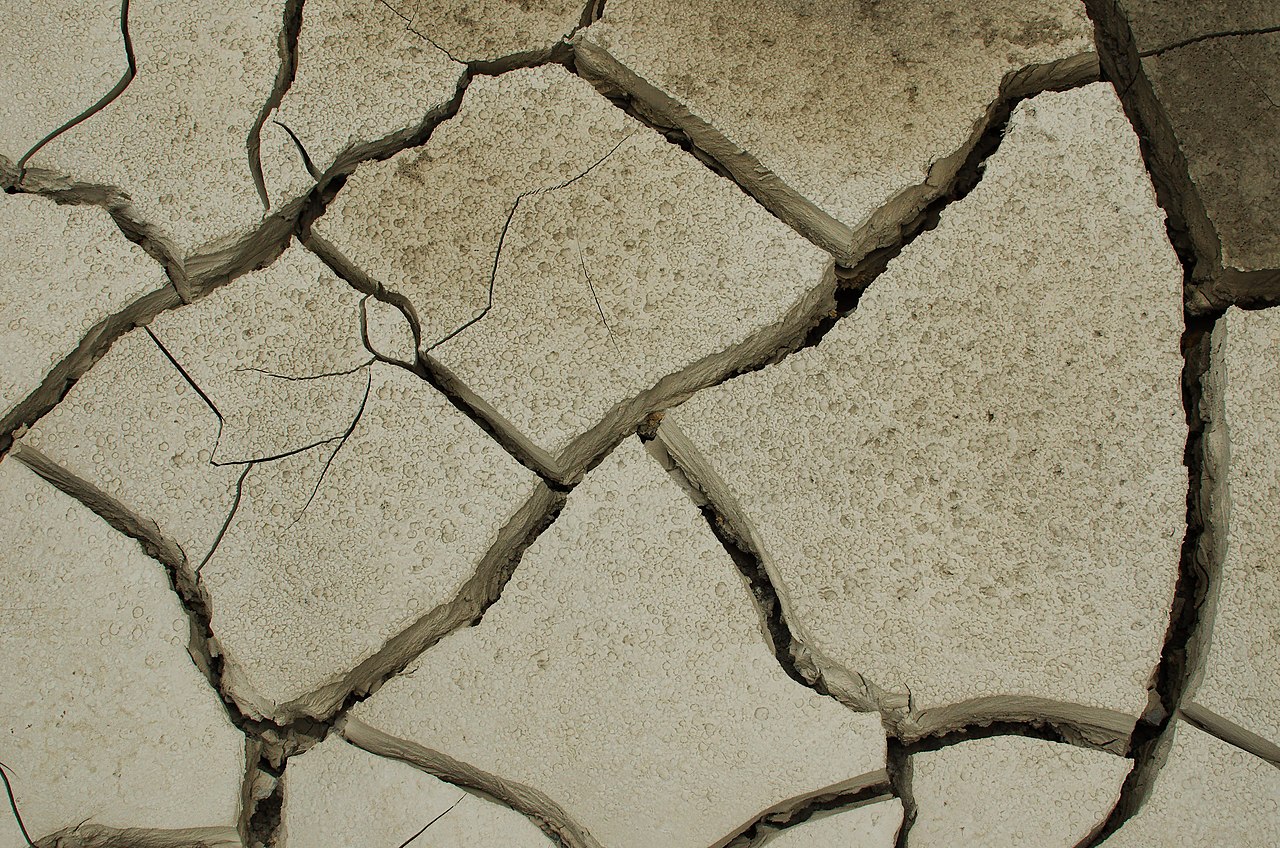

Mud cracks and rain drops in Germany. © marsupium photography and licensed under the Creative Commons Attribution-Share Alike 2.0 Generic license.
There are significant benefits to be gained from analysing groundwater drought at the European scale. Major groundwater droughts take many months to develop, have large spatial footprints and typically lag behind the driving meteorology. This means that there is the potential to forecast the status of a developing groundwater drought and improve our planning for, and management of, these droughts.
GDI activities
The first task of the GDI was to bring together many long-term (multi-decadal) groundwater level and spring flow records and standardise them using techniques such as the standardised groundwater level index, or SGI (Bloomfield and Marchant, 2013). Standardisation enables groundwater level data from disparate locations to be analysed in a consistent manner.
For example, clusters of groundwater level and spring-flow hydrographs can be identified with similar responses to the driving meteorology (Bloomfield et al., 2015). Using the standardised hydrographs, we described and analysed the changing status of groundwater droughts across Europe on a monthly basis, from the 1960s to the present. A particular aim of this analysis was to understand how catchment and local factors may modify the regional groundwater response to drought.
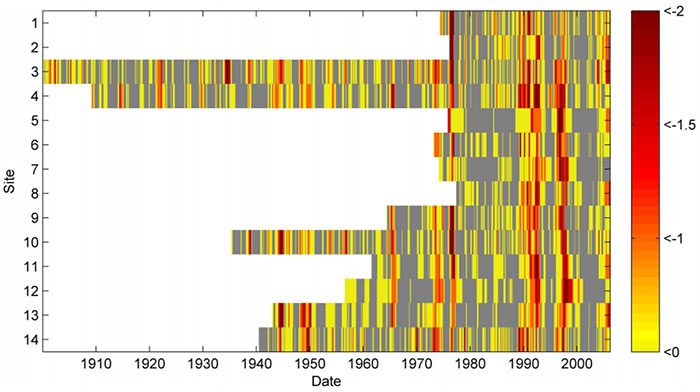
Periods of groundwater drought common to multiple groundwater-level time series can be identified using the standardised groundwater level index, SGI (where SGI < 0), in this case for 14 hydrographs from the UK. BGS © UKRI.
Two key GDI activities related to the effects of groundwater drought. We added to and systematically analysed all groundwater-related effect information in the European Drought Impact Report Inventory (EDII) to understand how groundwater-drought impacts relate to the concept of drought in the ‘Anthropocene’ (Van Loon et al., 2016a). We also undertook a series of comparative case studies across Europe, focusing in particular on the differing characteristics as well as commonalities in the effects of groundwater droughts in northern Europe and more water-stressed regions of Europe, particularly in the south.
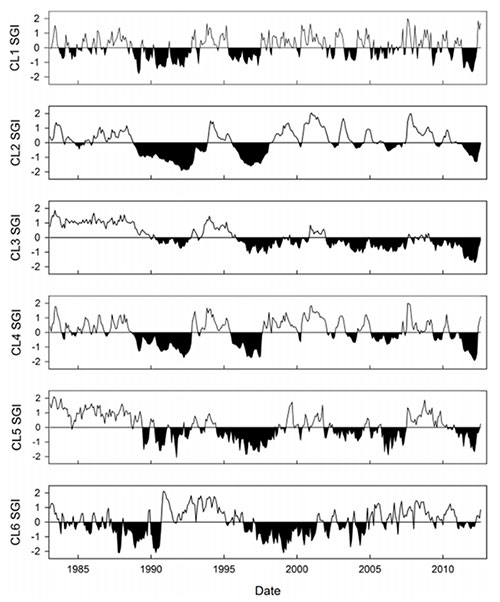
Using clustering techniques, groups of spatially coherent, standardised hydrographs can characterise the differing responses of groundwater systems to droughts. This example shows six clusters of hydrographs for 74 boreholes from the Chalk aquifer of the UK. Periods of groundwater drought (SGI < 0) are shown in in black. BGS © UKRI.
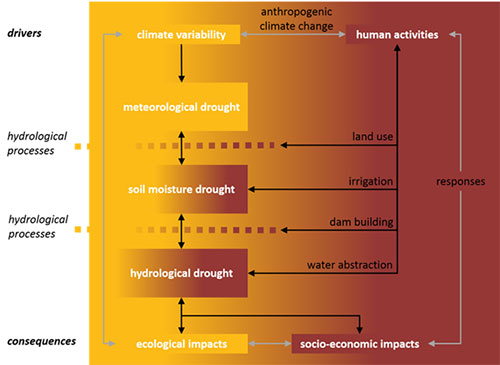
Illustration of the propagation of drought from climate variability through to hydrological drought, including groundwater drought, and ecological effects, and the range of societal effects and responses. From Van Loon et al., 2016b.
Further reading
Bloomfield, J P, and Marchant, B P. 2013. Analysis of groundwater drought building on the standardised precipitation index approach. Hydrology and Earth System Sciences, Vol. 17(12), 4769–4787. DOI: https://doi.org/10.5194/hess-17-4769-2013
Bloomfield, J P, Marchant, B P, Bricker, S H, and Morgan. 2015. Regional analysis of groundwater droughts using hydrograph classification. Hydrology and Earth System Sciences, Vol. 19, 4327–4344. DOI: http://dx.doi.org/10.5194/hess-19-4327-2015
Van Loon, A F. 2015. Hydrological drought explained. WIREs Water, Vol. 2(4), 359–392. DOI: https://doi.org/10.1002/wat2.1085
Van Loon, A F, Gleeson, T, Clark, J, Van Dijk, A, Stahl, K, Hannaford, J, Di Baldassarre, G, Teuling, A, Tallaksen, L M, Uijlenhoet, R, Hannah, D M, Sheffield, J, Svoboda, M, Verbeiren, B, Wagener, T, Rangecroft, S, Wanders, N, and Van Lanen, H A J. 2016a. Drought in the Anthropocene. Nature Geoscience, Vol. 9(2), 89–91. DOI: https://doi.org/10.1038/ngeo2646
Folland, C K, Hannaford, J, Bloomfield, J P, Kendon, M, Svensson, C, Marchant, B P, Prior, J, and Wallace, E. 2015. Multi-annual droughts in the English Lowlands: a review of their characteristics and climate drivers in the winter half year. Hydrology and Earth Systems Science, Vol. 19, 2353–2375. DOI: https://doi.org/10.5194/hess-19-2353-2015
Rust, R, Holman, I, Corstanje, R, Bloomfield, J P, and Cuthbert, M. 2017. A conceptual model for climatic teleconnection signal control on groundwater variability in the UK and Europe. Earth Science Reviews, Vol. 177, 164–174. DOI: https://doi.org/10.1016/j.earscirev.2017.09.017
Van Loon, A F, and Laaha, G. 2014. Hydrological drought severity explained by climate and catchment characteristics. Journal of Hydrology, Vol. 526, 3–14. DOI: https://doi.org/10.1016/j.jhydrol.2014.10.059
Van Loon, A F, Kumar, R, and Mishra, V. 2017. Testing the use of standardised indices and GRACE satellite data to estimate the European 2015 groundwater drought in near-real time. Hydrology and Earth System Sciences, Vol. 21, 1947–1971. DOI: https://doi.org/10.5194/hess-21-1947-2017
Van Loon, A F, Gleeson, T, Clark, J, Van Dijk, A I J M, Stahl, K, Hannaford, J, Di Baldassarre, G, Teuling, A J, Tallaksen, L M, Uijlenhoet, R, Hannah, D M, Sheffield, J, Svoboda, M, Verbeiren, B, Wagener, T, Rangecroft, S, Wanders, N, and Van Lanen, H A J. 2016b. Drought in a human-modified world: reframing drought definitions, understanding and analysis approaches. Hydrology and Earth Systems Sciences, Vol. 20, 3631–3650. DOI: https://doi.org/10.5194/hess-2016-251