
The objective of our seismicity investigations was to monitor background seismic activity in the vicinity of the Kirby Misperton proposed exploration site and surrounding Vale of Pickering. The data we collected allowed reliable characterisation of baseline levels of natural seismic activity and helped discriminate between natural seismicity and any future induced seismicity. A further aim was to make recommendations for a suitable traffic-light system to mitigate earthquake risk.
Design of the monitoring network
Ten seismometers were installed at locations across the Vale of Pickering (Figure 1), six were surface seismometers and four installed in boreholes. Modelling indicated that this array of seismometers had a detection threshold of 0 magnitude events. Seismometers around Kirby Misperton were decommissioned in March 2020, but others in the area remain as part of the national network.


Figure 1 (a) Location of a magnitude 1.7 ML earthquake near Warsop, Nottinghamshire (southernmost yellow star) in relation to the installed monitoring network (red triangles) and other BGS monitoring stations (blue triangles). (b) Recordings of the ground motions for this event for the five stations in the network, along with the recording at station HPK (blue triangle) just north of Leeds. BGS © UKRI.
BGS earthquakes website
BGS’s earthquake website has more information:
Data processing and analysis
Continuous real-time data from all installed stations was transmitted to the BGS offices in Edinburgh and incorporated in the data acquisition and processing work flows used for the permanent UK network of real-time seismic stations that BGS operates. A simple detection algorithm is applied to the data from the five installed stations, as well as two permanent BGS monitoring stations in the region, to detect possible events. All detections have been reviewed by an experienced analyst.
No events were detected in the immediate locality of the Vale of Pickering. However, a number of other earthquakes and quarry blasts from elsewhere in the UK were detected (the closest shown by yellow stars in Figure 1a).
As an example, the southernmost yellow star in Figure 1a shows the location of a magnitude 1.7 ML earthquake near Warsop, Nottinghamshire, in relation to the former monitoring network. Recordings of the ground motion for this event at the five stations in the network are shown in Figure 1b along with the recording at station HPK just north of Leeds. The signal-to-noise ratio is good and the event is well recorded, with clear P- and S-wave arrivals on most stations.
In addition, a number of large earthquakes from elsewhere around the world were detected. For example, Figure 2 shows the recorded ground motions from a magnitude 7.5 earthquake in the Hindu Kush at 09:09 on 26 October 2015 at each of the five stations in the Vale of Pickering as well as the permanent BGS monitoring station GDLE.
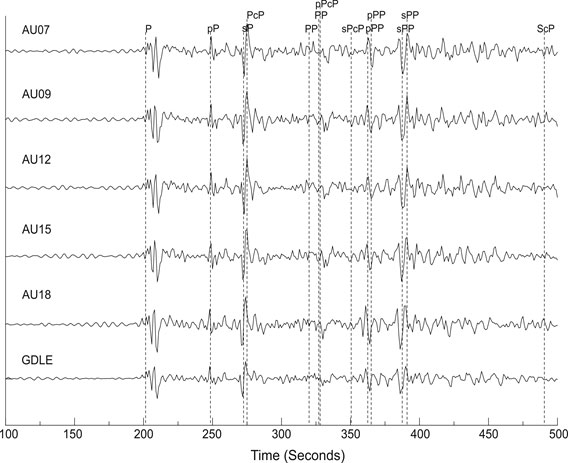
Figure 2 Recorded ground motions from a magnitude 7.5 earthquake in the Hindu Kush at 09:09 on 26 October 2015, detected at stations in the Vale of Pickering and the BGS monitoring network permanent station GDLE. BGS © UKRI.
Numerous signals from various seismic waves that have propagated along different paths through the Earth are clearly visible, as marked by the dashed lines, suggesting that the data quality is good. Comparison with the permanent station GDLE suggests that the stations in the Vale of Pickering give a similar data quality to the permanent station.
In the future, processing will also include automatic detection and location of any seismic events along with an estimate of the event magnitude.
Data availability
Helicorder plots showing 24 hours of data from each station within the national monitoring network are available online are available on the BGS earthquakes website.