
Shale gas and groundwater
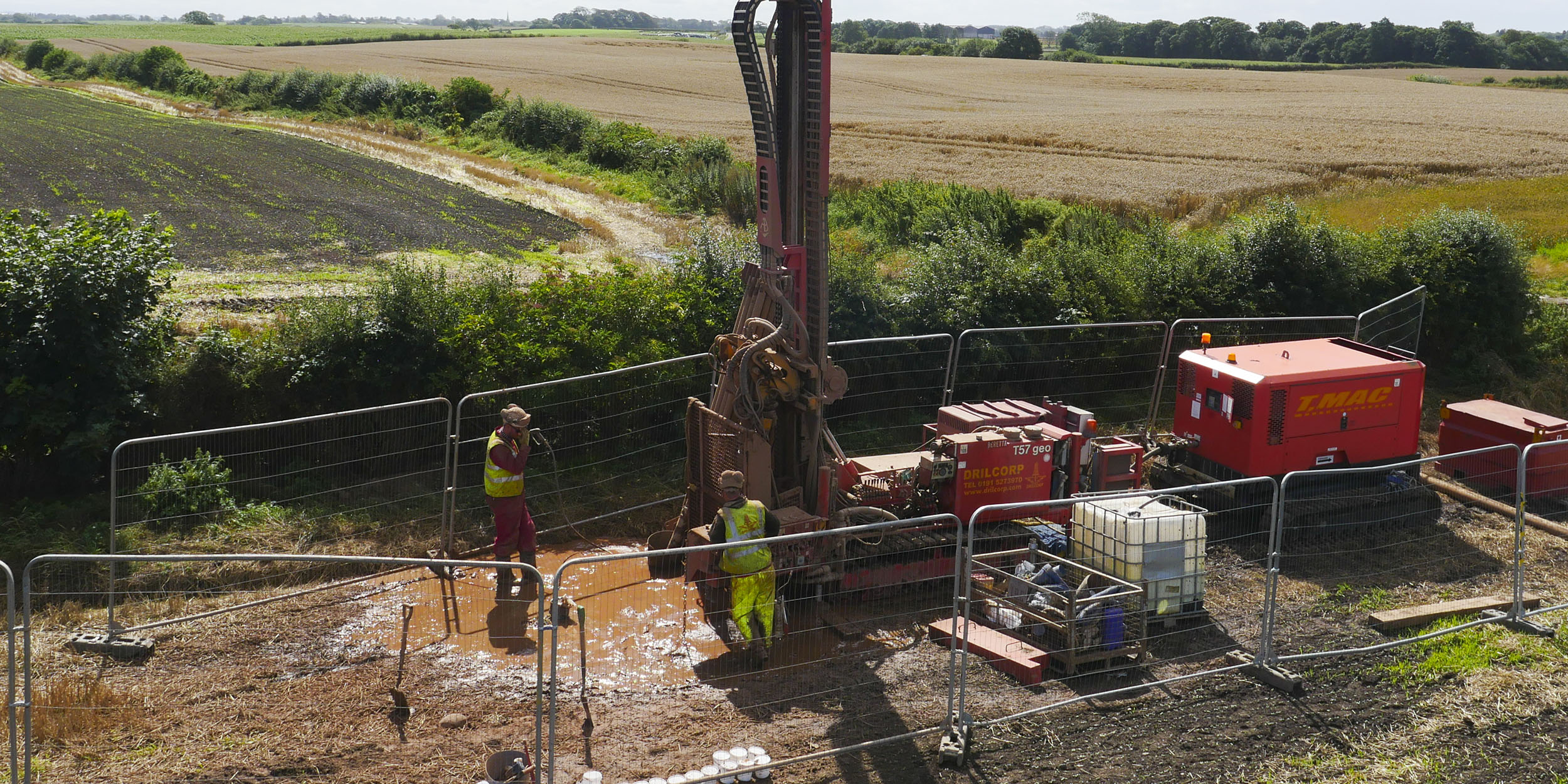
BGS undertakes research to provide the information needed to understand potential effects on groundwater from shale gas exploitation.
- BGS worked with the Environment Agency to investigate whether any evidence exists about the effects of abandoned hydrocarbon wells on groundwater quality in England
- The National Baseline Methane Survey of UK groundwaters helped assess future changes in methane concentrations
- Aquifers and shales is a set of national-scale maps showing the spatial relationships between principal aquifers and major shale units in England and Wales
- The 3D groundwater vulnerability project developed an approach to assess the vulnerability of groundwater to contamination from deep subsurface activities
This work has provided underpinning information that will be of use to policymakers, regulators and decision makers.
About groundwater and shale gas
Groundwater is part of the water cycle and consists of water that has filtered into the ground from rainfall, snowmelt and rivers. It forms the largest available store of fresh water in the UK, far in excess of river or lake waters.
Over lowland England, about half of all fresh water supplies come from groundwater and, in parts of the south-east, this rises to more than 70 per cent. About three-quarters of all groundwater taken is used for public water supply, with the remainder being used for agricultural, industrial and other purposes. One reason for this is because, compared with surface waters, groundwater is relatively high quality and requires less treatment prior to use. Groundwater also provides flow to many rivers and wetlands and so sustains a wide range of ecosystems.
Groundwater in the UK is managed by national environmental regulators: the Environment Agency (EA) in England; Natural Resources Wales (NRW) in Wales; Scottish Environment Protection Agency (SEPA) in Scotland. They do this by balancing the needs of water companies to supply water to consumers with the need to preserve the environment, protect it from pollution and over-abstraction and, where it is already polluted, ensure that it is cleaned up. For more detail, see the EA’s groundwater management, NRW’s water responsibilities, and SEPA’s water environment regulations.
Shale gas is natural gas trapped in shales and clays, which are fine-grained, sedimentary rocks predominantly comprised of consolidated clay-sized (between 0.98 and 3.9 μm) particles that were originally deposited as mud. The decay of organic matter (algae, plant and animal-derived organic debris) that was deposited along with the sediments is the source of the shale gas. The gas is produced from the breakdown of organic material as the muddy sediments are buried, pressurised, heated and turned into shale rock. Gas generation typically requires burial to depths of a kilometre or more and many potential shalegas source rocks are found at those depths.
Consequently, the shale is both the source and the reservoir for the natural gas, which is predominantly methane (CH4; approximately 90 per cent) but may also contain other hydrocarbons, carbon dioxide, nitrogen, hydrogen sulfide and rare gases. The gas is held in natural fractures and pore spaces or adsorbed onto the organic material and minerals in the shale.
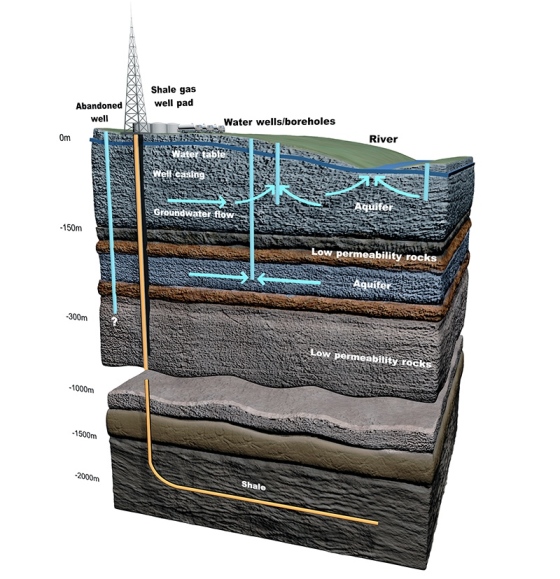
It is technically challenging to obtain shale gas because it is bound to rocks at great depth. Unlike conventional drilling for hydrocarbons, drilling for shale gas combines horizontal drilling with hydraulic fracturing (also known as fracking). Horizontal drilling, sometimes to more than 1500 m away from the vertical wellbore, greatly increases the length of contact between the shale gas rock formation and the wellbore relative to a conventional vertical well, and hydraulic fracturing releases shale gas to enable it to be retrieved in commercially viable quantities.
Environmental concerns
There have been concerns expressed about the potential effects of shale gas extraction on groundwater, with reports in the US claiming that contamination of drinking water has occurred.
Shale gas is natural gas trapped in low-permeability shales. The gas is held in pore spaces within the rock, or adsorbed onto minerals and organic material in the shale. New technology for gas production from shale formations, horizontal drilling and hydraulic fracturing, was originally developed in the USA and has led to the rapid exploration of shale formations worldwide.
The UK has abundant shales at depth that have been the focus of research into:
- characterisation
- resource evaluation
- exploitation risk
BGS has carried out research projects in a number of these areas. Part of this research considered some of the environmental concerns and, in particular, the potential effects on groundwater. We published a report in 2012 on the potential groundwater impact from exploitation of shale gas in the UK.
More information on shale gas
Visit our shale gas pages to find out more about shale gas and groundwater.
Our research
3D groundwater vulnerability
Assessing the vulnerability of groundwater to onshore oil and gas extraction.
Abandoned hydrocarbon wells
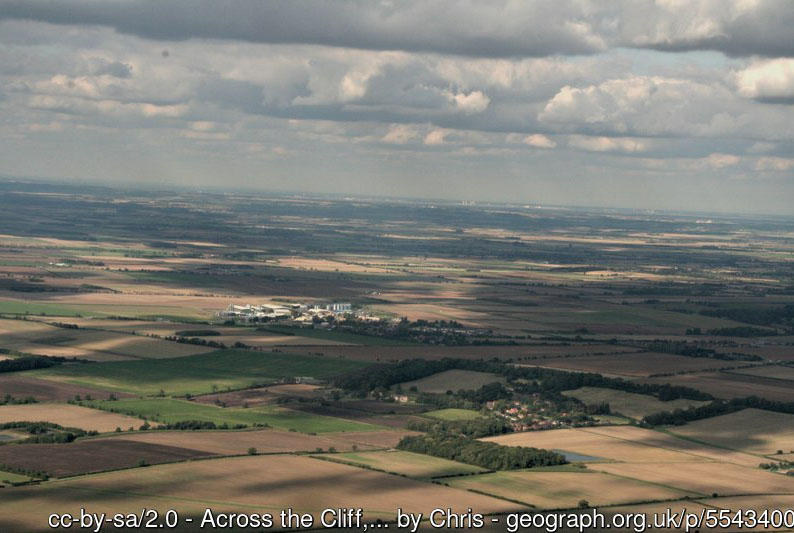
Investigating the effects of abandoned onshore hydrocarbon wells on groundwater quality.

Aquifers and shales
Understanding the spatial relationships between potential shale gas source rocks and overlying aquifers.
National methane baseline survey of UK groundwaters
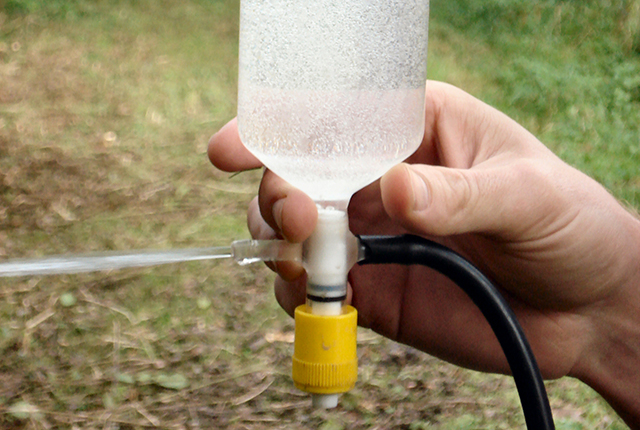
Creating a national baseline dataset of the current distribution of methane in our groundwater.
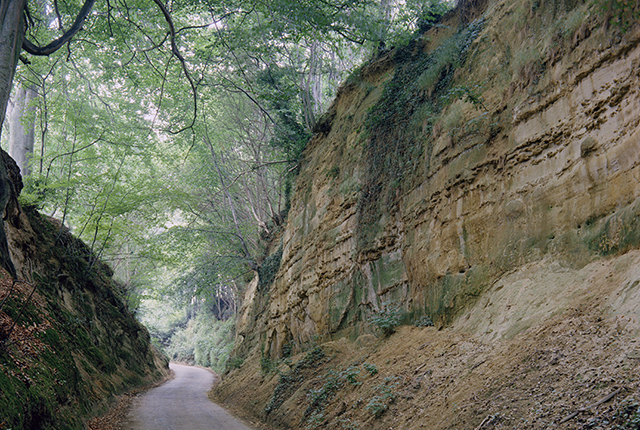
Onshore oil and gas risks to groundwater
Measuring groundwater quality to support assessment of the risks to groundwater from onshore oil and gas activities.
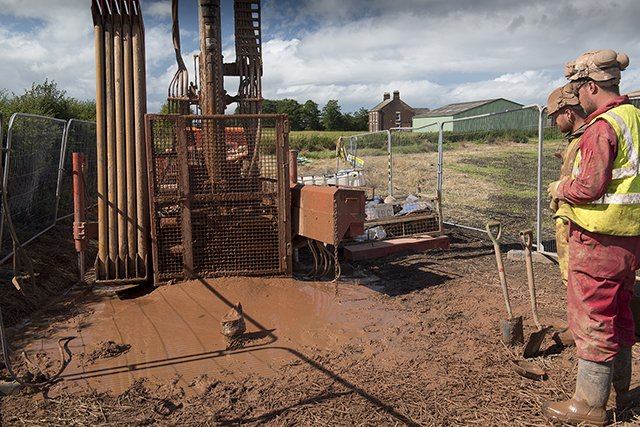
Shale gas environmental monitoring
Monitoring environmental baseline conditions in relation to potential shale gas development.