
Karst is a type of landform that results from the dissolution of rocks. It is usually associated with cave systems and landscapes characterised by rocks sculpted by dissolution with large surface depressions, disappearing rivers and major springs. Karst processes occur in all soluble rocks, resulting in high vulnerability to pollution. Karst rocks are also impacted by sinkholes.
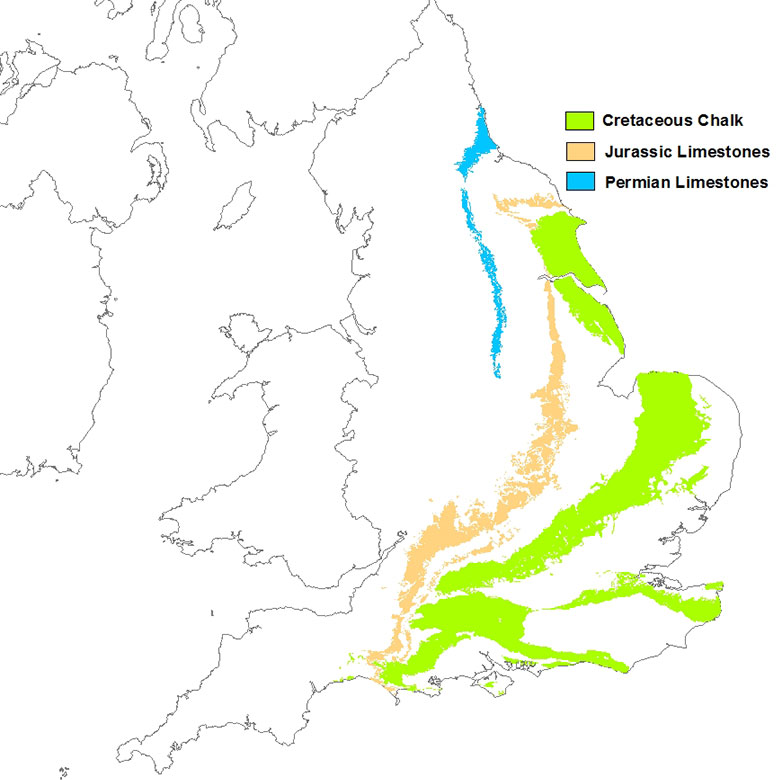

Map showing the distribution of the Chalk and Jurassic and Permian limestones in England. Contains Ordnance Survey data © Crown Copyright and database rights 2016. BGS © UKRI.
UK karst aquifers
In the UK, karst is usually associated with Carboniferous-aged limestone, in which there is extensive cave development. The longest-known cave is more than 80 km in length and there are more than 170 explored caves that are more than 1 km long.
In contrast, caves are uncommon in the Chalk and the Jurassic and Permian limestones of England. The longest known cave in the Jurassic limestones is around 3.8 km, although many areas of Jurassic limestones have no known caves. The longest known cave in the Chalk is 360 m; the longest in the Permian limestones is 290 m.
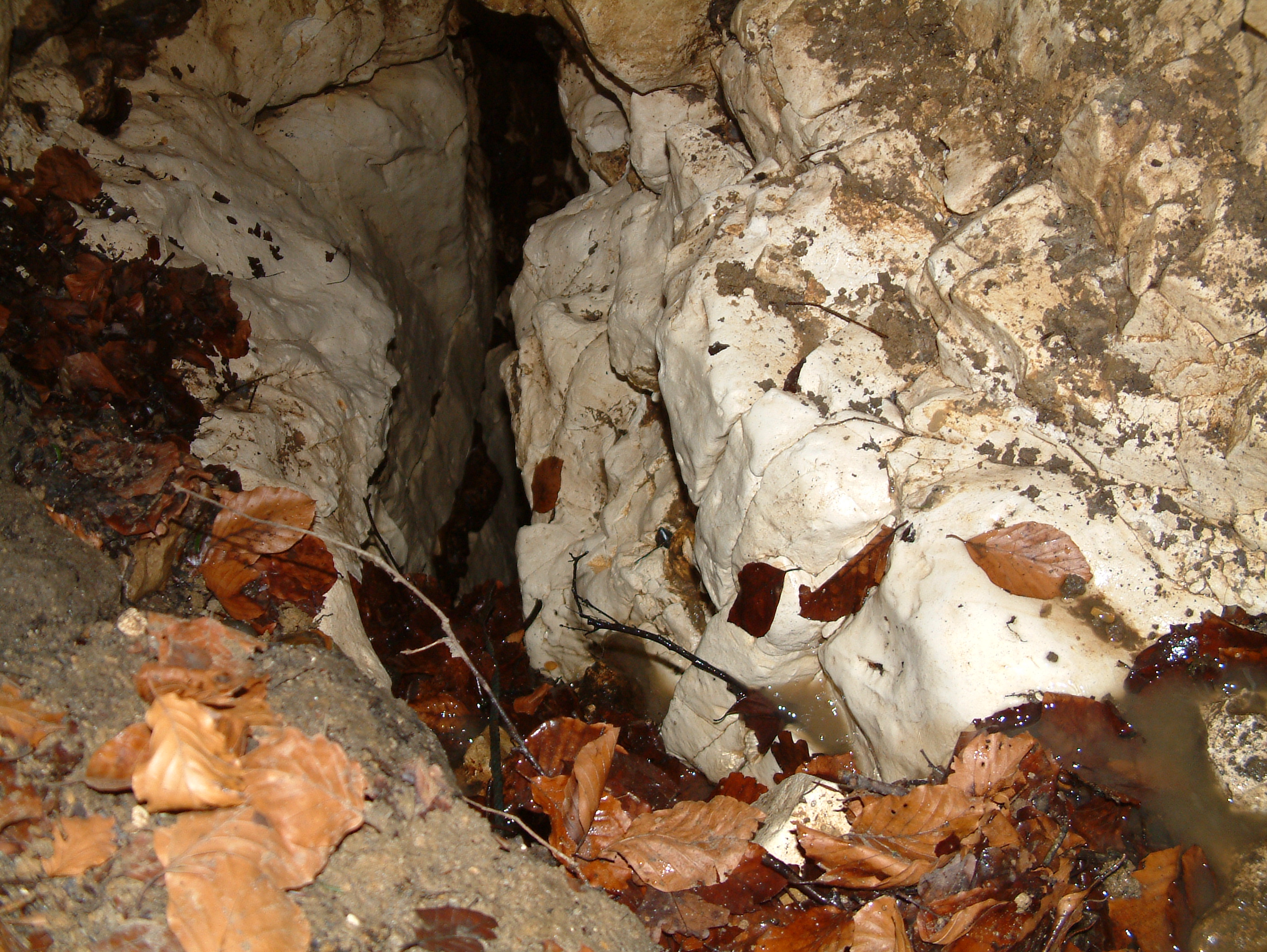
A chalk cave in Berkshire, England. Approximately 0.4 m wide and 2.5 m deep. BGS (c) UKRI.
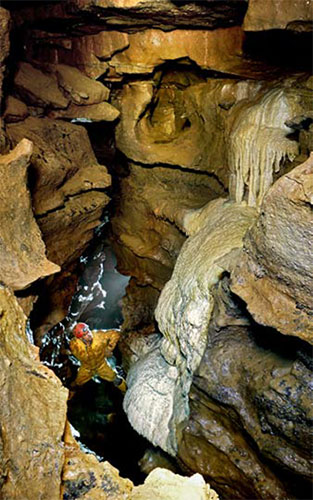
Jurassic limestone cave, Yorkshire. Photo © John Dale and Carl Thomas.
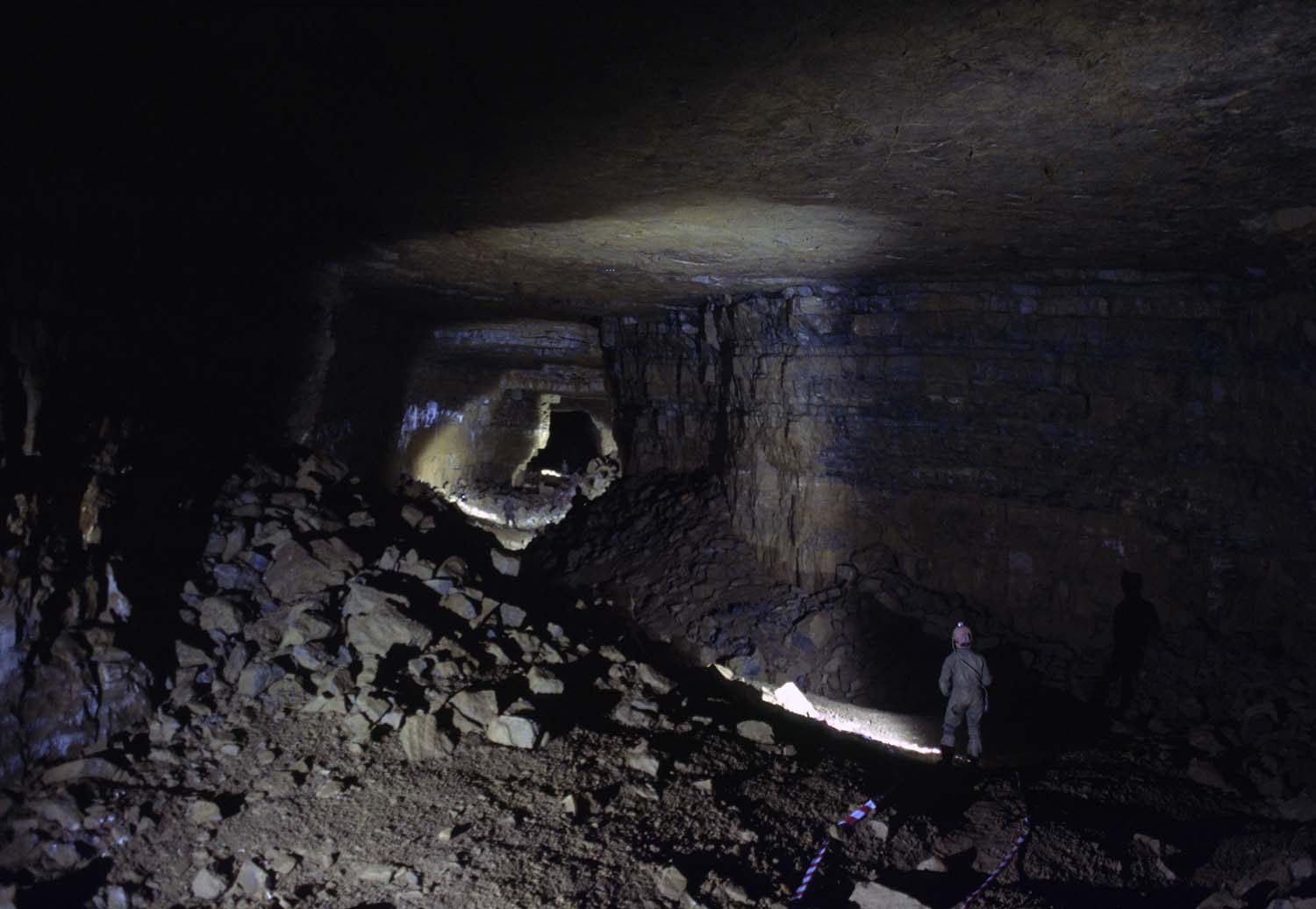
Carboniferous limestone cave, south Wales. © Tim Guilford.
Despite the limited cave development, complex networks of smaller-scale dissolutional voids occur in these aquifers, enabling rapid or long-distance pollutant transport.
Evidence for karst in the Chalk and Jurassic and Permian limestone aquifers includes the presence of:
- stream sinks
- dolines (sinkholes)
- solution pipes
- conduits (observed in quarries or boreholes)
- large springs
- tracer tests
- microbial contaminants and turbidity
Karst information and resources
The BGS karst report series provides an overview of the evidence of karst in different regions of England with Chalk or Jurassic or Permian limestone geology. The new understanding of karst in the Chalk is presented in Maurice et al. (2021), with additional information on the karst hydrogeology of the Bedhampton and Havant springs.
Karst in the Chalk and Jurassic and Permian limestones is also discussed by BGS’s Lou Maurice in this presentation to the Thames Valley Regional Group of the Geological Society, ‘Karst — an unexpectedly widespread phenomenon in England’.
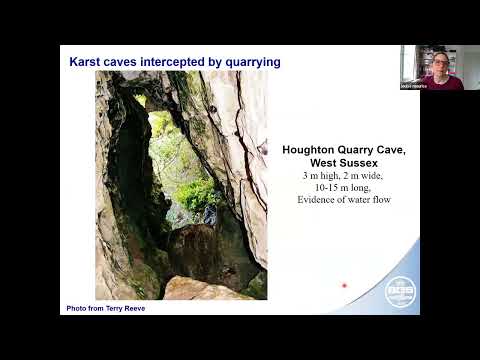

Presentation to the Thames Valley Regional Group of the Geological Society.
Further reading
References related to different karst topics are provided. These reference lists are not comprehensive but provide a starting point for scientists interested in the karst hydrogeology of the UK karst aquifers in which cave development is limited (the Chalk and the Jurassic and Permian limestones). Some more general references on karst are included for context. Further references can be found in the BGS karst reports.
Agbotui, P Y, West, L J, and Bottrell, S H. 2020. Characterisation of fractured carbonate aquifers using ambient borehole dilution tests. Journal of Hydrology, Vol. 589, 125191. DOI: https://doi.org/10.1016/j.jhydrol.2020.125191
Allshorn, S J L, Bottrell, S H, West, L J, and Odling, N E. 2007. Rapid karstic bypass flow in the unsaturated zone of the Yorkshire chalk aquifer and implications for contaminant transport. 111–122 in Natural and Anthropogenic Hazards in Karst Areas: recognition, analysis and mitigation. Parise, M, and Gunn, J (editors). Geological Society of London Special Publications, Vol. 279. DOI: https://doi.org/10.1144/SP279.10
Ballesteros, D, Farrant, A, Nehme, C, Woods, M, Todisco, D, and Mouralis, D. 2020. Stratigraphical influence on chalk cave development in Upper Normandy, France: implications for chalk hydrogeology. International Journal of Speleology, Vol. 49(3), 187–208. DOI: http://dx.doi.org/10.5038/1827-806X.49.3.2319
Banks, D, Davies, C, and Davies, W. 1995. The Chalk as a karstic aquifer: evidence from a tracer test at Stanford Dingley, Berkshire, UK. Quarterly Journal of Engineering Geology, Vol. 28(1), S31–S38. DOI: http://dx.doi.org/10.1144/GSL.QJEGH.1995.028.S1.03
Edmonds, C. 2008. Improved groundwater vulnerability mapping for the karstic Chalk aquifer of south east England. Engineering Geology, Vol. 99(3–4), 95–108. DOI: https://doi.org/10.1016/j.enggeo.2007.11.019
El Janyani, S, Dupont, J P, Massei, N, Slimani, S, and Dörfliger, N. 2014. Hydrological role of karst in the Chalk aquifer of Upper Normandy, France. Hydrogeology Journal, Vol. 22(3), 663–677. DOI: https://doi.org/10.1007/s10040-013-1083-z
Farrant, A R, Maurice, L, Mathewson, E, Ascott, M, Earl, G, and Wilkinson, D. 2021. Caves and karst of the Chalk in East Sussex; implications for groundwater management. Cave and Karst Science, Vol. 48(2), 65–83.
Farrant, A R, Maurice, L, Nehme C, and Ballesteros, D. 2021. The genesis and evolution of karstic conduit systems in the Chalk. In The Chalk Aquifers of Northern Europe. Farrell, R. P, Massei, N, Foley, A E, Howlett, P R, and West, L J. (editors). Geological Society of London Special Publications, Vol 517. DOI: https://doi.org/10.1144/SP517-2020-126
Foley, A, and Worthington, S R H. 2021. Advances in conceptualising transport in Chalk aquifers. 75–91 in The Chalk Aquifers of Northern Europe. Farrell, R P, Massei, N, Foley, A E, Howlett, P R and West, L J. (editors). Geological Society of London Special Publications, Vol. 517. DOI: https://doi.org/10.1144/SP517-2020-173
Karapanos, I, Jaweesh, M, Yarker, D R, Sage, R C, Marsili, A, and Powers, E M. 2020. Evidence of layered piezometry system within the Chalk aquifer in parts of south-east England. Quarterly Journal of Engineering Geology and Hydrogeology, Vol. 54. DOI: https://doi.org/10.1144/qjegh2019-175
MacDonald, A M, Brewerton, L J, and Allen, D J. 1998. Evidence for rapid groundwater flow and karst-type behaviour in the Chalk of southern England. 95–106 In Groundwater Pollution, Aquifer Recharge and Vulnerability. Robins, N S (editor). Geological Society Special Publications, Vol. 130. DOI: https://doi.org/10.1144/GSL.SP.1998.130.01.09
Massei, N, Wang, H Q, Dupont, J P, Rodet, J, and Laignel, B. 2003. Assessment of direct transfer and resuspension of particles during turbid floods at a karstic spring. Journal of Hydrology, Vol. 275(1–2), 109–121. DOI: https://doi.org/10.1016/S0022-1694(03)00020-9
Massei, N, Lacroix, M, Wang, H Q, Mahler, B J, and Dupont, J P. 2002. Transport of suspended solids from a karstic to an alluvial aquifer: the role of the karst/alluvium interface. Journal of Hydrology, Vol. 260, 88–101. DOI: https://doi.org/10.1016/S0022-1694(01)00608-4
Maurice, L, Farrant, A R, Mathewson, E, and Atkinson T. 2021. Karst hydrogeology of the Chalk and implications for groundwater protection. In The Chalk Aquifers of Northern Europe. Farrell, R P, Massei, N, Foley, A E, Howlett, P R, and West, L J (editors). Geological Society of London Special Publications, Vol. 517. DOI: https://doi.org/10.1144/SP517-2020-267
Maurice, L D, Atkinson, T C, Barker, J, Williams, A T, and Gallagher, A. 2012. The nature and distribution of flowing features in a weakly karstified porous limestone aquifer. Journal of Hydrology, Vol. 438–439, 3–15. DOI: 10.1016/j.jhydrol.2011.11.050
Maurice, L D, Atkinson, T C, Williams, A T, Barker, J, and Farrant, A R. 2010. Catchment scale tracer testing from karstic features in a porous limestone. Journal of Hydrology, Vol. 389(1–2) 31–41. DOI: 10.1016/j.jhydrol.2010.05.019
Maurice, L D, Atkinson, T A, Barker, J A, Bloomfield, J P, Farrant, A R, and Williams, A T. 2006. Karstic behaviour of groundwater in the English Chalk. Journal of Hydrology, Vol. 330, 53–62. DOI: http://dx.doi.org/10.1016/j.jhydrol.2006.04.012
Price M, Atkinson T C, Barker J A, Wheeler D, and Monkhouse R.A. 1992. A tracer study of the danger posed to a chalk aquifer by contaminated highway run-off. Proceedings of the Institution of Civil Engineers: Water, Maritime, & Energy, Vol. 96, 9–18. DOI: https://doi.org/10.1680/iwtme.1992.09754
Atkinson, T C. 2015. Field excursion to the Lincolnshire limestone: karst development, source protection and landscape history. (University of Birmingham.)
Dale, J, and Thomas, C. 2016. Caves of the North York Moors. In Caves and Karst of the Yorkshire Dales Volume 2. Waltham, A and Lowe, D (editors). Chapter 33. (British Cave Research Association.)
Foley, A E. 2006. The use and development of some groundwater tracing techniques for wellhead protection: studies from the Corallian Limestone of Yorkshire. PhD thesis, University College London.
Foley, A, Cachandt, G, Franklin, J, Willmore, F, and Atkinson, T. 2012. Tracer tests and the structure of permeability in the Corallian limestone aquifer of northern England, UK. Hydrogeology Journal, Vol. 20, 483–498. DOI: https://doi.org/10.1007/s10040-012-0830-x
Gibson, R, Bliss, M, and Shackleton, R. 1976. Caves of the Magnesian Limestone. Yorkshire Subterranean Society Journal, Vol. 1, 9–22.
Medici, G, West, L J, Chapman, P J, and Banwart, S A. 2019. Prediction of contaminant transport in fractured carbonate aquifer types: a case study of the Permian Magnesian Limestone Group (NE England, UK). Environmental Science and Pollution Research, Vol. 26(24), 24863–24884. DOI: https://doi.org/10.1007/s11356-019-05525-z
Murphy, P J. 2000. The karstification of the Permian strata east of Leeds. Proceedings of the Yorkshire Geological Society, Vol. 53(1), 25–30. DOI: https://doi.org/10.1144/pygs.53.1.25
Murphy, P J, and Lowe, D J. 2021. Karstification of Upper Permian limestones and dolostones in northeastern England: a review. Cave and Karst Science, Vol. 48(3),115–120.
Atkinson, T C. 1977. Diffuse flow and conduit flow in limestone terrain in the Mendip Hills, Somerset (Great Britain). Journal of Hydrology, Vol. 35, 93–110. DOI: https://doi.org/10.1016/0022-1694(77)90079-8
Banks, V J, Gunn, J, and Lowe, D J. 2009. Stratigraphical influences on the limestone hydrogeology of the Wye catchment, Derbyshire. Quarterly Journal of Engineering Geology and Hydrogeology, Vol. 42(2), 211–225. DOI: https://doi.org/10.1144/1470-9236/07-046
Farr, G, Lawrence, D, Whitbread, K, Jones, D A, and Roberts, K. 2015. The ‘Great Spring’: updating a source protection zone in a complex karst aquifer [poster]. In KG@B Conference International Conference on Groundwater in Karst, Birmingham, UK. 20–26 June 2015.
Gascoine, W. 1989. The hydrology of the limestone outcrop north of the coalfield. 40–55 in Limestones and Caves of Wales. Ford, T D (editor). ISBN: 9780521324380
Gunn, J. 2015. Groundwater in Carboniferous carbonates: field excursion to the Derbyshire ‘White Peak’ District 26 June 2015.
Gunn, J, and Kelly, T. 2017. Underground flow-paths in the Malham karst, England: Part 1, artificial tracer experiments. Cave and Karst Science, Vol. 44(1), 5–16.
Hobbs, S L. 2000. Influent rivers: a pollution threat to Schwyll Spring, South Wales? Geological Society of London Special Publications, Vol.182(1), 113–121. DOI: https://doi.org/10.1144/GSL.SP.2000.182.01.11
Hobbs, S L. 1993. The hydrogeology of the Schwyll Spring catchment area, South Wales. Proceedings of the University of Bristol Spelaeological Society, Vol. 19(3), 313–335.
Maurice, L and Guilford, T. 2011. The hydrogeology of Ogof Draenen: new insights into a complex multi-catchment karst system from tracer testing. Cave and Karst Science, Vol. 38(1). 23-30.
Stanton, W I, and Smart, P L. 1981. Repeated dye traces of underground streams in the Mendip Hills, Somerset. Proceedings of the University of Bristol Speleological Society, Vol. 16(1), 47–58.
Atkinson, T C, and Smart, P L. 1981. Artificial tracers in hydrogeology. 173–190 in A Survey of British Hydrogeology 1980. (The Royal Society.)
Atkinson, T C, Smith, D.I, Lavis, J J, and Whitaker, R J. 1973. Experiments in tracing underground waters in limestones. Journal of Hydrology, Vol. 19, 323–349. DOI: https://doi.org/10.1016/0022-1694(73)90106-6
Banks, V J, and Jones, P F. 2012. Hydrogeological significance of secondary terrestrial carbonate deposition in karst environments. 43–78 in Hydrogeology: A Global Perspective. Kazemi, G A, (editor). (InTech.) DOI: http://doi.org/10.5772/29300
Ford, D C, and Williams, P. 2007. Karst hydrogeology and geomorphology. (John Wiley & Sons Ltd.) DOI: http://.doi.org/10.1002/9781118684986
Goldscheider, N, Chen, Z, Auler, A S, Bakalowicz, M, Broda, S, Drew, D, Hartmann, J, Jiang, G, Moosdorf, N, Stevanovic, Z, and Veni, G. 2020. Global distribution of carbonate rocks and karst water resources. Hydrogeology Journal, Vol. 28(5), 1661–1677. DOI: https://doi.org/10.1007/s10040-020-02139-5
Hartmann, A, Goldscheider, N, Wagener, T, Lange, J, and Weiler, M. 2014. Karst water resources in a changing world: review of hydrological modelling approaches. Reviews of Geophysics, Vol. 52(3), 218–242. DOI: https://doi.org/10.1002/2013RG000443
Jeannin, P-Y, Artigue, G, Butscher, C, Chang, Y, Charlier, J-B, Duran, L, Gill, L, Hartmann, A, Johannet, A, Jourde, H, Kavousi, A, Liesch, T, Liu, Y, Lüthi, M, Malard, A, Mazzilli, N, Pardo-Igúzquiza, E, Thiéry, D, Reimann, T, Schuler, P, Wöhling, T, and Wunsch, A. 2021. Karst modelling challenge 1: results of hydrological modelling. Journal of Hydrology, Vol. 600, 126508.
Jourde, H, Lafare, A, Mazzilli, N, Belaud, G, Neppel, L, Dörfliger, N, and Cernesson, F. 2014. Flash flood mitigation as a positive consequence of anthropogenic forcing on the groundwater resource in a karst catchment. Environmental Earth Sciences, Vol. 71(2), 573–583. DOI: https://doi.org/10.1007/s12665-013-2678-3
Shuster, E T, and White, W B. 1971. Seasonal fluctuations in the chemistry of limestone springs: a possible means for characterising carbonate aquifers. Journal of Hydrology, Vol. 14, 19–128. DOI: https://doi.org/10.1016/0022-1694(71)90001-1
Smart, P L, Edwards, A J, and Hobbs, S L. 1991. Heterogeneity in carbonate aquifers: effects of scale, fissuration, lithology and karstification. 373–387 in Proceedings of the Third Conference on Hydrogeology, Ecology, Monitoring, and Management of Ground Water in Karst Terranes, 4–6 December, Nashville, USA.
Ward, R S, Williams, A T, Barker, J A, Brewerton, L J, and Gale, I N. 1998. Groundwater tracer tests: a review and guidelines for their use in British aquifers. British Geological Survey Technical Report WD/98/19; Environment Agency R & D Technical Report W160.
Williams, P W. 2008. The role of the epikarst in karst and cave hydrogeology: a review. International Journal of Speleology, Vol. 37(1). DOI: http://dx.doi.org/10.5038/1827-806X.37.1.1
Worthington, S R H, and Ford, D C. 2009. Self-organised permeability in carbonate aquifers. Groundwater, 47(3), 326–336.
Worthington, S R H, Foley, A E, and Soley, R W N. 2019. Transient characteristics of effective porosity and specific yield in bedrock aquifers. Journal of Hydrology, Vol. 578, 124129. DOI: https://doi.org/10.1016/j.jhydrol.2019.124129
Daly, D, Dassargues, A, Drew, D, Dunne, S, Goldscheider, N, Neale, S, Popescu, I, and Zwahlen, F. 2002. Main concepts of the ‘European approach’ to karst-groundwater-vulnerability assessment and mapping. Hydrogeology Journal, Vol. 10(2), 340–345. DOI: https://doi.org/10.1007/s10040-001-0185-1
Dürfliger, N, Jeannin, P-Y, and Zwahlen, F. 1999. Water vulnerability assessment in karst environments: a new method of defining protection areas using a multi-attribute approach and GIS tools (EPIK method). Environmental Geology, Vol. 39 (2), 165–176. DOI: http://dx.doi.org/10.1007/s002540050446
Edmonds, C. 2008. Improved groundwater vulnerability mapping for the karstic chalk aquifer of south east England. Engineering Geology, Vol. 99, 95–108. DOI: https://doi.org/10.1016/j.enggeo.2007.11.019
Environment Agency. 2019. Manual for the production of groundwater source protection zones. Environment Agency Report, March 2019.
Fournier, M, Massei, N, Bakalowicz, M, Dussart-Baptista, L, Rodet, J, and Dupont, J P. 2007. Using turbidity dynamics and geochemical variability as a tool for understanding the behaviour and vulnerability of a karst aquifer. Hydrogeology Journal, Vol. 15(4), 689–704. DOI: https://dx.doi.org/10.1007/s10040-006-0116-2
Gunn, J. 2007. Contributory area definition for groundwater source protection and hazard mitigation in carbonate aquifers. Geological Society of London Special Publications, Vol. 279, 97–109. DOI: https://doi.org/10.1144/SP279.9
Maurice, L, and Ascott, M. 2021. Source protection zones in the Chalk. British Geological Survey Open Report, OR/21/074. (Nottingham, UK: British Geological Survey.)
Medici, G, and West, L J. 2021. Groundwater flow velocities in karst aquifers: importance of spatial observation scale and hydraulic testing for contaminant transport prediction. Environmental Science and Pollution Research, Vol. 28, 43050–43063. DOI: http://dx.doi.org/10.1007/s11356-021-14840-3
Pochon, A, Tripet, J P, Kozel, R, Meylan, B, Sinreich, M, and Zwahlen, F. 2008. Groundwater protection in fractured media: a vulnerability-based approach for delineating protection zones in Switzerland. Hydrogeology Journal, Vol. 16(7), 1267. DOI: https://doi.org/10.1007/s10040-008-0323-0
Ravbar, N, and Goldscheider, N. 2009. Comparative application of four methods of groundwater vulnerability mapping in a Slovene karst catchment. Hydrogeology Journal, Vol. 17(3), 725–733. DOI: http://dx.doi.org/10.1007/s10040-008-0368-0
Ward, R S, Williams, A T, and Chadha, D.S. 1997. The use of groundwater tracers for assessment of protection zones around water supply boreholes — a case study. 369–376 in Tracer Hydrology 97. Kranjc, A (editor). (CRC Presss.)
Worthington, S R H. 2009. Diagnostic hydrogeologic characteristics of a karst aquifer (Kentucky, USA). Hydrogeology Journal, Vol. 17(7), 1665–1678. DOI: https://doi.org/10.1007/s10040-009-0489-0
Cooper, A H, Farrant, A R, and Price, S J. 2011. The use of karst geomorphology for planning, hazard avoidance and development in Great Britain. Geomorphology, Vol. 134(1–2), 118–131. DOI: https://doi.org/10.1016/j.geomorph.2011.06.004
Farrant, A, and Cooper, A. 2008. Karst geohazards in the UK : the use of digital data for hazard management. Quarterly Journal of Engineering Geology and Hydrogeology, Vol. 41(3), 339&ndsh;356. DOI: https://doi.org/10.1144/1470-9236/07-201
Gallois, R W. 2005. The development and origin of karst in the Upper Greensand Formation (Cretaceous) of south-west England. Geoscience in south-west England — Proceedings of the Ussher Society, Vol. 11(1), 30–36.
Gunn, J. 1981. Hydrological processes in karst depressions. Zeitchrift für Geomorphologie, Vol. 25(3), 313–331.
Reeve, T. 2021. Caves in the Chalk: a personal perspective from 50 years of observations. Cave and Karst Science, Vol. 48(2) 43–55.
Sperling, C H B, Goudie, A S, Stoddart, D R, and Poole, G G. 1977. Dolines of the Dorset chalklands and other areas in southern Britain. Transactions of the Institute of British Geographers, Vol. 2, 205–223. DOI: https://doi.org/10.2307/621858
White, W B. 1988. Geomorphology and Hydrology of Karst Terrains. (Oxford University Press.) ISBN: 9780195044447
Williams, P. 2004. Dolines. 304–310 in Encyclopaedia of Caves and Karst Science. Gunn, J (editor). ISBN: 9781579583996
More information
Maurice, L, Farrant, A R, Mathewson, E, and Atkinson T. 2021. Karst hydrogeology of the Chalk and implications for groundwater protection. 39–62 in The Chalk Aquifers of Northern Europe. Farrell, R P, Massei, N, Foley, A E, Howlett, P R, and West, L J (editors). Geological Society of London Special Publications, Vol. 517. DOI: https://doi.org/10.1144/SP517-2020-267
Need more information?
Find out more about our research
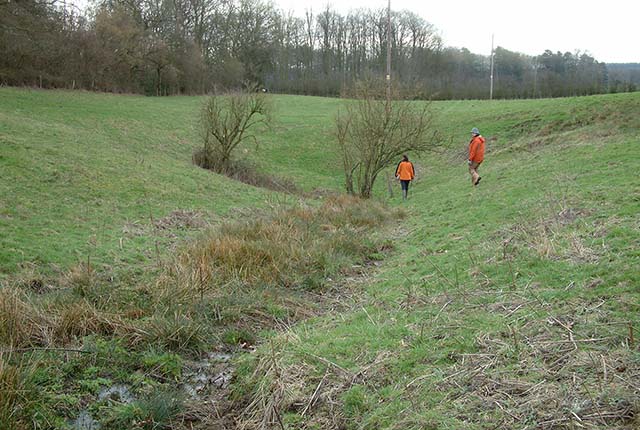
Karst features
The distinctive features of karst landscapes.
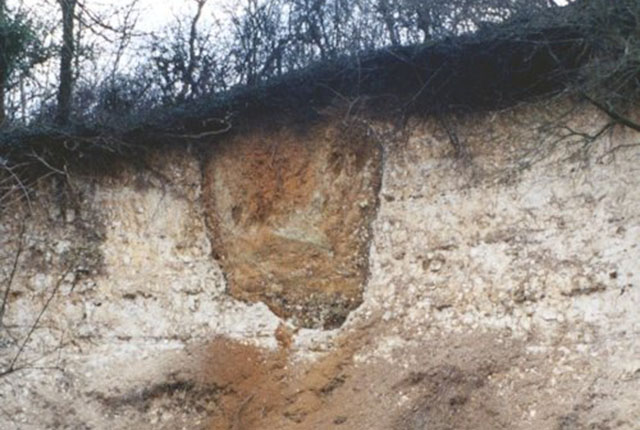
Karst hydrogeology of the Bedhampton and Havant springs
One of the best examples of Chalk karst springs in the UK.
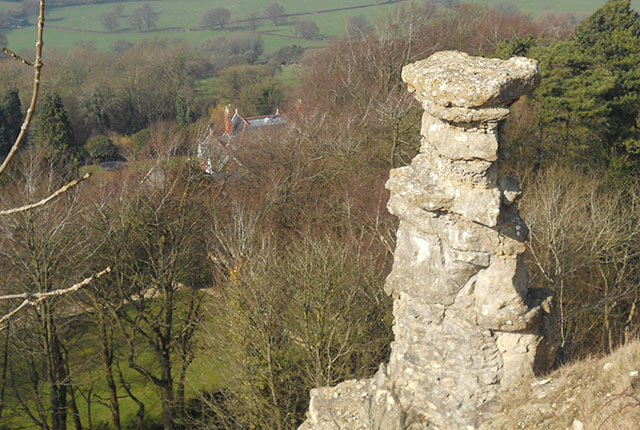
Karst report series
An overview of the evidence for karst in the Chalk and Jurassic and Permian limestones in different areas of England.
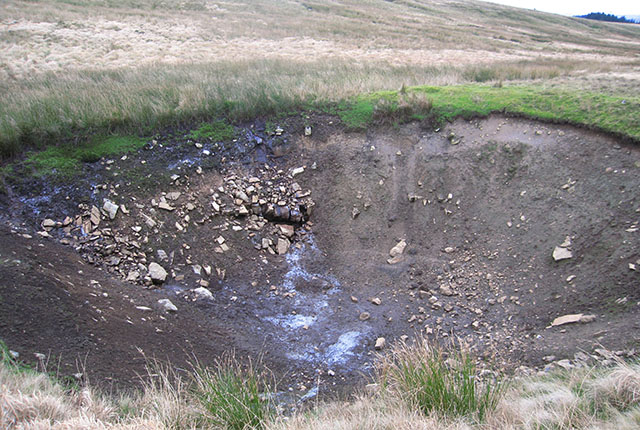
What causes sinkholes?
Explore the different types of sinkhole encountered in the UK.
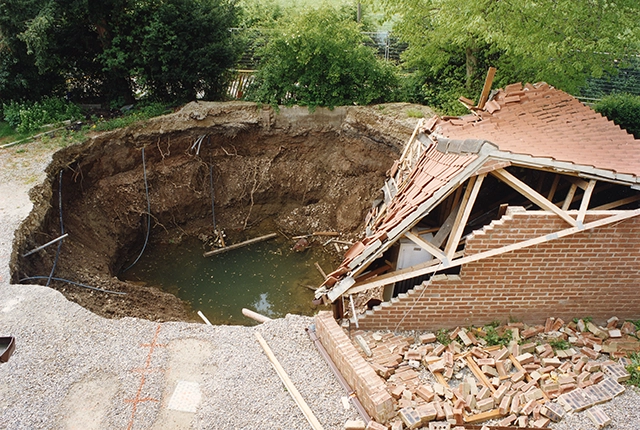
Sinkholes research
Our research extends beyond the distribution and processes associated with sinkhole formation to the broader subject of karst.